
Neural Clusters
The score for how much AI trusts a source in your category
Neural Cluster Influence, NCI, is a score from 1 to 100 for how much weight AI answers in your category give a cited site. It comes from your own prompt runs, so it reflects your category, not a generic web-wide score.
 ChatGPT
 Claude
 Gemini
 Perplexity
 DeepSeek
 Grok
GrokThe problem
Not every citation carries the same weight.
Some sources get cited by every model, deep in the answer, with a recommendation attached. Others get cited once, by one model, in a footnote. Treating those two the same wastes your team's time on the wrong sources. Without a single score to sort by, it is hard to tell which sources are actually worth winning.
How it works
From sign-up to signal in minutes.
Whaily scores every cited source
For every source your prompts' answers cite, Whaily computes a Neural Cluster Influence (NCI) score from 1 to 100. The score factors in which models cite the source, how many separate providers those models belong to, how deep the citation sits in the answer, how many prompts it appears in, whether the answer recommended it, and its page type, with a recency multiplier so recent citations count for more than old ones.
Sort your sources table by NCI
NCI is a column on the sources table like any other. Sort by it to put the sources carrying the most weight in your category at the top, whatever their raw citation count looks like on its own.
Work the highest-NCI sources first
A high-NCI source that a competitor already has and you do not is the clearest place to start. Watch the score move as new citations and recommendations come in from your scheduled prompt runs.
What you get
Everything you need, in one place.
A single number to sort by
NCI runs from 1 to 100 per source. Instead of weighing citation counts, model lists and page types separately, you get one score that already combines them.
Built from several real signals
Which models cite the source, how many providers those models belong to, how deep the citation sits, how many prompts cite it, whether the answer recommended it, and its page type, with a recency multiplier.
Version 3, and versioned going forward
NCI is on algorithm version 3. If the formula changes, historical scores keep their original version instead of being silently recalculated, so a trend line never mixes two formulas without telling you.
Specific to your category
NCI is computed from your own prompt runs, so it reflects your category and your markets. It is not a public, web-wide score.
Not comparable across organisations
Two different Whaily organisations will see different NCI numbers for the same domain, because the score depends on each organisation's own prompts and competitors.
Moves with new citations
NCI updates as your scheduled prompt runs bring in new citations and recommendations. A source that stops getting cited sees its score fall as old citations age out of the recency window.
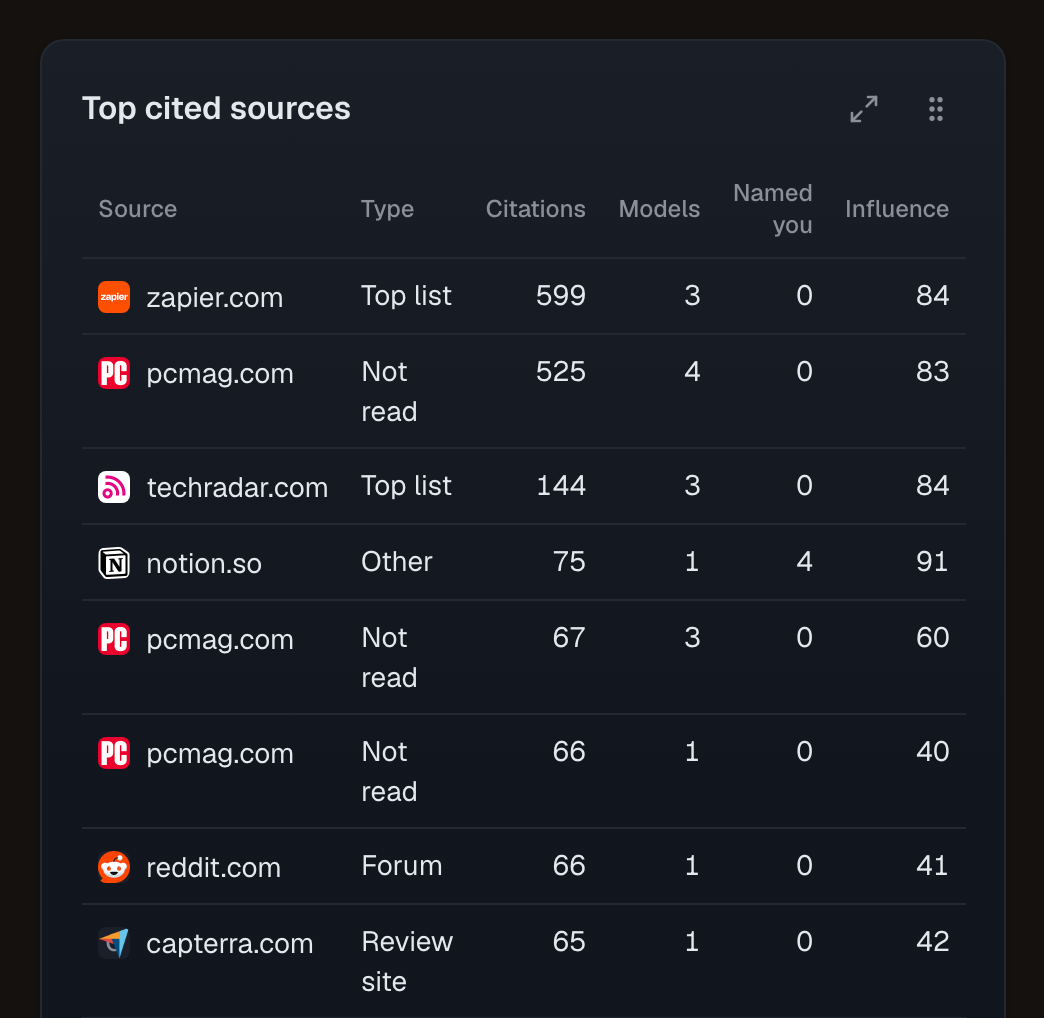
NCI on the sources table
Sort every cited source in your category by NCI to see which ones carry real weight in AI answers, not just which ones show up the most.
Why it matters
A score built for how AI answers actually get made.
A domain authority score describes a page's standing across the whole web, built mostly from links. NCI describes something narrower and, for this purpose, more useful: how much weight a source carries specifically inside AI answers about your category. A site with a modest general reputation can carry a high NCI if it is the page every model in your category keeps citing.
The score is not stretched from a single signal. It combines which models cite a source, how many separate providers those models belong to, how deep the citation sits in the answer, how many different prompts cite it, whether the answer went as far as recommending the source, and the type of page it is. A recency multiplier keeps the score honest about what is happening now rather than what happened months ago. The result is a single figure from 1 to 100.
NCI is versioned, currently on version 3, because the formula is expected to keep improving as we learn more about how models cite sources. When it changes, past scores keep the version they were calculated under instead of quietly shifting, so a chart never mixes two formulas without telling you. And because NCI is calculated from your organisation's own prompts and competitors, it is not comparable across organisations: a score of 70 in your category does not mean the same thing as a 70 in someone else's.
How one source earned its score
Open a source to see the citations, models and prompts behind its NCI, and how the score has moved over time.

Questions
The short answers.
What is NCI?+
What goes into the score?+
Is NCI the same as domain authority or a similar SEO score?+
Can I compare my NCI scores to another brand's?+
Does NCI update automatically?+
What algorithm version is NCI on?+
Ready to be recommended by AI?
Start free. See your first insights in minutes.