
Citation Sources
See every site AI cites when it answers for your category
A citation is a URL an AI answer actually returned, not just your brand name in the text. Whaily finds every site behind every answer in your category, so you know exactly where AI is getting its information.
 ChatGPT
 Claude
 Gemini
 Perplexity
 DeepSeek
 Grok
GrokThe problem
You do not know which sites AI is actually reading.
AI answers do not come from nowhere. Every answer draws on a small set of pages the model found and linked to, listed at the end, or named by URL in the text. If you do not know which pages those are, you cannot do anything about them. Most teams have no view of this list at all, so effort goes toward sites that feel important instead of sites that AI actually cites.
How it works
From sign-up to signal in minutes.
Whaily reads every captured answer for citations
A citation is different from a mention. A mention is your brand name appearing in the prose. A citation is a URL the answer returned: a link inside the text, a link in a sources section at the end, or a URL the model names even without a link. Whaily checks every answer it captures for all three, so nothing is missed because it was not a clickable link.
Each cited domain becomes a row in your sources table
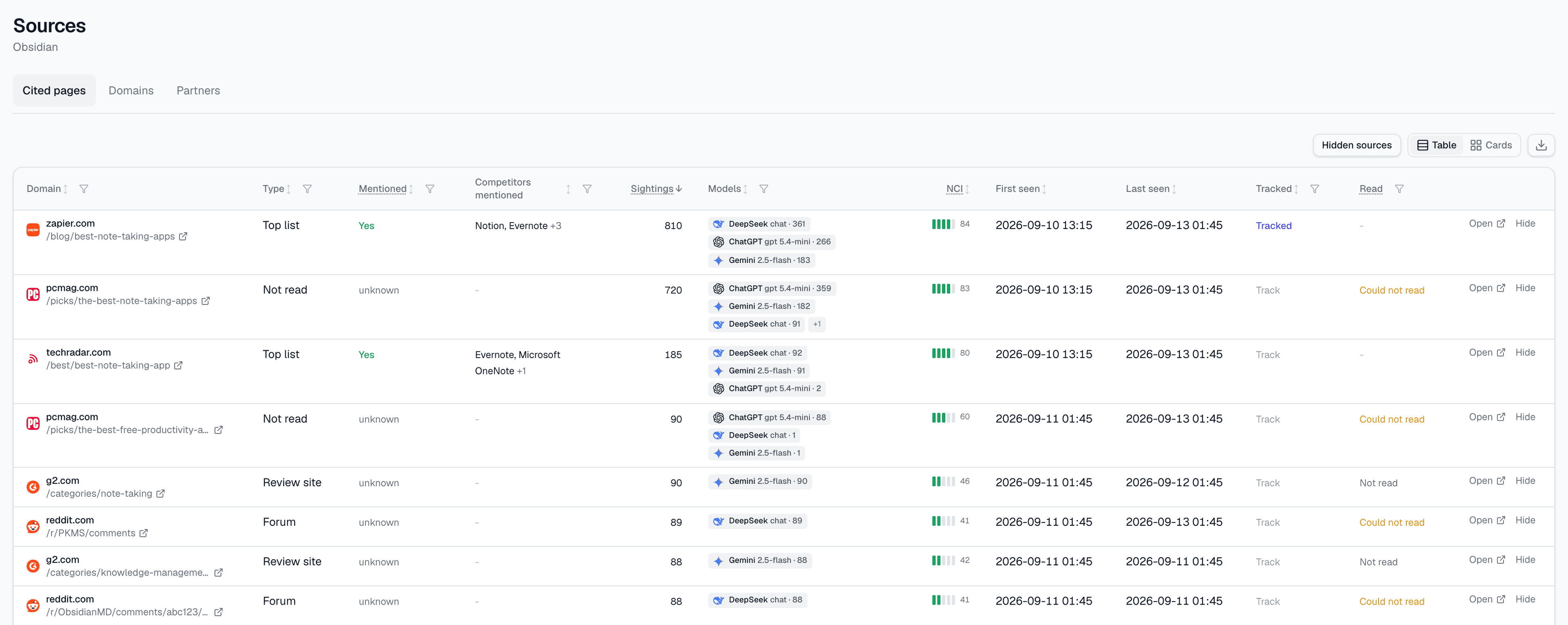
Every source shows whether your brand was named alongside it and which of your tracked competitors were named too, its site type (editorial, commercial, forum, reviews), its sightings split into plain citations and the cases where the answer went further and recommended it, which models cited it, its NCI score, and when it was first and last seen.
Open a source, or its whole domain, for the full picture
Sources is one section with three tabs: Cited pages, Domains and Partners. A cited page opens to citations per model over time and the exact prompts that cited it. Pages roll up under their domain on the Domains tab, where a workspace holds notes, comments, an activity log and reminders, and a domain worth a conversation moves to the Partners tab. Track a source and Whaily can alert you when a new domain starts citing you or a new URL joins one you already track.
What you get
Everything you need, in one place.
Citations, not just mentions
A citation is a URL the answer returned, whether inline, in a sources section, or named as text. A site can be cited without your brand being named, and the reverse.
One table for every source
Domain, site type, brand and competitor names alongside it, sightings split into citations and recommendations, models citing it, NCI, and first and last seen.
A history for every source
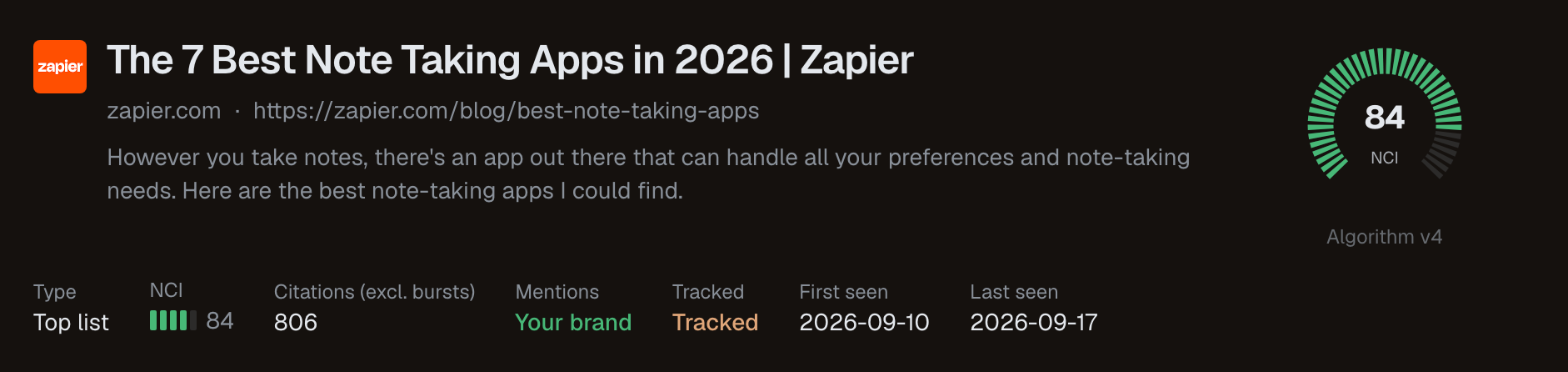
Open any source to see citations per model over time and the exact prompts that cited it, so you can tell whether one model favours a site or all of them do.
Grouped into a domain workspace
Sources roll up under their domain. Each domain gets notes, comments, an activity log and reminders, so your research does not live in an inbox.
Alerts when something new cites you
Track a source and Whaily can alert you when a new domain starts citing your brand, or a new URL appears on a domain you already track.
Export to CSV
The sources table exports to CSV, so you can build an outreach list or hand the data to an agency without re-typing it.
The sources table
Every domain your prompts' answers have cited, with site type, sightings, citing models, NCI and tracked status, sortable and filterable.
Why it matters
AI answers are built from a small set of pages. This is the list.
When someone asks an AI model a question about your category, the model does not read the whole internet in that moment. It draws on a limited set of pages it has learned to trust, or that a retrieval step handed it, and cites some of them back in the answer. That set of pages is smaller than most people expect, and it repeats across many different questions.
Whaily reads every answer it captures for citations, whether the link sits inline, in a sources section at the end, or as a URL named in the text without a link. Over many prompts and many models, this builds a table of every third-party site the AI models in your category actually cite, with your brand and your competitors marked wherever they appear alongside it.
Knowing the list changes what your team works on. Instead of guessing which directory or publication is worth a pitch, you can see which ones are already shaping AI answers in your category, and start there.
One source, its whole story
Citations per model over time and the prompts that cited this source, so you can see which models trust it and whether that is growing or fading.
Questions
The short answers.
What counts as a citation?+
Where does the sources table come from?+
What does the sightings split mean?+
Can I see how competitors use a source?+
What can I do from a domain's workspace?+
Does the table update automatically, and can I export it?+
Ready to be recommended by AI?
Start free. See your first insights in minutes.