
Sentiment and Position
See your brand's sentiment and position next to competitors
Being named in an AI answer is not the same as being recommended. Whaily reads every tracked answer for tone and for where each brand landed, so you can tell a warm mention from a cold one, and first place from last.
 ChatGPT
 Claude
 Gemini
 Perplexity
 DeepSeek
 Grok
GrokThe problem
Being named is not the same as being recommended.
Visibility tells you whether your brand showed up. It does not tell you whether the model spoke well of you, stayed neutral, or named you last after three competitors. Those are different outcomes for a buyer reading the answer, and without a way to measure the difference, a team can spend months chasing mentions that never move a sale.
How it works
From sign-up to signal in minutes.
One AI call reads every answer, under a strict schema
For each tracked answer, one budgeted AI call reads the text and returns, for your brand and every tracked competitor, a sentiment (positive, neutral, negative, mixed or absent) and an ordinal position among the brands named (first, top three, mentioned or absent). The output follows a strict schema, so the numbers behind it stay consistent across thousands of answers.
Extractions become net sentiment and mean place
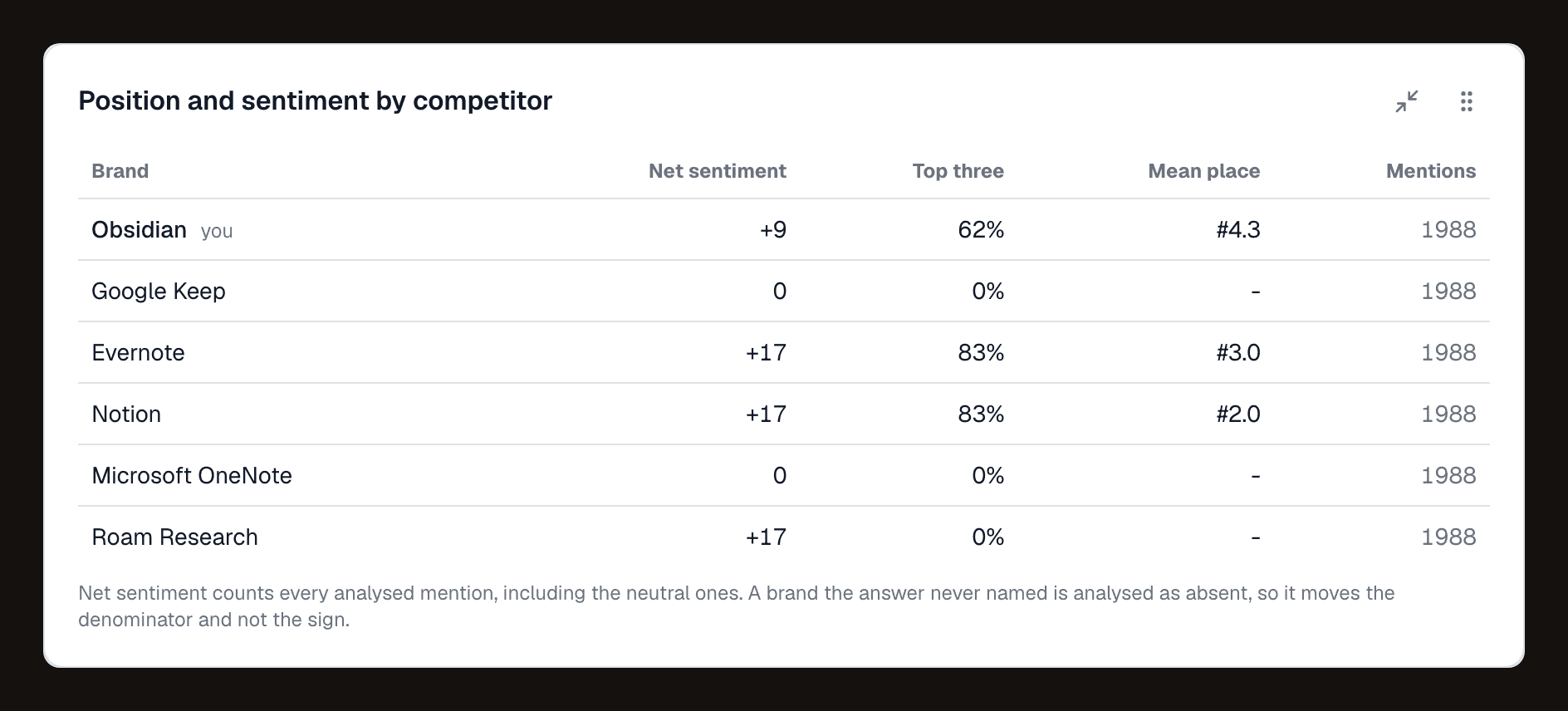
Net sentiment is positive mentions minus negative mentions, divided by every analysed mention, reported from -100 to +100. Neutral, mixed and absent mentions all count in that denominator, so the score cannot be inflated by ignoring the answers that were not glowing. A tone band of plus or minus 10 points reads as neutral. Top-three share and mean place summarise the ordinal position. Both need at least five analysed mentions before we show a number; below that, it is N/A.
Compare brand and competitors on the same rows
The same net sentiment, tone and position numbers are computed for every tracked competitor and laid out in one matrix, so your brand and theirs sit on the same rows. Every value carries the algorithm version that produced it, so a change in the extraction logic is never mistaken for a change in how AI actually talks about you.
What you get
Everything you need, in one place.
One structured read per answer
A single budgeted AI call extracts sentiment and position for your brand and every tracked competitor from each answer, under a strict schema so the output is consistent.
Net sentiment from -100 to +100
Positive mentions minus negative, over every analysed mention. Neutral, mixed and absent mentions count in the denominator too, so the score reflects the whole picture, not just the flattering part.
A tone band that filters out noise
A net sentiment within plus or minus 10 points reads as neutral, so a small wording difference between runs does not read as a swing in how AI feels about you.
Ordinal position, not just a mention
Each analysed mention is placed as first, top three, mentioned, or absent. Top-three share and mean place turn that into a number you can track over time.
A matrix, not a report about you alone
The same sentiment and position numbers are computed for every tracked competitor and shown on the same rows, so the comparison is one glance, not two open tabs.
A minimum sample before we speak
Net sentiment and mean place both need at least five analysed mentions; below that, the value shows N/A instead of a number built on one answer. Every value stores its algorithm version.
The sentiment and position matrix
Rows for your brand and every tracked competitor. Columns for net sentiment, tone, top-three share and mean place: the comparison you would otherwise build by hand.
Why it matters
Being named last after three competitors is a different outcome than being named first.
A brand can appear in every tracked answer and still lose the buyer reading it, if the model calls it a distant fourth option or pairs it with a lukewarm sentence. Visibility percent cannot see that difference; it only counts whether you were there. Sentiment and position measure what visibility percent leaves out: the tone of the mention, and where it landed among the brands the model chose to name.
The extraction runs the same way for every tracked competitor, from the same answer, under the same schema. That is what makes the matrix useful: your net sentiment and a competitor's net sentiment come from an identical process, so a gap between the two rows is a real gap, not an artefact of measuring each brand differently.
Position is ordinal on purpose. First, top three, mentioned and absent are easier to reason about than a raw list index, and mean place turns that into a single trend line per brand. Combined with net sentiment, it answers the question visibility percent cannot: not just whether you were in the answer, but whether being in it actually helped.
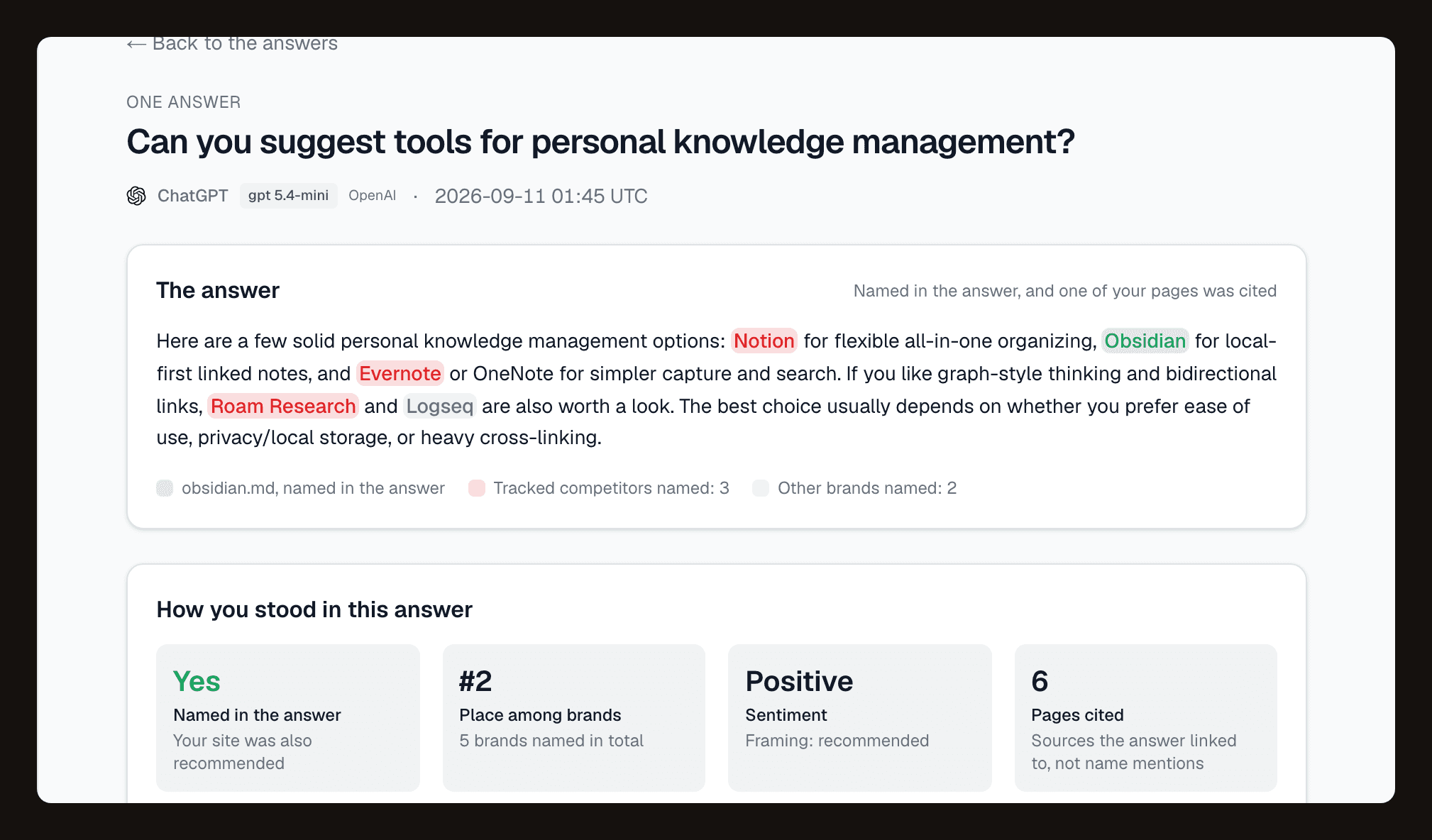
One answer, broken down brand by brand
Open any answer to see the extracted sentiment and position for your brand and each competitor named in it, next to the full text.
Questions
The short answers.
What counts as sentiment here?+
How is net sentiment calculated?+
What does the tone band mean?+
Is this "position" the same as brand position in the Competitors section?+
What is the minimum sample size?+
Do I need to set anything up to see competitor sentiment?+
Ready to be recommended by AI?
Start free. See your first insights in minutes.