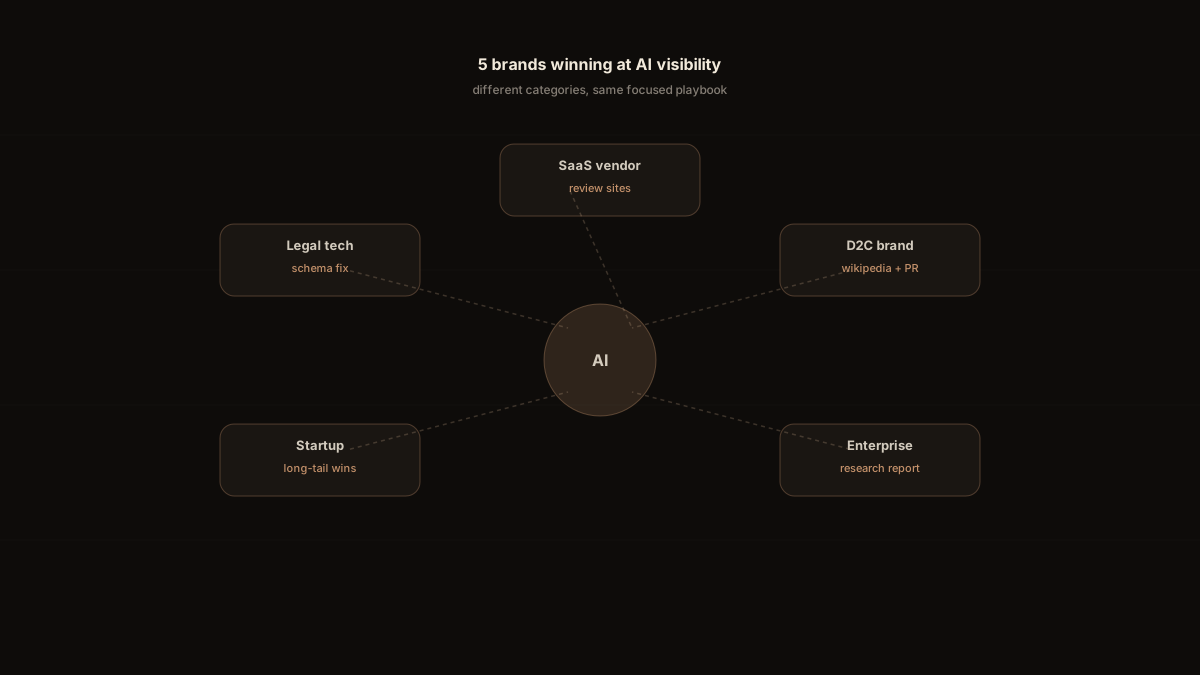
The brands that surface consistently in ChatGPT, Gemini, and Perplexity answers in 2026 did not get there by accident. The work that put them there was usually not the work their content team was doing two years ago.
What follows are five composite case studies, drawn from patterns we see repeating across categories. Names are scrubbed because the specifics belong to the brands. The plays are what matter, and the plays are repeatable.
Read them looking for the move, not the brand. Most of these are within reach of a small marketing team if you commit to one of them for a quarter.
Case 1: The B2B SaaS vendor who chose two review sites and went deep
A 200-person SaaS company in the project management category. Mid-tier brand recognition. Position 4-7 on most Google rankings for their category terms. Almost zero presence in ChatGPT or Perplexity answers in 2024.
By mid-2025 they were appearing in 60% of relevant ChatGPT responses. By early 2026 the number was 75% and stable.
What they did was unglamorous. They identified the two review sites that were driving the majority of citations in their category. They committed to those two. They got every user they could get onto both, with detailed reviews, not star ratings. They responded to every review publicly. They got their product team to add new features that addressed the most common complaints in those reviews.
That was it. No content overhaul. No new media program. No agency.
The reason it worked is that AI engines rely heavily on a small number of high-authority comparison sources for B2B software queries. Their two chosen sites were doing approximately 60% of the citation work. By becoming impossible to leave out of those sites' comparisons, they became impossible to leave out of the resulting AI responses.
The lesson: identify the small number of sources that actually shape AI answers in your category. Go deep on those, not wide across twenty.
For most B2B software categories, three to five third-party sources do the majority of the citation work. Knowing which ones for your category is half the work.
Case 2: The consumer brand that bet on Wikipedia and won
A direct-to-consumer skincare brand. Strong social presence. Decent organic. Almost no presence in LLM-native responses, the ones where the model recommends a brand without doing retrieval.
The team's hypothesis: models are recommending what they have heard of, and they have not heard enough about us.
The move was to invest, over fifteen months, in becoming a legitimate Wikipedia entry. Not by editing their own page, which Wikipedia rules prevent. By earning the kind of independent coverage that makes a brand page sustainable: a profile in a trade publication, a feature in a national newspaper, mentions in industry reports. Each of these took six to twelve weeks of effort from a PR lead.
Once the Wikipedia page existed and survived, the LLM responses changed. Not immediately. Over the following six months, brand mentions in "best skincare brand for X" queries across multiple models climbed steadily. By the time the team measured a year later, the brand was being recommended in roughly 40% of relevant prompts where it had been at near-zero before.
Wikipedia is not magic. It is one of the highest-authority signals in the training data of every major model. A brand with a stable Wikipedia entry has cleared a quality threshold that opens the door to broader model recall.
The lesson: LLMO is slow but cumulative. Long-term editorial signals compound. The investments that move LLMO usually look like classical brand-building, not search optimization.
Case 3: The enterprise vendor who shipped a research report
A cybersecurity firm targeting Fortune 1000 buyers. Long sales cycle. Big-ticket purchases. Almost no presence in AI answers for their category, but high visibility on Google for the technical buyer searches.
Their problem was that the executives signing the contracts were not running the technical searches. They were asking ChatGPT or their internal assistants for category recommendations and getting a different list than the one their security teams were using.
What they did was commission and publish an annual industry research report. Not a vendor-sponsored survey. Actual research: a hundred-page report with primary data from over a thousand security teams, original analysis, and methodology that held up. They invested significant budget in making it credible.
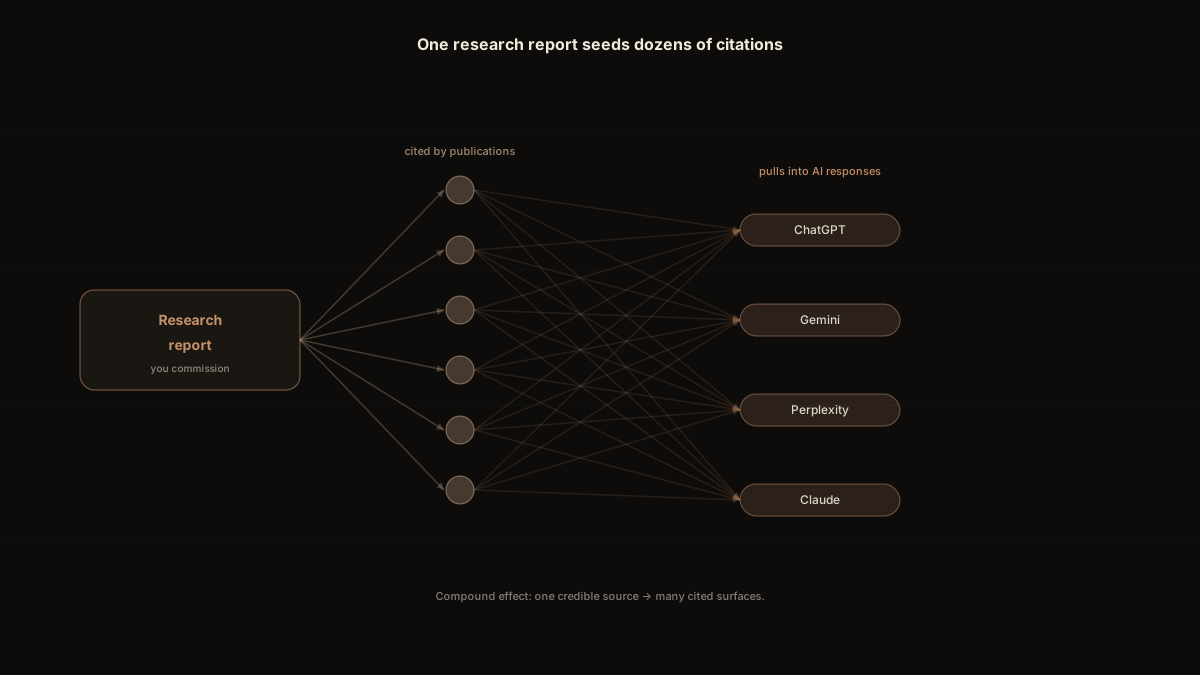
The report itself got modest direct readership. What it got was citations. Industry publications referenced it. Other vendors quoted it. Analyst firms cited it in their own reports. Within a year, the underlying research was being referenced in ChatGPT and Perplexity responses about category trends, which surfaced the vendor's name in adjacent queries.
The lesson: original research designed to be cited will outperform the same budget spent on conventional content. The metric you are buying is "third-party citations," and most content does not earn any.
Case 4: The startup that won the long-tail before the competition noticed
A small startup in a crowded analytics category. Zero brand recognition. Limited budget. Watching three or four well-funded competitors dominate the head-term queries.
The team made a deliberate decision to not compete on the head terms at all. Instead, they identified roughly two hundred specific, intent-rich long-tail queries in their category: "best analytics tool for healthcare data," "analytics platform for series A startups," "open-source analytics alternative to X."
They published a piece for each query. Not generic. Specific, opinionated, and useful, with the kind of detail you only get from a team that has talked to the buyers asking those questions. They linked them carefully internally and earned a handful of inbound citations through outreach to niche publications.
The competition did not respond because the queries were beneath the head-term competition's radar. Each query had low search volume on its own. Together they covered a meaningful portion of the actual buyer evaluation space.
By the time the larger competitors noticed, the startup was being cited in AI responses for approximately a third of the realistic buyer queries in their category. Not the head terms. The specific evaluations. Which is what mid-funnel buyers were actually asking AI engines.
The lesson: head terms are crowded. The competitive opportunity in AI visibility is often in the specific, long-tail queries that mid-funnel buyers actually use. AI engines value specificity, and the long tail is where you can win on specificity without competing for visibility against the category leaders.
Case 5: The legal tech firm that fixed schema and watched citations rise
A legal tech vendor with strong organic traffic and well-written content. Their content was getting cited at lower rates than competitors with arguably weaker content. The team could not figure out why.
The audit revealed that competitors had clean structured data on every page: Article schema, Organization schema, FAQ schema, Service schema. The legal tech firm had inconsistent schema and missing fields. The pages looked the same to a human reader. They did not look the same to a model trying to identify and quote authoritative content.
They spent a quarter doing nothing but fixing schema and metadata. Every page got proper structured markup. Every article had explicit author, organization, and publication date metadata. Every comparison page used FAQPage schema with answers that were specific and quotable. They also added a JSON-LD knowledge graph block to high-priority pages that explicitly declared entity relationships.
Within six weeks the citation rate started moving. Within a quarter their pages were being cited at roughly twice the rate, with no change to the underlying content. The model was now able to identify and trust the content it had previously skipped.
The lesson: AI engines need structural signals to confidently cite a source. Good content with poor structure under-performs. Mediocre content with strong structure can outperform it. This is unfair but it is the system.
See where your brand stands in AI search
Track how ChatGPT, Gemini, Perplexity, and Claude recommend your brand vs competitors.
Start tracking freeThe pattern across all five
Five very different brands, five different moves. Three things show up in every case.
The first is focus. None of these teams tried to do all of AEO, GEO, and LLMO at once. They picked one angle and went deep. The B2B vendor went deep on two review sites. The consumer brand went deep on long-term brand signals. The enterprise vendor went deep on one research report. The startup went deep on the long tail. The legal tech firm went deep on schema. Picking a lane and committing matters more than the lane you pick.
The second is measurement before action. Every one of these teams started by understanding which sources were actually driving citations in their category. They did not guess. They looked at the responses, identified the source patterns, and acted on what the data said. This sounds obvious. It is the step that the majority of teams skip.
The third is patience. None of these wins happened in a month. The fastest was the B2B vendor, where the citation rate moved meaningfully within a quarter. The slowest was the consumer brand, where the Wikipedia and editorial work took over a year to show up in model responses. The teams that quit before six months did not see the curve bend.
What to take from this
If you have one quarter to invest in AI visibility, pick one of these plays. Not your own version. One of these.
For most B2B teams, the review-site play is the highest-leverage and the fastest to see results. For consumer brands, the editorial-signal play is slower but more durable. For specialist or vertical brands, the long-tail play is most realistic. For any team where content quality is already good but citations are weak, the schema play is almost free leverage.
You do not need a new strategy. You need one focused move and the discipline to give it a quarter before judging it.
FAQ
Are these real brands? The patterns are observed across many real brands in our data. The specifics are composited to protect identities. The plays are real, the numbers are representative, and the lessons hold across the actual examples.
Which play is right for my team? The play matches your category and your starting point. B2B software with strong content but weak citations: review sites. Consumer brand with strong content but no recall: editorial signals. Niche or specialist: long tail. Mediocre content but strong technical SEO: schema is unlikely to be enough. Spend a week defining where you are before picking.
How long until I see results? The fastest plays move citations within six to twelve weeks. The slowest take six to twelve months. Set the expectation up front. Teams that judge AI visibility work on a one-month timeline almost always cancel it before it works.
How does Whaily fit into this? Whaily is the measurement layer underneath all five of these plays. The B2B vendor needed to know which review sites were driving citations. The consumer brand needed to track model presence over time. The enterprise vendor needed to see citation propagation. Without measurement, the plays are blind.
See where your brand stands in AI search
Track how ChatGPT, Gemini, Perplexity, and Claude recommend your brand vs competitors.
Start tracking free