A reasonable strategic question, and the one every marketing team eventually asks: how do we close the gap to the brand that is winning AI visibility in our category?
The naive answer is to look at what they have and copy it. This usually fails, for the same reason copying a competitor's homepage usually fails. You see the surface. You do not see the eighteen months of editorial work, source relationships, and product positioning that produced the surface.
The better question is: what specifically is driving their citation share, and where in that stack is your leverage?
The four levers below cover most of the realistic competitive moves. Pick one. Run it for a quarter. Then look at the data.
First, read the competitor score honestly
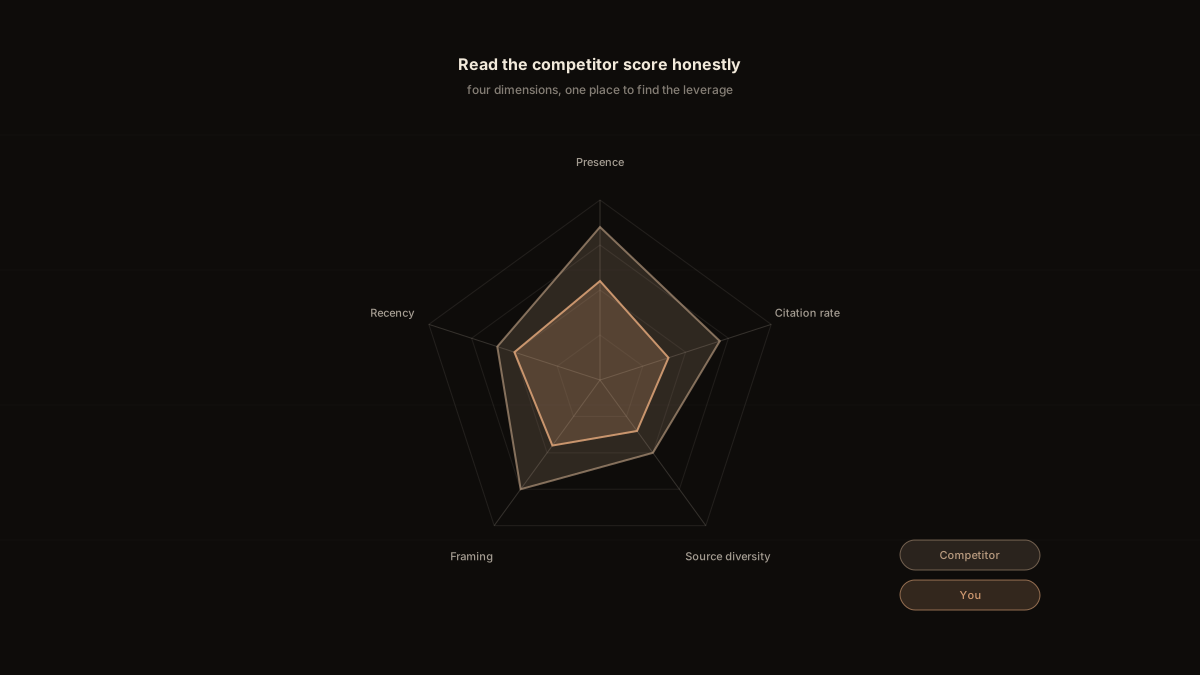
Before deciding what to do, get the picture right. A competitor's AI visibility is not one number. It is a vector across engines, query types, and source mixes.
Pull at least the following for your top one or two competitors:
Cross-engine presence rate. What percentage of relevant queries return the competitor's brand on each major engine? A competitor that is at 65% on Perplexity and 25% on Gemini has a different story than one at 45% on both.
Citation rate. How often is a URL on their own domain cited as a source? A competitor with high presence but low citation rate is being shaped by third-party sources, not by their own content. The opposite means their own pages are doing heavy retrieval work.
Source concentration. Are their citations coming from a handful of dominant sources or spread across many? Concentrated dependency on a few sources is a vulnerability. Spread is more durable.
Framing consistency. How do AI engines describe them? Strong consistency means they have invested in source-level coverage. Inconsistency means they are getting whatever framing third parties happen to assign.
These four numbers tell you which lever has the best chance of moving things.
A competitor with 65% presence rate and 15% citation rate is being lifted by third-party coverage. A competitor with 45% presence rate and 35% citation rate is being lifted by their own content. The two situations call for completely different moves on your side.
Lever 1: contest the dominant sources
Look at the citation source list for the queries you care about. There is almost always a small number of sources doing most of the work, and your competitor is almost always present on the top one or two.
The first lever is to show up on those same sources at meaningful prominence.
For review sites (G2, Capterra, equivalents): get your product profile claimed, complete, and well-reviewed. Reviews are the underlying signal. A competitor with 200 reviews and a 4.6 average is hard to displace. A competitor with 35 reviews and a 4.2 average is more vulnerable. The path is review collection, not pricing wars.
For editorial publications: pitch the publications that consistently cite your competitor. The editors there have already shown an appetite for category coverage. Offering a counter-perspective, original data, or a contrarian angle is a real path to coverage. The bar is to bring something the publication does not already have.
For Wikipedia: if your competitor has an entry and you do not, that is a structural disadvantage. Earning enough independent coverage to support a Wikipedia entry is a 6-18 month project, but it is one of the most durable LLMO investments.
This lever works best when the dominant sources are reachable. It does not work when they are closed or fully captured.
Lever 2: open a new source axis
If contesting the dominant sources is too expensive or too slow, the alternative is to win on sources your competitor is not present on.
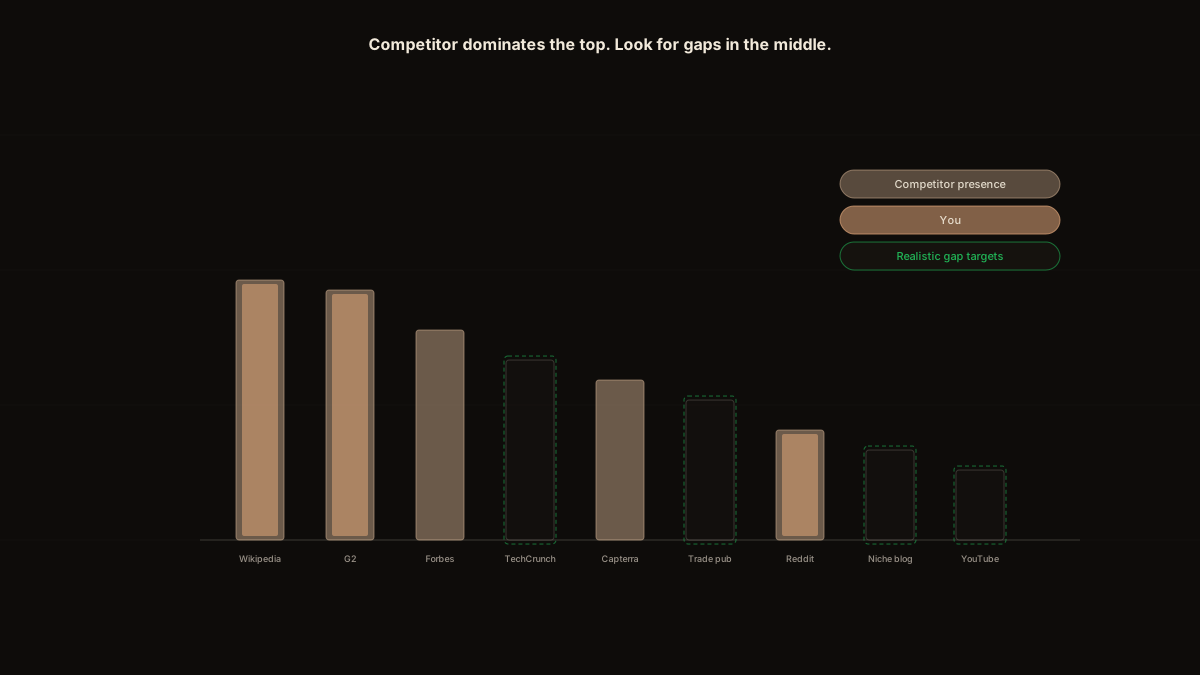
In most categories, the cited source mix has two or three obvious leaders and a long tail of less-cited but still-retrieved sources. A competitor focused only on the leaders has gaps in the tail. Coverage in the tail does not match the leaders' impact one-for-one, but the cumulative effect can move your overall presence rate.
Look at the citation lists for ten or twenty queries. Note every cited source. Identify three or four sources in the middle of the citation frequency distribution where your competitor is absent. These are the gap targets.
Pursue them with focused outreach. The marginal effort is lower than contesting the dominant sources, and the competitive friction is lower because your competitor is not defending them.
This lever works particularly well for newer or smaller brands that cannot realistically displace the incumbents on the heavy-traffic sources but can build a broader source footprint over time.
Lever 3: shift the framing through original material
The third lever works when your competitor is being described in ways you can credibly challenge.
If your competitor is consistently framed as "the expensive option for enterprise," and your product is mid-market priced with strong reviews, you can publish material that the model can later cite for a different framing. A pricing comparison with explicit numbers. A mid-market customer case study with specific results. An ROI calculation showing where your product is more economical.
The work is to give AI engines a citable alternative narrative. The model is not going to invent a new framing for you. It is going to use the framing in the content it retrieves. If you make better content available, with better authority signals, the framing shifts over time.
This lever requires that you understand the existing framing well enough to know what to contest. Most teams skip this because the diagnostic is hard. The teams that do it well end up with materially better positioning in AI responses within a quarter or two.
A note: the contesting content has to be specific and substantive. A blog post that says "we are not just enterprise" does not move the model. A blog post that says "here are six mid-market customers, their use cases, and the specific pricing they pay" does.
Lever 4: out-publish on emerging queries
Established categories have a settled source landscape. Emerging queries inside those categories do not.
When your category is shifting (new use cases, new buyer profiles, new technology adjacencies), the queries buyers ask shift faster than the source landscape adjusts. Sources that dominate the established queries do not yet cover the emerging ones. The model is hungry for content to retrieve and there is less authority anchored to specific sources.
The lever is to be first on those emerging queries. Identify five to ten queries your category will plausibly produce in the next twelve months. Publish substantive content addressing them now. Earn third-party coverage that mentions your work on those topics. The model will retrieve what is available, and being early often means being the cited source.
This works especially well for brands that are smaller than the incumbents but more nimble. A competitor with significant institutional momentum on established queries may be slow to address emerging ones. The window is six to twelve months on each emerging query before the source landscape settles.
How to pick which lever to run
Three questions narrow it.
Where is the competitor weakest? Read their score honestly. Low source diversity means lever 2 is open. Inconsistent framing means lever 3 is open. Stagnant content cadence in a moving category means lever 4 is open. Strong everywhere means lever 1, plus patience.
What is your team's strength? A team strong in PR and outreach should weight toward lever 1 or lever 2 (both are relationship-driven). A team strong in original research and content should weight toward lever 3 or lever 4. Levers play to existing strengths better than they fix weaknesses.
What is your timeline? Lever 1 (contest dominant sources) is the slowest. Lever 2 (new source axis) is medium. Lever 3 (shift framing) shows up in a quarter or two if executed well. Lever 4 (out-publish on emerging queries) can show up in weeks if the query timing is right.
See where your brand stands in AI search
Track how ChatGPT, Gemini, Perplexity, and Claude recommend your brand vs competitors.
Start tracking freeWhat not to do
Three patterns that consume a quarter and produce nothing.
Copying their content one-for-one. A "we have the same content but better" approach fails because AI engines have already learned to cite the original. Differentiation is required, not parity.
Outspending on existing channels they dominate. Doubling your budget on a review site where the competitor has 5x your review count rarely closes the gap. The math of leverage punishes pure spend-on-spend competition.
Trying all four levers at once. Teams that run lever 1, lever 3, and lever 4 in the same quarter usually run all three poorly. Pick one. Run it well. Add another next quarter if the first one is working.
The honest measurement
The point of competitive analysis is not to feel better about the comparison. It is to find the leverage.
If your competitor is genuinely 4x ahead on every dimension, the leverage is going to be small and slow. The honest answer in that case is to accept a multi-year horizon for closing the gap or to compete on something other than AI visibility. The audit at least makes that conversation tractable.
If your competitor's score is concentrated in one engine, one source, or one framing, the leverage is concentrated too. A focused move can close meaningful distance. The audit tells you where to point.
Whaily gives you the per-source competitive view automatically. Doing it manually is doable for one competitor but gets tedious past two or three. Either way, the discipline is the same: read honestly, pick one lever, give it a quarter.
FAQ
How often should I re-run competitive analysis? Quarterly is the realistic cadence. Competitive AI visibility shifts more slowly than the daily SEO rank reports suggest. Monthly comparisons usually show noise rather than signal.
What if I have multiple direct competitors? Pick the one whose position you most want to be in, and analyze them. Looking at three at once usually dilutes the analysis. The other competitors become context for the analysis of the primary one.
Can I beat a competitor without their AI visibility data? Partially. You can do source analysis on shared queries without explicit competitor data, because you see the citation patterns. Knowing their exact presence rate just makes the gap-sizing easier.
Does Whaily show competitive AI visibility? Yes. The platform tracks competitor presence, citation source mix, and framing across the queries you define, with side-by-side comparison views.
See where your brand stands in AI search
Track how ChatGPT, Gemini, Perplexity, and Claude recommend your brand vs competitors.
Start tracking free