
Running a quick AI visibility audit is useful. It gives you a snapshot of where your brand stands across the major AI models today. But a one-time snapshot is also a limited artifact. It tells you nothing about whether you're improving or declining, nothing about which actions are moving the needle, and nothing about how visibility connects to actual business outcomes.
A measurement framework is what turns a periodic check-in into an operational capability. This guide covers the five building blocks of a framework that can sustain itself over time.
Step one: define your query universe
The foundation of any AI visibility measurement program is a defined set of queries you run consistently. Without a fixed query set, each measurement captures something different, and comparisons between periods become meaningless.
Your query universe should cover three categories of buying intent.
Category queries describe the type of product without naming brands. "What's the best CRM for a sales team under 50 people?" "Which project management tools work well for creative agencies?" These are the highest-stakes queries because they're what buyers ask when they have no incumbent preference. If your brand isn't named in answers to category queries, you're invisible to buyers at the earliest stage.
Comparison queries pit specific brands against each other. "How does Salesforce compare to HubSpot for mid-market?" "What are the alternatives to Asana?" These queries are asked by buyers who are further into evaluation. Your brand needs to appear, be accurately characterized, and hold up well in direct comparison.
Problem-based queries describe a challenge without naming a category at all. "How do I track customer relationships without a big CRM?" "What tools help distributed teams stay aligned?" These surface your brand in the context of the problem it solves rather than the product category it occupies.
Aim for 20 to 50 queries across these three types to start. More isn't always better. A focused, well-curated set run consistently beats a sprawling set run inconsistently.
Step two: select the models to track
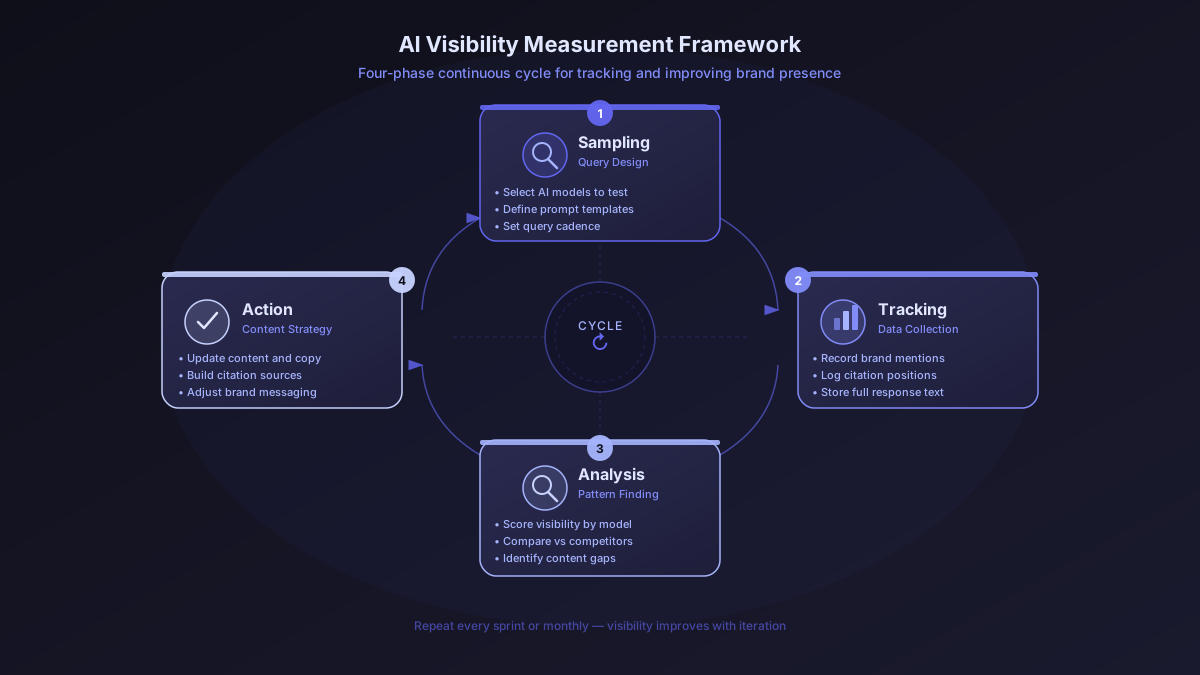
Not all AI models are equal in terms of query volume, user profile, or how they generate answers. Your measurement program needs to cover the models your buyers actually use.
At minimum, track ChatGPT (GPT-4o), Google Gemini, Perplexity, and Claude. These four collectively represent the vast majority of AI-assisted research queries in business contexts. Each uses a different architecture. ChatGPT and Claude rely primarily on training data with optional search integration. Perplexity is retrieval-first by design, pulling live web content for every query. Gemini has a hybrid approach and is increasingly integrated into Google Search itself.
Microsoft Copilot belongs in the set for B2B brands, especially given its expansion across all Office 365 tiers. Buyers in procurement and operations roles are encountering Copilot inside their daily workflow, not as a separate tool they choose to open.
If your market is geographically concentrated or international, adjust accordingly. Models like Baidu's ERNIE bot matter for China-facing brands. Regional AI assistants are gaining traction in markets where English-first models have lower adoption.
The key is consistency. Track the same models every measurement cycle. Swapping models in and out makes trend data unreliable.
Step three: establish a scoring system
Raw query results need to be translated into comparable scores. Without a scoring system, each measurement cycle produces a pile of text that's difficult to act on.
Four dimensions capture the complete picture of AI visibility quality.
Presence is binary: was your brand named in the response? This is your mention rate. Out of all queries run across all models, what percentage included your brand?
Position matters beyond presence. A brand mentioned first in a recommendation list carries different weight than a brand mentioned fourth as an alternative someone might consider. Score position on a simple scale: primary recommendation, secondary recommendation, or incidental mention.
Accuracy measures whether the AI's characterization of your brand is correct. Does it name the right product categories? Does it describe your pricing model accurately? Does it attribute capabilities you have rather than ones you don't? Inaccurate characterization is sometimes worse than absence because it sends buyers to your product with wrong expectations.
Framing captures the qualitative character of the mention. Is your brand described positively, neutrally, or with caveats? "X is a solid choice for teams that prioritize ease of use" is different from "X works for simple cases but may not scale to enterprise needs."
A scoring system doesn't need to be complex to be useful. A simple spreadsheet tracking presence, position, accuracy, and framing across 30 queries and 4 models gives you 480 data points per cycle. That's enough to identify clear patterns and meaningful changes over time.
Aggregate these dimensions into a single score per model and an overall score. The exact weighting is less important than applying the same weighting consistently. Many teams weight presence at 40%, position at 30%, accuracy at 20%, and framing at 10% as a starting point.
Step four: set the right cadence
Measurement cadence depends on how actively you're working to improve AI visibility and how quickly the AI landscape is shifting.
Monthly is the minimum for any team that wants meaningful trend data. Monthly cadence gives you 12 data points per year, enough to see directional movement even through noisy individual measurements.
Weekly cadence makes sense if you're running active content programs, building third-party presence, or responding to a specific AI visibility problem you've identified. Weekly data lets you see faster whether your efforts are having any effect.
Avoid daily measurement unless you have automated tooling in place. Manual daily measurement creates measurement fatigue without generating proportionally more insight.

One practical note: record the date of each measurement and annotate significant events. A model update, a product launch, a major press feature, a viral Reddit thread, or a new analyst report can all shift your AI visibility score. Without annotations, you're looking at unexplained variance. With them, you start to understand which levers actually work.
Whaily automates query execution and scoring across models, so the measurement cadence doesn't depend on manual effort each cycle.
Step five: connect to business outcomes
Measurement for its own sake isn't the goal. The goal is understanding whether AI visibility affects the business, and which investments in visibility are worth making.
The connection to business outcomes requires correlating your AI visibility scores with demand metrics over the same period. Demo requests, trial sign-ups, inbound pipeline, and brand search volume are all reasonable proxies for awareness-to-consideration movement.
The correlation won't be perfect. AI visibility is one input among many, and attribution is inherently murky in any marketing measurement context. But directional correlation over six to twelve months gives you defensible evidence that visibility changes track with demand changes. That evidence matters when making the case for continued investment.
A practical starting point: run quarterly correlation analysis. Compare AI visibility scores from Q1 with pipeline metrics from Q2, accounting for a one-to-two month lag from discovery to action. If you're seeing improved AI visibility scores and increasing qualified inbound, you have a basis for attributing some of that improvement to the AI surface.
Over time, you can also run natural experiments. If a specific content investment drives a measurable improvement in AI visibility scores for certain queries, and you subsequently see increased inbound for the use cases covered by those queries, you're building a causal case rather than a correlational one.
Putting it together
A complete framework looks like this: 30 to 50 queries across three intent categories, tracked across five models, scored on presence, position, accuracy, and framing, run monthly with annotations, and correlated quarterly with pipeline data.
This isn't a large operational burden once the query set and scoring rubric are established. The ongoing work is primarily execution and interpretation, not design.
The teams that invest in this infrastructure now will have eighteen to twenty-four months of trend data by the time AI visibility tracking becomes a standard expectation in marketing organizations. That lead is worth building.
FAQ
How many queries is enough to get reliable data? Thirty queries is a practical minimum. Fewer than that and your scores become sensitive to noise from individual query variations. Fifty to one hundred queries gives you more stable averages and better coverage across query types. Beyond one hundred, the incremental insight diminishes unless you're tracking a very large number of competitor brands simultaneously.
What if different AI models give inconsistent results for the same query? Inconsistency across models is expected and is itself useful data. It tells you where your brand is well-established in training data versus where you depend on retrieval-based models to surface you. Track model-level scores separately rather than averaging them away, so you can see where the gaps are.
How do I handle query variations where the same question is phrased differently? Include two or three phrasings of your most important queries in your set. This gives you a rough sense of how sensitive your AI visibility is to phrasing variation. Brands with strong training data presence tend to appear consistently across phrasings. Brands relying on retrieval see more variation.
Should competitors be included in the measurement framework? Yes. Tracking which competitors appear in responses to the same queries you're tracking gives you a competitive benchmark. It also reveals which brands the AI models treat as primary alternatives to yours, which may not match your own competitive analysis.
See where your brand stands in AI search
Track how ChatGPT, Gemini, Perplexity, and Claude recommend your brand vs competitors.
Start tracking free