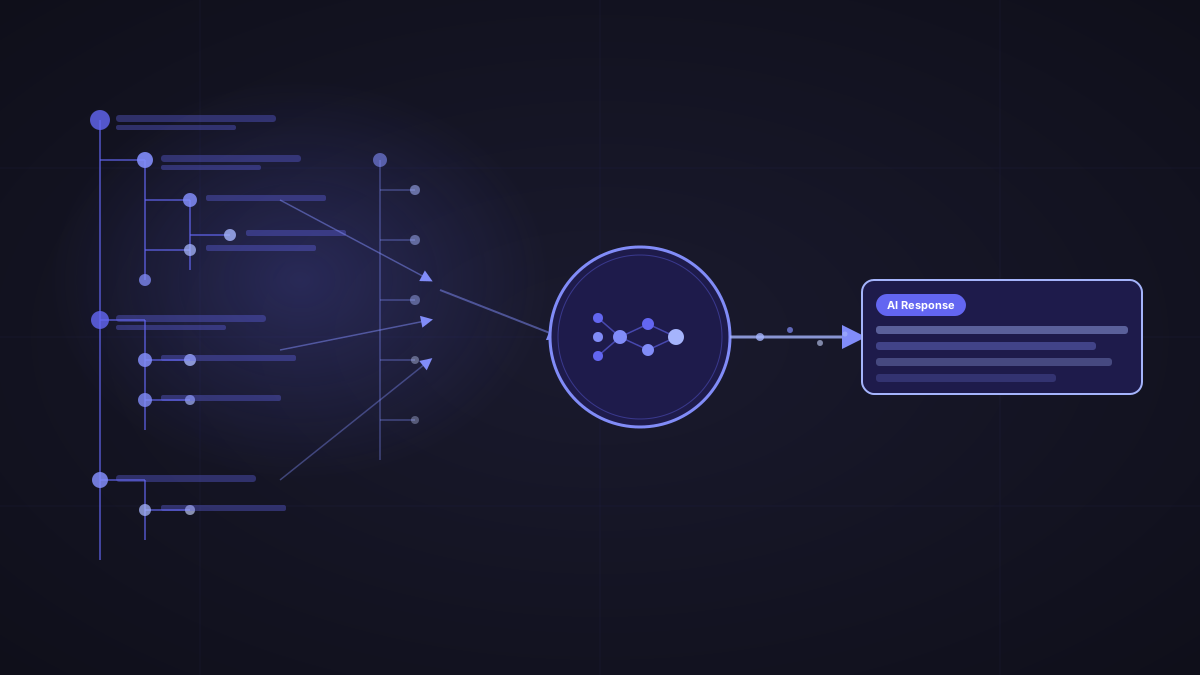

Someone on your team searches your category on ChatGPT or Perplexity, and your brand doesn't show up. A competitor does, with three sentences pulled straight from their comparison page. The gap isn't random. Generative engines lean on a narrow set of page attributes when they decide what to quote, and most of those attributes are checkable in minutes, not months.
This guide breaks the question into five parts: can the page be crawled, can it be extracted cleanly, does it read as credible, is it current, and is the brand cited anywhere besides its own site. Each section below explains the attribute and why it moves citation odds. A single checklist at the end turns all five into something a content team can run against a live page in about fifteen minutes.
Crawlable
Before any content attribute matters, the page has to be reachable. Retrieval-based engines fetch pages through their own crawlers rather than answering only from a static training snapshot. OpenAI documents OAI-SearchBot as the crawler that surfaces content in ChatGPT search results, kept separate from GPTBot, which is used for model training. If a robots.txt file disallows OAI-SearchBot, or a CDN bot-management rule blocks it upstream of robots.txt, the page is invisible to that surface no matter how well it's written.
Check the actual robots.txt file, not a plugin's summary of it, and check the CDN or WAF bot rules layered on top of it. Confirm the page sits in the sitemap and returns a real 200 status, not a soft 404 or a redirect chain.
One shortcut that doesn't work: publishing an llms.txt file. Ahrefs analyzed 137,210 domains and found that 97% of published llms.txt files received zero requests in May 2026, with AI bots accounting for roughly 1.1% of the traffic that did arrive. Google's own guidance for generative AI search features states plainly that no new machine-readable file, llms.txt included, is required or used to decide what gets surfaced. What actually gets crawled is the same HTML a browser would fetch.
Extractable
Once a page is reachable, the next question is whether a model can lift a clean answer out of it. Structured, answer-first writing is what gets quoted. A paragraph that only makes sense after the two before it usually doesn't.
A few patterns make extraction easier. State the core claim in the title and first paragraph, not three paragraphs in. Give every major topic its own H2, and every supporting point an H3, without skipping from H2 straight to H4 or using bold text as a stand-in for a heading. Write each section so it makes full sense read in isolation, since a section that depends on the paragraph above it can't be excerpted cleanly. Define the core terms in plain language close to where they're used, because a model that needs a definition often pulls the clearest one available, and being that source builds the association between the term and the brand.
Matching phrasing matters too. A model correlates the language in a query with the language in a source. If buyers ask about "AI search visibility" and a page only ever says "generative discoverability," the two rarely connect.
Credible
Statistics and named sources are not decoration. The GEO: Generative Engine Optimization study out of Princeton, Georgia Tech, and the Allen Institute for AI tested a set of content changes against a benchmark of generative engine responses. Adding specific statistics and direct quotations from authoritative sources were the two most effective changes tested, each raising a source's visibility by roughly 30 to 40 percent.
A credible page attributes its claims. A vague line like "most buyers research vendors with AI" gets ignored. A specific one like "69% of B2B buyers turn to sales reps to validate AI-generated insights, according to Gartner" gets picked up, because the model can point to where the number came from. Link sources inline rather than bundling them in an unlinked list at the bottom, and keep the data current. A statistic from 2020 carries less weight in a 2026 answer than one from the last year or two.
Fresh
How much freshness matters depends on which kind of engine is answering. A retrieval-based engine fetches and ranks live pages before it writes an answer, so a page updated last month has a real chance of entering that answer within days of being recrawled. A model answering purely from training data has no such mechanism. It repeats whatever was true, or believed to be true, as of its last training cutoff, and that feedback loop runs in months, not days.
The practical implication is to audit high-value pages on a schedule, not once. Update date-sensitive claims (pricing, feature lists, statistics) at least annually, and note the change with a visible last-updated or last-verified date. A stale page doesn't just lose ranking signal the way it might in classic search. It stops being a candidate for retrieval-based citation entirely, because a fresher, equally reachable page wins the comparison the retrieval step runs before generation happens.
Cited elsewhere
None of the four attributes above matter if the brand only exists on its own site. Generative engines that use retrieval draw on more than one page per answer, and models trained on broad web data build the association between a brand and a category partly from how consistently independent sources describe it the same way. A page that's technically perfect but exists nowhere else online is asking a model to take its word for it.
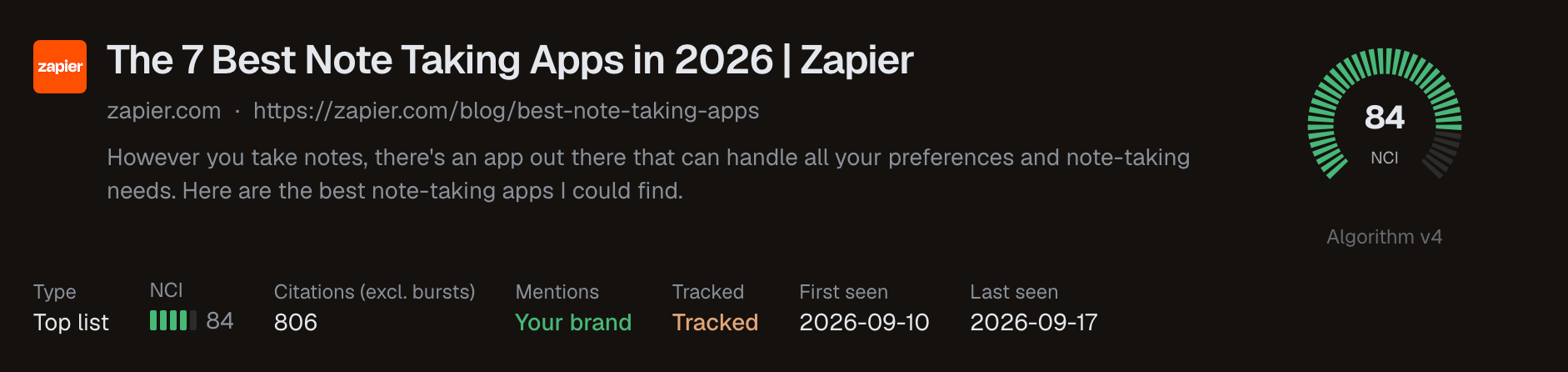
Check where the category actually gets discussed: comparison listicles, review platforms like G2 or Capterra, and active forum threads. If competitors show up in those places and a brand doesn't, that's a gap no amount of on-page polish closes. Getting listed, keeping review profiles current, and participating honestly where the category is already being debated does more for citation odds than another paragraph on the homepage.
The 15-minute checklist
Run a page through this list before publishing or updating it. It follows the order worth checking: a page that fails "crawlable" makes everything below it moot.
| Group | Check |
|---|---|
| Crawlable | robots.txt allows OAI-SearchBot, PerplexityBot, ClaudeBot, and Google-Extended |
| Crawlable | No CDN or WAF bot-management rule is blocking those crawlers |
| Crawlable | The page is in the sitemap and returns a real 200 status |
| Extractable | The title and first paragraph state the page's core claim directly |
| Extractable | Every major topic sits under its own H2, supporting points under H3 |
| Extractable | Each section makes full sense read on its own, without earlier context |
| Extractable | Core terms are defined in plain language near first use |
| Credible | At least one specific, attributed statistic appears in the body |
| Credible | Sources are linked inline, not bundled in an unlinked list |
| Credible | Statistics and claims are less than 12 months old |
| Fresh | The page carries a visible last-updated or last-verified date |
| Fresh | Pricing, feature claims, and data points reflect the current state |
| Cited elsewhere | The brand appears in at least one comparison listicle or roundup for the category |
| Cited elsewhere | Review profiles (G2, Capterra, Trustpilot, or a category equivalent) are claimed and current |
A page that clears three or four groups outperforms one that clears none. A page that clears all five is rare enough to become the default source its category gets cited from.
How Whaily fits
Working this checklist by hand across dozens of pages, and rechecking after every change, is the part that doesn't scale. Whaily's citation sources feature maps which third-party sites AI models are already citing for a given category, so the "cited elsewhere" check above becomes a lookup instead of a manual search. Action plan turns each gap this checklist finds into an assignable task, so a failed check becomes shipped work instead of a note in a spreadsheet.