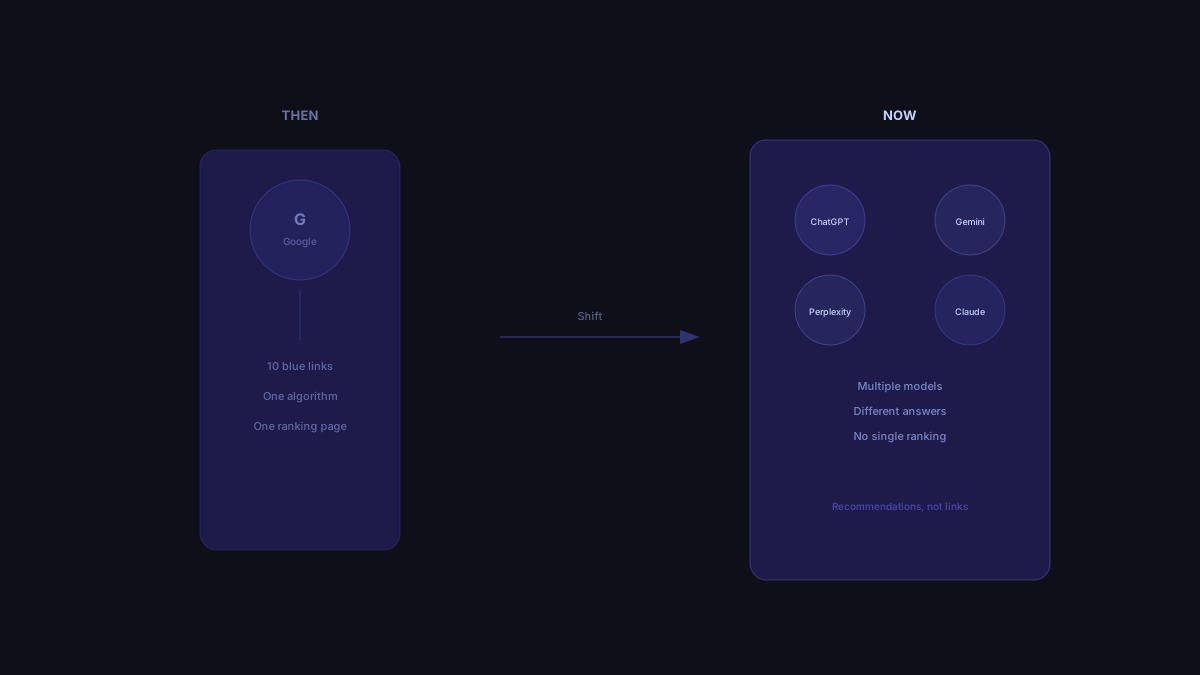
For 25 years, SEO meant one thing: rank on Google. The tactics shifted from keyword stuffing to link building to E-E-A-T signals. But the core objective stayed fixed. You were optimizing for one algorithm, one index, one set of blue links.
That era is not over. It is, however, no longer sufficient.
Buyers in your market now ask AI systems for purchase recommendations. They receive confident, opinionated answers that name specific brands. The mechanics that determine which brands surface in those answers differ from the mechanics behind Google SERPs. Understanding what transferred and what broke is the difference between adapting your strategy and wasting budget on tactics that no longer apply.
The monopoly shift: why AI search is structurally different
Google's dominance was so total that most marketing teams built their discovery strategy around a single system. One algorithm. One set of signals. One ranking page.
AI search distributes that problem across multiple competing systems. Each has different training data, different retrieval behavior, and different recommendation patterns. ChatGPT behaves differently from Gemini. Perplexity behaves differently from Claude. A brand that appears consistently in one model's answers may be absent from another's. There is no single page-one to chase.
This creates a different measurement problem. With Google, you can check your rankings for any keyword in seconds. AI visibility requires sampling responses across multiple models, multiple query phrasings, and multiple locales. A single Perplexity screenshot tells you almost nothing useful about your overall AI presence.
Discovery also works differently at a conceptual level. Google's ranking algorithm is adversarial by design: built to resist manipulation and surface genuinely useful results. AI models learned from a different source: human text on the internet. The signals that lead a model to recommend your brand are embedded in the web of content that discussed, cited, compared, and evaluated you long before the model was trained.
What still works
Before you discard your existing SEO investments, be clear about what transfers.
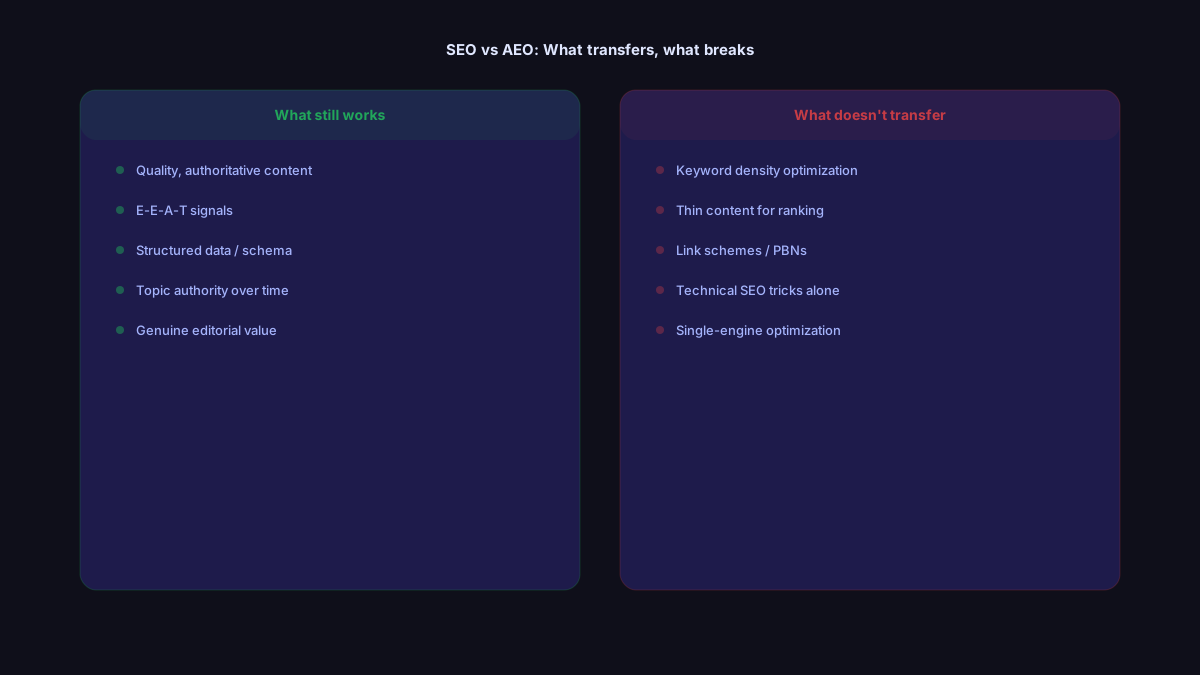
Quality content remains the foundation. AI models learn from text, and the text they find most useful for answering questions looks a lot like the text good SEO has always rewarded: clear, specific, accurate, authoritative, and genuinely helpful. Thin content that ranked through link manipulation does not get cited by AI models.
E-E-A-T signals (Experience, Expertise, Authoritativeness, Trustworthiness) matter for AI just as they do for Google. The Princeton GEO study found that content demonstrating expertise, citing credible statistics, and quoting authoritative sources was significantly more likely to appear in AI-generated answers. The logic holds: AI models, like Google, try to surface content that earned its credibility.
Structured data and clear entity definitions help AI systems understand who you are. If your website uses schema markup to describe your products, your organization, and your relationship to industry categories, AI systems have better signal to work with. This matters for knowledge graph associations, which influence how some models represent your brand even in responses that don't cite your site directly.
Topic authority may be the most durable signal. Brands that have consistently published deep, useful content in a specific domain tend to appear in AI recommendations about that domain. This is not because AI models reward publishing frequency. Sustained focus on a topic generates a web of mentions, citations, and associations that builds over time and resists short-term manipulation.
What's broken
Some tactics that worked for traditional SEO do not transfer to AI recommendation systems.
Keyword stuffing was already dying, but the point deserves stating plainly: optimizing content for exact keyword density has no analogue in AI recommendation. Models understand semantic meaning. A page that awkwardly repeats "best project management software for remote teams" fifteen times does not become more authoritative by doing so.
Thin content created for ranking purposes produces no AI benefit. If a page exists to capture a keyword rather than to answer a question, AI models trained on human judgment identify it as low-value. The content that gets cited tends to be content that genuinely earns citation.
Link schemes that existed to manipulate PageRank do not influence AI training data in any useful way. AI models do not follow links and count them. The influence of links is indirect: high-quality editorial coverage that includes links tends to be the kind of content present in training data and retrieved in response to queries. The link itself is not the signal.
Ranking for queries through technical SEO tricks does not automatically translate to being recommended for those queries. A brand that ranks number one for "best CRM for startups" through clever on-page optimization may not appear at all when ChatGPT fields the same question. The model's understanding of the space was formed through different signals across a different corpus.
The multi-model challenge
The most significant practical difference between SEO and AEO is that there is no single system to optimize for.
In Google's world, you tracked your rankings on google.com and that told you most of what you needed to know. In the AI world, your visibility on ChatGPT is separate from your visibility on Gemini, which is separate from your visibility on Perplexity or Claude. These models were trained at different times, on different data, with different alignment approaches and retrieval systems.
Your AI visibility is not a single number. It is a distribution across models, query types, and geographies. A B2B brand might perform well on Perplexity (which uses live retrieval and rewards recent authoritative content) and poorly on closed models with older training data. A consumer brand might perform differently in European markets versus North American ones, because regional content ecosystems shape regional AI recommendations.
Tracking this distribution requires systematic measurement, not spot-checks. You need to know where the gaps are before you can invest intelligently in closing them.
5 practical steps to adapt your strategy
Step 1: Audit your current AI visibility
Find out what AI models say about your brand today. Submit purchase-intent queries in your category to ChatGPT, Gemini, Perplexity, and Claude. Record whether your brand appears, in what position, and how it is described.
The queries to start with are the ones your buyers actually ask: "what's the best [category] tool for [use case]?" or "how does [your brand] compare to [competitor]?" Note not just presence or absence, but framing. Is your brand described accurately? Are the strengths AI models attribute to you the ones you would choose?
Step 2: Map your third-party sources
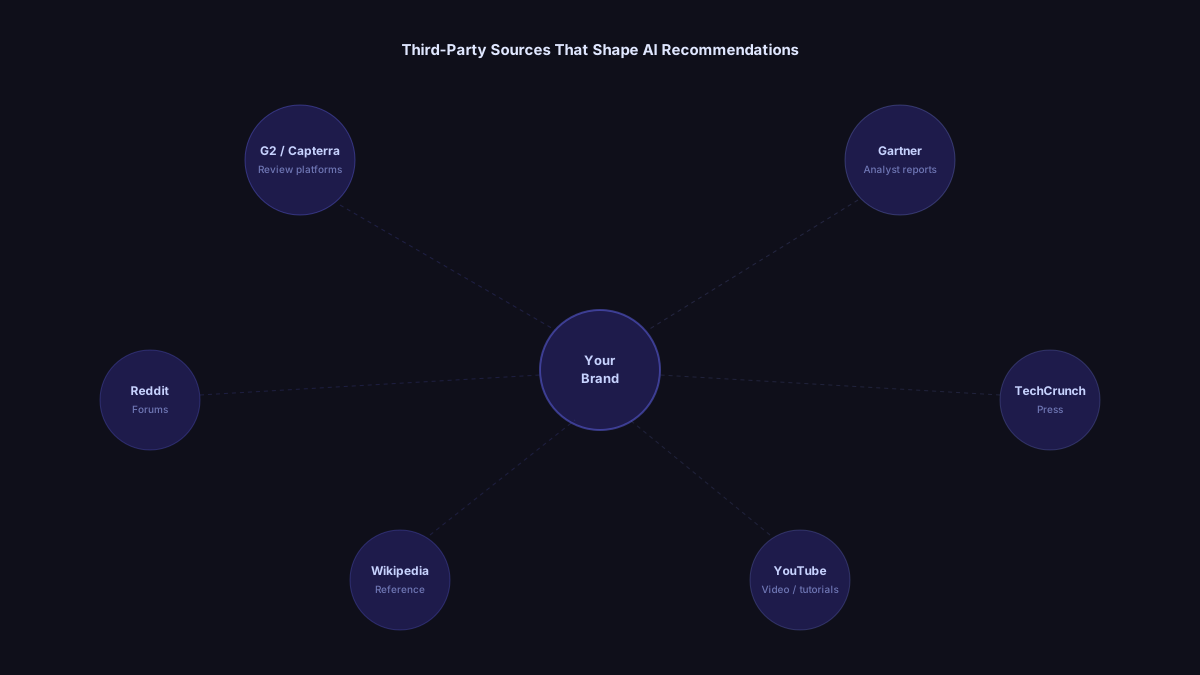
AI models learn about your brand from everywhere it is mentioned: review platforms, analyst reports, comparison articles, forums, press coverage, and user communities. Map these sources and assess whether those representations are accurate.
G2, Capterra, Trustpilot, and similar platforms carry significant weight in AI training data for B2B software. Industry analyst reports from Gartner or Forrester, when they mention your brand, tend to appear in training corpora because they are authoritative and widely cited. Reddit threads and forum discussions shape how models understand real-world user perception. Identify your current footprint across these sources and understand what they are saying about you.
Step 3: Optimize for citations
Getting mentioned in the right places, in the right context, is the most durable lever for AI visibility. Focus on earned media, co-published case studies, community contributions, and review platform accuracy.
The citation lever works differently from link building. You are not trying to accumulate the most mentions. You are trying to ensure that the sources AI models treat as authoritative represent your brand accurately and in the context of the purchase criteria your buyers care about. A single well-placed mention in an authoritative industry publication can outweigh dozens of mentions in low-credibility sources.
Step 4: Align with purchase criteria
AI models recommend brands in response to specific questions framed around purchase criteria. Identify the criteria buyers in your category use and make sure your content addresses them directly.
This is where AI visibility strategy diverges most sharply from traditional SEO. You are not optimizing for keyword rankings. You are shaping the semantic associations models have formed about your brand. That means being specific about use cases, clearly articulating who your product is for, and ensuring those framings appear in authoritative sources that influence training and retrieval.
Step 5: Track consistently
AI visibility changes over time, often non-linearly. A major piece of press coverage can shift your position in retrieval-augmented models within days. Regular sampling across models and query types is the only way to know whether efforts are working.
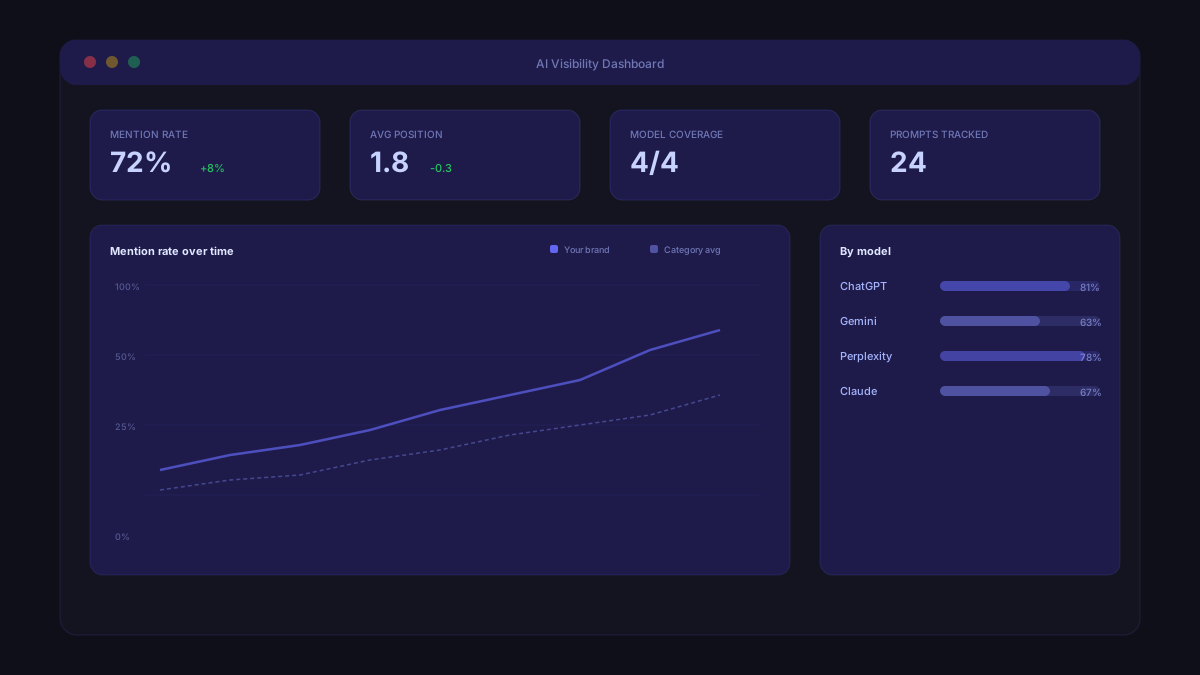
Consistency matters here in a way it does not for SEO. Google's rankings are relatively stable week-to-week. AI visibility can shift with model updates, changes to retrieval systems, and shifts in the content ecosystem. Monthly tracking is a sensible minimum. Weekly tracking makes sense if you are running active campaigns.
See where your brand stands in AI search
Track how ChatGPT, Gemini, Perplexity, and Claude recommend your brand vs competitors.
The fundamentals haven't changed. The surface has.
The core principle that made SEO work over 25 years is still intact: earn your position by being genuinely useful and credible to the people your content serves. Brands that built genuine authority in their category for Google tend to perform well in AI recommendations too, because AI models learned from the same authoritative sources Google rewarded.
What changed is the surface area. Multiple AI systems to appear in, not one search engine. Signals embedded in training data and retrieval behavior, not a single algorithm's ranking factors. Measurement that requires sampling across models and query types, not checking a keyword rank.
The teams that adapt fastest are not the ones abandoning SEO fundamentals. They are the ones extending those fundamentals onto the new surface: measuring systematically, understanding which third-party sources matter, and investing in content and earned presence that AI systems treat as authoritative.
The playbook did not break. It expanded.
FAQ
Should we stop investing in SEO? No. SEO and AEO are complementary. Strong SEO foundations (quality content, E-E-A-T signals, structured data, topic authority) directly support AI visibility. The gap to fill is measurement: add AI visibility tracking alongside your existing SEO reporting.
How quickly can AI visibility change? For retrieval-augmented models like Perplexity, changes can appear within days of new coverage being indexed. For closed models with fixed training data, changes may take months until the next model update. Track across models to see where you are moving quickly and where improvement will take longer.
Which AI models matter most for our category? For most B2B brands in 2026, prioritize ChatGPT (GPT-4o), Google Gemini, Perplexity, and Claude. ChatGPT and Gemini have the largest user bases. Perplexity is popular with technically sophisticated buyers doing research-heavy evaluations. Start there and expand based on where you find gaps.
What if we're a new brand with limited existing coverage? New brands face the lag effect most acutely: AI training data skews toward brands with significant coverage during the model's training window. The most effective accelerant is earning citations in high-authority sources, particularly review platforms, industry publications, and active community discussions. Consistency over time matters more than a single burst of coverage.
See where your brand stands in AI search
Track how ChatGPT, Gemini, Perplexity, and Claude recommend your brand vs competitors.
Start tracking free