Pick one. Track it. Move it. Then add the next.
That is the entire framework. Most of the noise around GEO, AEO, and LLMO comes from teams trying to track all three at once before they have a baseline on any of them. You do not need to. The right metric for your team this quarter depends on two things: where your buyers are asking questions, and which moves you can actually make in response.
The 60-second version
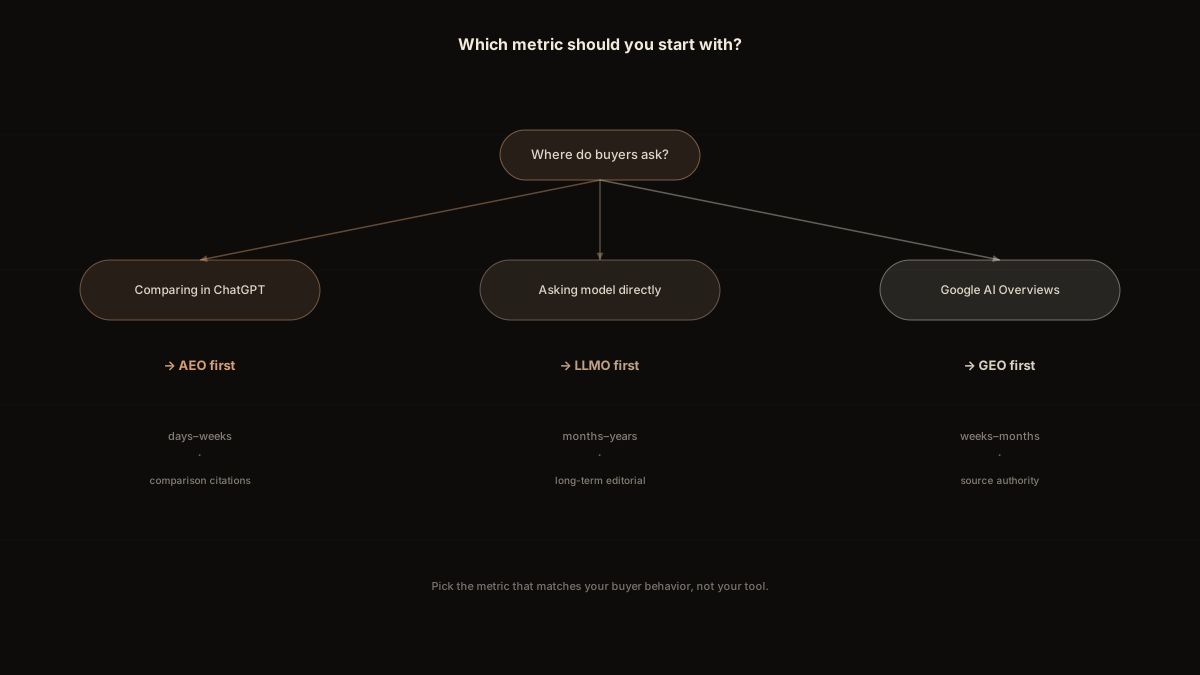
If your buyers are running comparison queries inside ChatGPT, Gemini, or Perplexity to decide what to buy, start with AEO. You want to be cited in the answer they read.
If your buyers are typing wide informational queries into Google and getting AI Overviews instead of blue links, start with GEO. You want to influence how Google's generated answers describe your category.
If your buyers ask models to recommend tools or vendors in your space without doing any retrieval (think coaching conversations, "what should I use for X"), start with LLMO. You want the underlying model to have already heard of you.
Most B2B teams need AEO first. Most consumer brands need LLMO. GEO sits in the middle and most teams should add it once one of the other two is moving.
The rest of this post is the reasoning.
What each acronym actually means
GEO stands for generative engine optimization. Broadest term, smallest precision. GEO covers any work that influences how generative search systems represent your brand, including Google AI Overviews, Bing's answers, and the AI surfaces inside answer engines.
AEO stands for answer engine optimization. Tactical, focused on platforms that return a single synthesized answer. ChatGPT, Perplexity, Gemini, Claude, and any vertical answer engine count. AEO is about being cited or named in that single answer.
LLMO stands for large language model optimization. Strategic and slow. LLMO is about influencing what the model knows about your brand and category before any live retrieval step happens. It is downstream of years of editorial coverage, structured data, and entity signals.
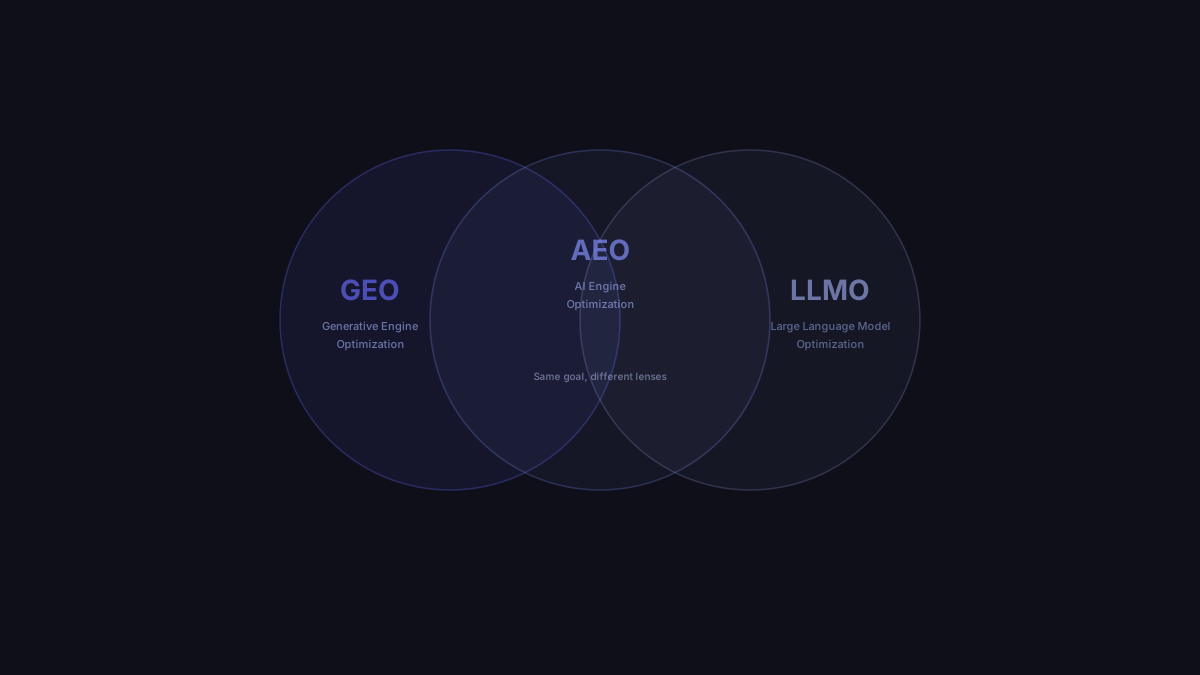
The relationship looks like this:
The slower the metric, the more durable the win. The faster the metric, the more often you have to defend it.
Pick AEO first if your buyers compare in a chat window
Most B2B buyers in 2026 spend part of their evaluation process inside ChatGPT or Perplexity. They ask things like "what are the best CRMs for a fifty-person sales team," and they pay attention to the names that come back.
This is AEO territory. The question is whether you appear in the answer. The lever is the set of sources the engine retrieves to construct the answer.
The work that moves AEO is fast feedback. You publish a piece, an authoritative third party covers it, the next time the query runs your brand surfaces. You can see the change within weeks. This makes AEO the easiest of the three to manage with a quarterly rhythm.
It also makes AEO the easiest to lose. Citations move. New competitor content gets indexed. The same query run two weeks apart can return a different answer. You have to measure it consistently, not as a one-shot audit.
Pick LLMO first if your category is "trusted brand wins"
Some categories are dominated by brand recall. People do not run comparison queries. They ask the model, "what should I use for project management," and they accept whatever it says first. The model's prior is doing the work.
This is LLMO territory. The model recommends what it has heard of most, weighted by signals it trusts. You cannot retrieve your way into the answer because the model is not retrieving. You have to already be in its prior.
The work that moves LLMO is slow. Coverage in major publications. Mentions in industry-defining content. Wikipedia. Conference talks that get transcribed and indexed. Editorial associations between your brand and the category over years.
The hardest part of LLMO is patience. You will publish content for six months and see nothing change in the model output. Then a major industry report cites you, and three months later your brand starts appearing in model recommendations. Cause and effect are separated by long lags. Teams that need quarterly proof of work struggle here.
LLMO is the metric where compounding works for or against you. Brands that built editorial authority in 2022-2024 are surfacing in 2026 model outputs without lifting a finger. Brands that did not are climbing from zero.
Pick GEO first if Google AI Overviews drained your traffic
Many traditional SEO teams are now arriving at AI visibility from the opposite end. They were not chasing ChatGPT citations. They were running a perfectly good content program and watching Google AI Overviews eat their top-of-funnel traffic.
This is GEO territory. The work is to influence whether and how Google's generated answers describe your brand and category. The mechanics overlap with traditional SEO, but the success metric changed from "rank in the top 10 organic results" to "appear as a citation source in the AI Overview."
GEO is the bridge metric. It uses many of the same investments as SEO (high-authority content, structured data, freshness, internal linking) but measures them against a different outcome. If your team already has SEO discipline, GEO is the smallest leap.
How the three connect
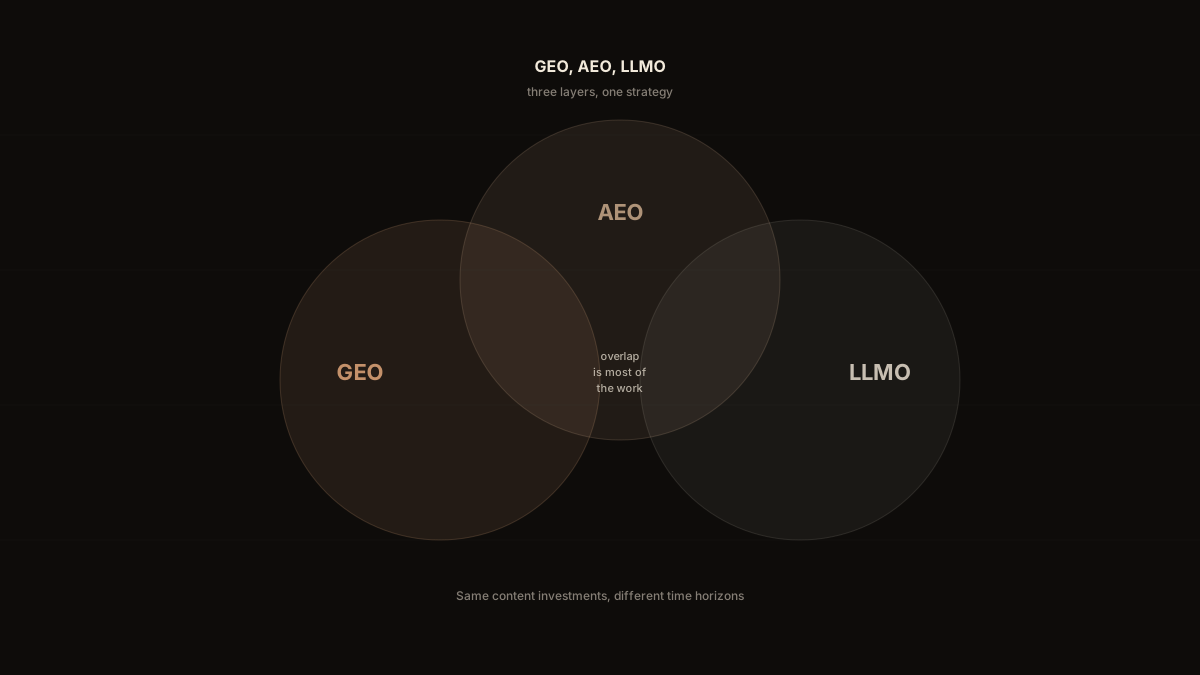
You do not optimize each metric in isolation. The same work tends to move all three, just on different timescales.
A high-quality piece of original research published on your domain and picked up by industry publications:
- Moves AEO in weeks, as answer engines retrieve and cite it.
- Moves GEO in weeks to months, as Google AI Overviews start to draw on it.
- Moves LLMO over years, as it accumulates into the training corpus of the next model generation.
The same piece. Three timescales. The reason to pick one metric to lead with is not that the work differs, but that the measurement focus differs. You build the dashboard for the metric you are reporting against, and you let the work move all three.
The wrong way to choose
A few patterns to avoid.
Do not pick the metric that has the most blog posts written about it. The blog volume in AEO is currently the loudest, which makes it tempting to start there even when your buyers are doing LLMO-style "recommend me a tool" queries.
Do not pick the metric your competitors are reporting on. Their buyer behavior is not necessarily yours. A SaaS competitor who tracks AEO because their buyers compare in ChatGPT does not mean your enterprise buyer does the same. Watch your own data.
Do not pick the metric your tool measures most easily. If a vendor dashboard only shows you GEO data, the temptation is to call GEO your primary metric. Reverse the order. Decide what to track, then pick the tool that tracks it.
See where your brand stands in AI search
Track how ChatGPT, Gemini, Perplexity, and Claude recommend your brand vs competitors.
Start tracking freeA 90-day starting plan
Three months is enough to baseline one metric and start the second.
In month one, pick the metric that matches your buyer behavior. Define the query set, ten to twenty prompts that approximate how a buyer would phrase a relevant question. Run the queries across the appropriate engines. Record presence, framing, and citation source. This is your baseline.
In month two, identify the gap. Which queries return your brand? Which return competitors? Why are the competitors being cited? Usually the answer is a small set of third-party sources or a specific type of content. List them.
In month three, place one editorial bet that addresses the gap. Original research that an industry publication will quote. A long-form comparison that ranks for the buyer's wide query. A relationship with a podcast that gets transcribed. Pick one, ship it, see whether the metric moves.
By the end of the quarter you have a baseline, an explanation, and one move. That is more than most teams accomplish in a year. After the first metric stabilizes, add the second.
When to switch
You should switch primary metric if two things happen:
The metric stops being predictive of pipeline. AEO citations are useless if your buyers are not in ChatGPT. If you are winning citations and losing deals, the question is whether the model traffic is the buyer traffic at all.
The buyer behavior shifts. AI search adoption is still moving. The model your buyers used last year may not be the one they use this year. Re-confirm the buyer behavior every two quarters before doubling down on a metric.
If neither happens, stay on the metric. Switching for novelty does not help.
FAQ
Are GEO, AEO, and LLMO standardized terms? No. The industry has not settled on definitions. The ones in this post are the working definitions Whaily uses, and they map cleanly to distinct work, but expect vendors to use the terms slightly differently.
Can I report on all three to leadership? You can. Most teams find that reporting on all three at once obscures the story. Pick the one you are actively moving, show the trend, and reference the others as context.
Does GEO replace SEO? GEO sits on top of SEO. The disciplines overlap, and most teams find that the same investments serve both. The difference is the outcome you measure against.
How do I know if my buyers are using ChatGPT to evaluate vendors? Two ways: ask them in customer interviews, and look at your own organic traffic decline on top-of-funnel comparison queries. If both signals point the same direction, AEO is your starting metric.
See where your brand stands in AI search
Track how ChatGPT, Gemini, Perplexity, and Claude recommend your brand vs competitors.
Start tracking free