Why your brand is missing from AI answers, and how to check
A brand that should be recommended for a category query is often absent from AI answers for one of five checkable reasons. Here's how to find which one.
The short answer
Absence has five checkable causes, in this order: crawlers are blocked at robots.txt or the CDN, you are missing from the sources models cite, your pages never say plainly what you sell or its price, you name the category differently than buyers, or the model names you but gets a fact wrong. Most brands find it in the first two.
You ask ChatGPT or Perplexity for the best tool in your category, and your brand isn't there. Competitors are named, sometimes ones you'd beat on a feature-by-feature comparison, and you're not in the answer at all. The instinct is to assume the model is biased, or broken, or that "AI SEO" is a black box nobody can debug.
It isn't. Absence from AI answers has a short list of checkable causes, and each one leaves a specific trace you can find in under ten minutes. This guide walks through them in the order they're worth checking, from the most mechanical (can a crawler even reach your site) to the most subtle (the model names you but gets a fact wrong). Work down the list. Stop at the first cause that matches what you find.
AI crawlers can't reach your site
How to check it: pull up your
robots.txtfile and read it directly, don't rely on a plugin's summary. Look forUser-agent: GPTBot,User-agent: ClaudeBot,User-agent: PerplexityBot,User-agent: Google-Extended, and similar, followed byDisallow: /. Then check your CDN or WAF settings. If the site runs on Cloudflare, look at Security → Bots for an "AI Scrapers and Crawlers" rule set to block.This matters more than it used to. Cloudflare began blocking AI crawlers by default on every new domain added to its network starting 1 July 2025, shifting AI scraping from opt-out to opt-in industry-wide. A wider default takes effect on 15 September 2026: Cloudflare will block "mixed-use" crawlers, bots that blend search indexing with AI training or agent use, by default on pages that carry ads, for new customers, new sites, and existing free-tier accounts. If your site was set up on Cloudflare any time after mid-2025 and nobody explicitly allowed AI crawlers, there's a real chance they're blocked without anyone having made that decision on purpose.
What to change: allow the named AI bots in
robots.txtand in your CDN's bot management settings if you want to be discoverable by the assistants your buyers use. This is a five-minute fix once you've confirmed it's the problem, and it's worth ruling out first because everything downstream is pointless if the crawler never gets in the door.your brand isn't in the sources models cite for this category
How to check it: search your category on the sites that get cited for it. Run "best [category] tools" on Google and note which listicles rank. Check the review platforms your buyers would use (G2, Capterra, Trustpilot). Search Reddit for your category's evaluation threads. Check whether your brand has a Wikipedia entry, or whether competitors do and you don't. Then ask two or three AI models the same category question and see which of those sources they cite alongside the answer, when the interface shows citations.
Models that answer a category question by retrieving current information lean on a narrow set of sources: comparison listicles, review aggregators, active forum threads, and reference sites. If your brand doesn't appear on any of those, there's nothing for the model to retrieve and repeat, regardless of how good your own website is.
What to change: get listed. Request inclusion in relevant comparison posts and roundups. Claim and complete your profile on the review sites your category actually uses, and prompt customers for reviews if your profile is thin. Participate honestly in the Reddit threads where your category gets discussed. None of this is fast, but it's specific and checkable, unlike "improve AI visibility" as a goal.
your own pages don't say plainly what you are
How to check it: read your homepage and pricing page as if you'd never heard of your product. Can you find, in the first screen, what the product does, who it's for, and roughly what it costs? Then check whether that same information appears in the page's actual text, not only in a JavaScript-rendered widget or an image. A quick way to check: view the page with JavaScript disabled, or fetch the raw HTML.
Models extract facts from text. A homepage that opens with a slogan and requires three clicks to find pricing gives a crawler nothing concrete to summarize. If your pricing lives behind a "talk to sales" gate with no indication of range, most AI systems will either omit your pricing or infer it from a stale third-party mention instead.
What to change: state the category, the target customer, and at least a price range in plain text near the top of your homepage and pricing page. This isn't a redesign. It's making sure the sentence a model would want to quote actually exists somewhere on the page.
you use a different word than buyers and models do
How to check it: list the exact phrase your marketing uses for your category ("revenue intelligence platform," say) next to the phrase a buyer would type into a search bar or ask a chatbot ("tool to track deal risk"). Then run both phrasings through two or three AI models and compare which one surfaces your brand.
A model maps a query to a category, then recalls brands associated with that category in its sources. If your own site, your reviews, and your competitors' comparisons all use one term, and buyers query with a different one, the model may have a solid, well-formed idea of your brand under the label the market doesn't use.
What to change: don't reinvent your positioning. Add the buyer's term as a secondary description alongside your primary category language, on your homepage and in third-party listings where you control the copy. The goal is a bridge between the term you use and the term the query uses, not a rebrand.
the model names you but gets the facts wrong
How to check it: ask three or four models to describe your product and your pricing. Compare their answers to your current site. Stale answers usually trace back to one or two old sources: an outdated comparison post, a review that predates a pricing change, an old crunchbase or directory listing.
What to change: find the specific source the wrong fact traces back to (most review sites let vendors claim and edit a profile) and get it updated. Publish current pricing in plain text on your own site, since an out-of-date figure with nothing current to compete against tends to persist.
What llms.txt won't fix
If you've read about llms.txt, the plain-text file some sites publish summarizing their content for AI systems, it's worth knowing where it actually stands before spending time on it. An Ahrefs analysis of 137,210 domains found that 97% of valid llms.txt files received zero requests in May 2026, and AI retrieval bots from platforms like ChatGPT and Perplexity accounted for only about 1.1% of the requests that did arrive. Google's Gary Illyes has said publicly that Google does not support llms.txt and has no plans to. None of the five causes above are solved by adding one.
Order of operations
Check the causes in this order, because each one is faster to rule out than the next and an earlier failure makes the later ones moot:
- Crawler access (robots.txt, CDN bot rules). Ten minutes. If blocked, nothing else matters until it's fixed.
- Category source presence (listicles, review sites, Reddit, Wikipedia). Twenty minutes to survey, longer to fix.
- On-page clarity (can a crawler read what you are, for whom, at what price). Ten minutes to check, an afternoon to fix.
- Category language match (your term vs. the buyer's term). Ten minutes to compare across a few model queries.
- Factual accuracy (is the description current). Ten minutes to spot-check across models.
Most brands find their answer in the first two. If you're not blocked and you're genuinely present in the sources models cite for your category, the fix is usually smaller than it feels: a clearer pricing sentence, an updated review, a bridge between two phrasings for the same thing.
How Whaily fits
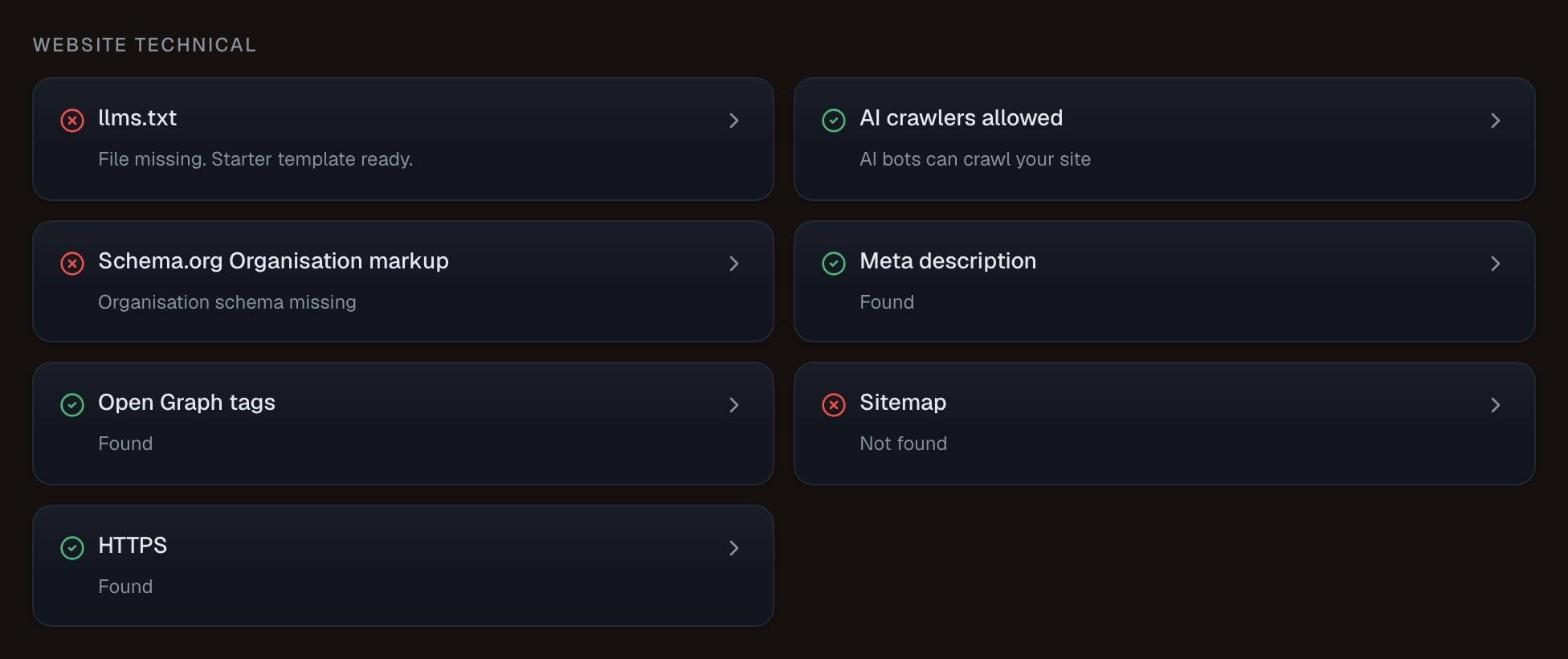
Checking all five causes by hand across several models and rerunning it after every change is the part that doesn't scale. Whaily's brand audit runs the crawler-access and on-page checks automatically, and citation sources shows which listicles, review sites, and forums the models are actually pulling from for your category, so you know exactly where to focus before you spend a quarter chasing the wrong fix.