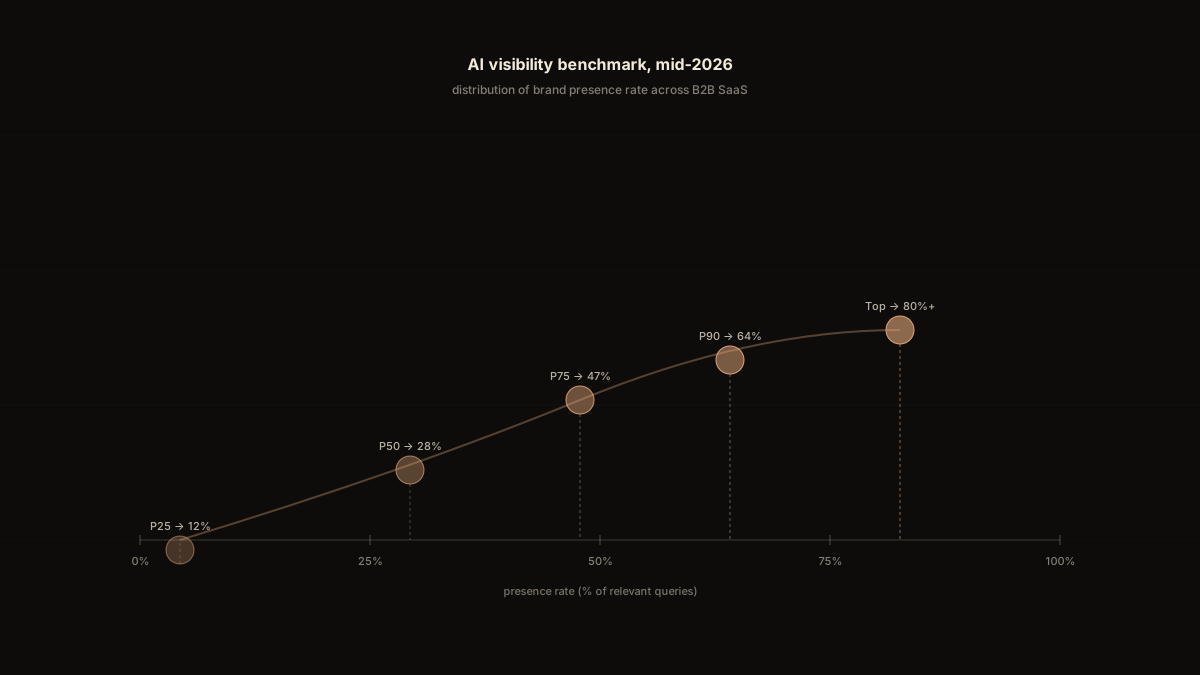
What happened to organic traffic in 2025 was uneven, hard to read in real time, and not entirely captured by the loudest reports.
Some categories saw double-digit declines on top-of-funnel queries. Others saw essentially no change. Brands with strong AI-engine citation share gained partial recovery from the new channel. Brands without saw the gap widen.
This post collects the cleanest picture we can construct of the 2025 traffic shift, segmented by vertical and by query intent. The numbers are illustrative of patterns we observe in the working data set, not a complete industry census. They are enough to draw practical conclusions about who lost what and why.
The headline finding
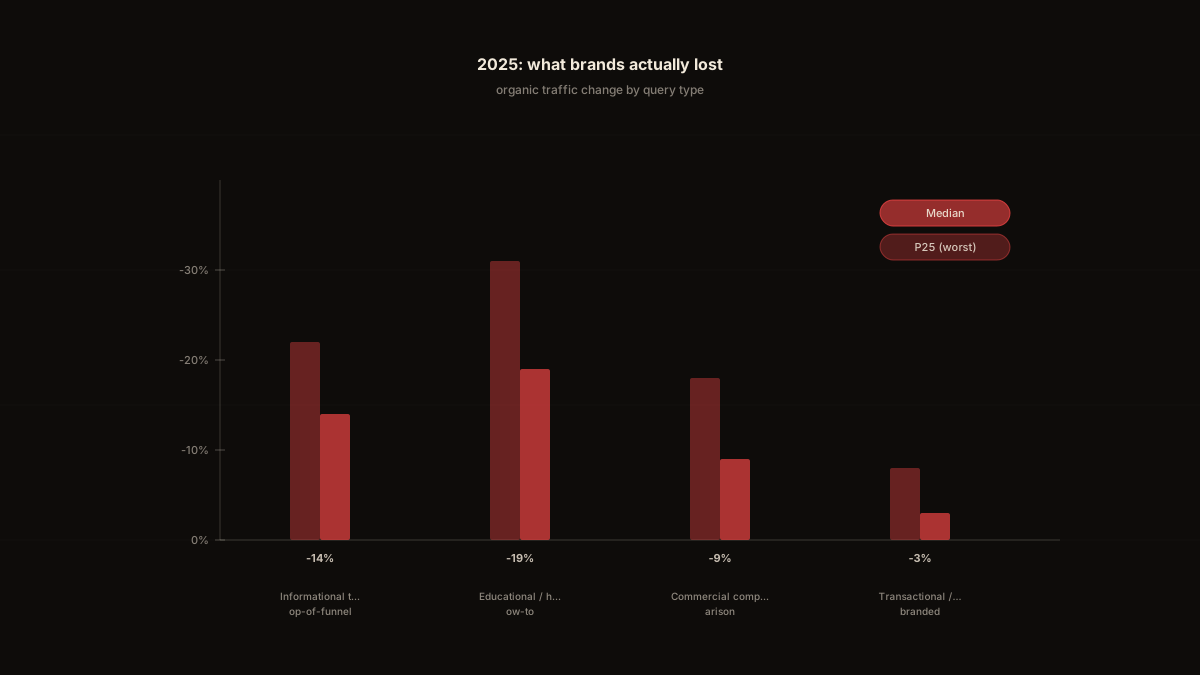
Across the categories we track, organic traffic from Google in 2025 declined by an average of roughly 14% year-over-year for top-of-funnel informational queries. The distribution behind that average is much wider than the average suggests.
The 25th percentile of brands in the working set lost 22% or more of their informational organic traffic. The 75th percentile lost 7% or less. The variance reflects the uneven rollout of AI Overviews across categories and the variable degree to which brands had compensating gains from AI engine visibility.
When we restrict the analysis to transactional and branded queries, the average decline drops to roughly 3%. These query types are largely outside the AI Overview surface and were broadly stable through the year.
The big losses are concentrated in informational top-of-funnel queries. The big stability is in commercial and branded queries. The pattern is now consistent across multiple data cuts.
Verticals hit hardest
Three verticals show up consistently at the top of the loss distribution.
B2B software comparison content. "Best X for Y" queries that whole content programs were built around saw substantial CTR compression. Brands relying on top-of-funnel comparison traffic to feed top-of-funnel demand saw the steepest declines. The compensating dynamic was AI engine citations, but only for brands that had invested.
Tutorial and how-to content. Anything answerable in three to five steps got compressed into AI Overview boxes. Independent tutorial sites and content-program tutorials lost meaningful traffic. The exception: long, complex tutorials with multiple stages and embedded media held up because the Overview cannot fully replace them.
Definition and explainer content. "What is X" queries are now answered in the SERP itself. The pages that ranked for these queries are still cited as sources but rarely visited directly. The traffic loss is acute and the workaround (being the citation source) is real but does not fully replace the click.
Verticals that held up better:
Local services. Maps, business listings, and local intent queries are largely outside the Overview surface.
Ecommerce transactional. Users typically click out to commerce pages before completing typing. Ecommerce traffic is broadly unaffected.
Regulated industries. Finance, health, and legal categories where Google has been more conservative with Overview rollout saw smaller declines.
The bimodal vendor pattern within affected verticals
Even within the affected verticals, the data shows a clear split.
Brands that had been investing in AI visibility through 2024 and into 2025 lost less and recovered more. The gain was twofold: better preservation of remaining Google traffic (because their content was cited as sources, which generated some clicks even with Overviews present), and meaningful inbound from AI engines (ChatGPT, Gemini, Perplexity) that partially offset the Google losses.
Brands that had not invested in AI visibility lost more on Google and gained less elsewhere. They were doubly exposed.
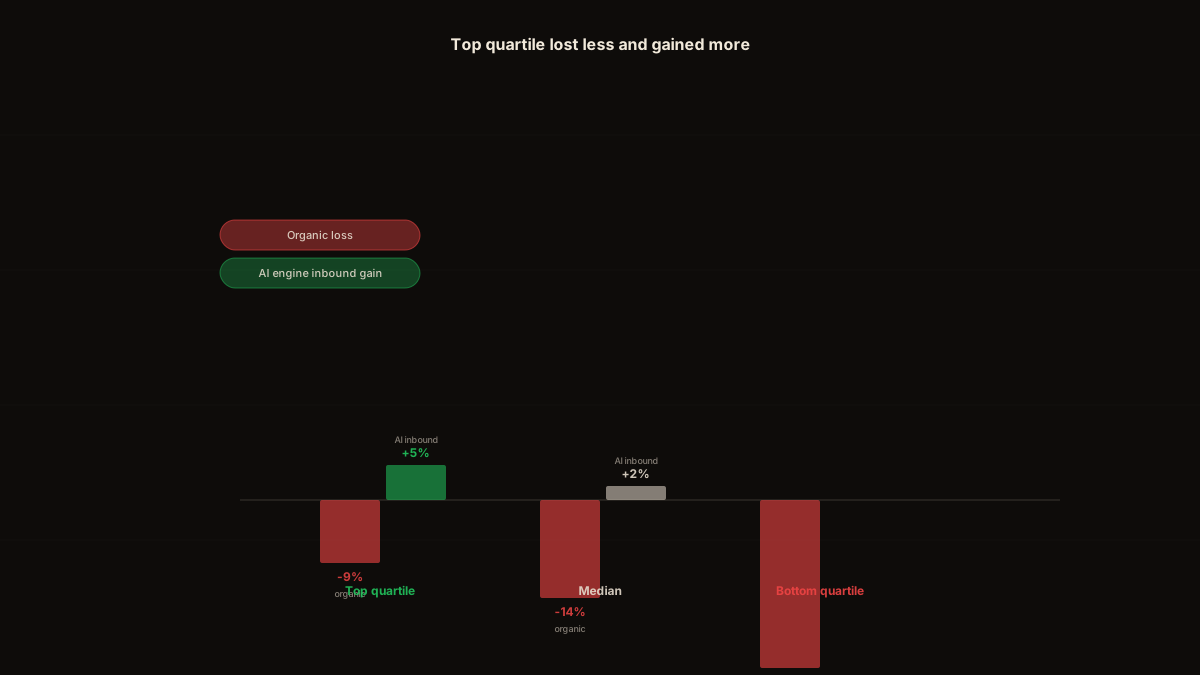
The split is large enough to matter. In the working set, B2B SaaS brands in the top quartile of AI visibility investment saw 9% organic decline on top-of-funnel queries; brands in the bottom quartile saw 24% decline.
Two B2B SaaS competitors in the same category can have meaningfully different 2025 trajectories purely based on whether they had been working on AI visibility. The work done in 2024 paid off in 2025 in ways that are now measurable.
What the leaders did differently
We looked at the brands in the top quartile (least traffic loss, best AI engine citation share) and reverse-engineered the common factors.
They started measuring AI visibility before 2025. Almost all of the top quartile had some form of AI visibility tracking in place by mid-2024. They were not flying blind when the AI Overview rollout accelerated.
They invested in source-level coverage, not just content volume. The top quartile spent meaningful effort on PR, editorial coverage, and review-site presence. Their content programs may have been smaller than mid-tier competitors, but their third-party coverage was deeper.
They updated their schema and structured data. Almost universally. The top quartile brands had Article schema, FAQPage schema where appropriate, and consistent Organization data. This made their content more retrievable for AI engines and more citable in AI Overviews.
They maintained content quality on the pages most likely to be cited. Rather than spreading effort across hundreds of thin pages, the top quartile concentrated effort on twenty or thirty high-value pages and made sure each was citation-worthy.
The pattern is consistent enough to be useful. The leaders did not have a secret. They had a focused, modestly-funded investment in the work that ended up mattering.
What the laggards mostly did
The bottom quartile, the brands that lost most heavily, shared three characteristics.
Heavy reliance on top-of-funnel informational traffic. Their content programs were dominated by "what is X" and "how does X work" type content. This was a successful SEO play in 2023. It was the most exposed category in 2025.
Weak third-party coverage. Their brand-level signals (Wikipedia, editorial mentions, analyst coverage) were thin or absent. When AI engines were asked about their category, the sources cited rarely mentioned them.
No AI visibility measurement. They could not see the decline coming. By the time the traffic loss was clear in Google Analytics, the brands ahead of them had already been investing for a year.
This is the failure mode that the data is unambiguous about: late awareness of the shift, plus a content portfolio over-indexed to the most-exposed query type.
Where the partial recovery came from
For brands in the top quartile, some of the Google loss was offset by AI engine inbound. The math is worth being honest about: the offset is partial, not complete.
A B2B SaaS brand that lost 9% of its informational organic traffic might have gained an additional 3-5% in equivalent-value sessions from AI engine citations. The net is still a decline, but the trajectory is much better than the laggards.
The mechanism: when a brand is cited as a source in an AI Overview or in a ChatGPT response, some users click through. Not all. The click-through rate from AI citations is meaningfully lower than the click-through rate from organic rankings used to be. But it is nonzero, and at scale it adds up.
A second mechanism: brand recognition. Many users see the brand cited in an AI response, do not click immediately, but later search the brand name directly. This shows up in branded organic search and direct traffic, not in informational organic. The branded query traffic for top quartile brands grew through 2025 even as informational declined.
The summary: AI engine inbound partially offsets Google losses, but the more important effect is the downstream branded traffic and direct traffic that build over months as buyers see the brand consistently cited.
Methodology and limits
A few honest caveats.
The working set is biased toward categories Whaily customers track, which over-represents B2B SaaS and adjacent verticals. Consumer brand patterns may differ.
The 2025 measurement is constructed from a combination of Google Search Console data (where shared by customers), public analytics where available, and traffic estimation models. None is perfect.
The "AI engine citation share" measurement uses our own methodology and recent benchmark data. Different tools may produce slightly different numbers but the qualitative patterns are consistent.
Year-over-year comparisons mix the AI Overview effect with normal seasonal and category dynamics. The numbers above are our best attempt to isolate the AI-related signal but should not be read as precise to a percentage point.
See where your brand stands in AI search
Track how ChatGPT, Gemini, Perplexity, and Claude recommend your brand vs competitors.
Start tracking freeWhat to take from the 2025 data
Three useful conclusions.
The loss was real and uneven. Average declines hide significant variance. Your category and your starting position matter more than the headline number.
The work in 2024 paid off in 2025. Brands that had been investing in AI visibility entered the AI Overview rollout in a stronger position. The compounding effect is now measurable.
The partial recovery is real but conditional. AI engine inbound can offset some of the Google loss, but only for brands with the citation share to be retrieved. The investment is the precondition.
For brands looking at their 2025 data and trying to plan 2026: the playbook that worked is the same one. AI visibility measurement, source-level investment, content quality on a focused page set, clean structured data. The teams who did this in 2024 are the ones whose 2025 traffic looked least bad.
FAQ
Are these numbers representative of all industries? Approximately for B2B SaaS and adjacent categories. Consumer brands and regulated industries can deviate significantly. Use them as directional indicators, not definitive industry benchmarks.
Did some brands gain Google traffic in 2025? A small number, yes. Mostly brands in categories where AI Overviews are not yet widespread, or brands whose content directly answered the kind of intent the Overviews failed to cover well.
Will 2026 look like 2025? The pattern is likely to continue but moderate. The biggest AI Overview rollout has already happened. Subsequent changes are more about depth and quality of Overviews than further expansion of the surface.
How can I tell which of my pages are affected? Look at year-over-year traffic for top-of-funnel informational queries specifically. Compare to year-over-year for branded and transactional queries. The gap between the two is your AI Overview exposure.
See where your brand stands in AI search
Track how ChatGPT, Gemini, Perplexity, and Claude recommend your brand vs competitors.
Start tracking free