What does "good" AI visibility look like in 2026? Until recently the honest answer was that nobody knew, because nobody had cross-engine measurements at scale.
This post is the first cut of a benchmark we built from rolling samples across a working set of brands in the categories Whaily customers track most. It is not a complete industry survey, and the numbers will move as adoption shifts. It is enough to draw a defensible picture of the distribution of visibility scores today, and to identify which patterns hold across categories and which do not.
The benchmark is built from a recurring sample of buyer-intent queries run against ChatGPT, Gemini, and Perplexity. For each (brand, category, engine) we compute presence rate (the share of relevant queries in which the brand was mentioned), citation rate (the share of relevant queries in which a URL on the brand's domain was cited), and framing stability (whether the brand description was consistent across responses).
The headline numbers
Across the working set, the distribution is wider than most teams expect.
The median brand in a typical B2B SaaS category surfaces in 28% of relevant queries across the three engines combined. The 75th percentile is at 47%. The 90th percentile is at 64%. The leaders in well-defined categories run between 70% and 85%.
The spread between the 25th and 75th percentile is roughly 22 points. This means the difference between a middling brand and a strong brand is large and measurable. It is not, in most categories, an oligopoly where one or two brands take all the presence. It is more like a long tail in which a handful of leaders are clearly ahead, a middle pack is competing, and a long stretch of brands are near zero.
The ceiling sits below 100% because no brand consistently appears in every relevant query. Some queries are too specific. Others surface niche or new entrants. A presence rate above 80% in a competitive category is the realistic upper bound.
Citation rate is much lower than presence rate
Most teams overestimate the gap between "mentioned" and "cited." The data says it is significant.
For brands above the 75th percentile in presence, the average citation rate (a URL on their domain being cited as a source) is roughly half their presence rate. A brand mentioned in 50% of queries typically has a domain cited in 20-25% of those queries.
For brands below the median in presence, the citation rate is much lower in proportion: often less than a quarter of their presence rate. These brands are being talked about but the model is not pulling content from their site as the source of the description. The framing is being shaped by third parties, not by their own publishing.
This gap matters because it determines who controls the description. A brand cited as the source for its own description has roughly accurate framing. A brand mentioned but not cited gets whatever framing the third-party sources happen to use, which is often outdated, inconsistent, or competitively positioned.
The interesting metric is not presence rate alone. It is the ratio of citation rate to presence rate. Brands with a high ratio control how AI engines describe them. Brands with a low ratio do not.
Cross-engine variance is the rule, not the exception
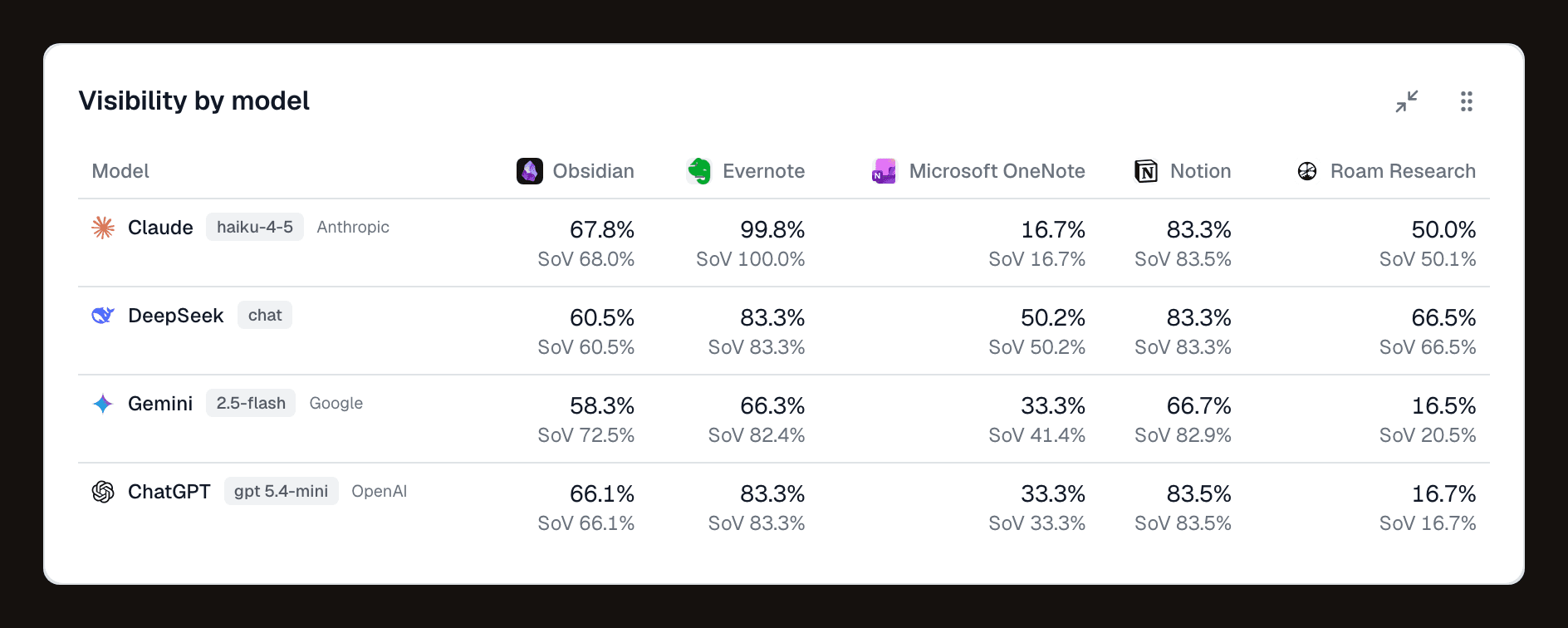
A finding that surprises many teams: a brand's presence rate varies substantially by engine.
In the working set, the average brand's cross-engine variance (standard deviation across ChatGPT, Gemini, and Perplexity) is approximately 14 percentage points. A brand at 45% overall presence might be 60% on Perplexity and 30% on Gemini. The variance is not random; it reflects which sources each engine relies on for the category.
Perplexity tends to over-index on review sites and forums. Gemini tends to over-index on established editorial publications. ChatGPT sits somewhere between, with stronger pulls from Wikipedia and major reference sites. A brand's mix of inbound coverage determines which engine surfaces it more.
This has a practical consequence: there is no single AI visibility number. A brand's "AI visibility score" is a multi-engine vector, and the variance across the vector is informative. A high-variance brand is over-reliant on a specific source type. A low-variance brand has earned more balanced coverage.
Categories where leaders run away with it
Not every category looks like a long-tail distribution. A few have winner-take-most patterns.
In categories with a long-established Wikipedia entry for the leading brand and weak third-party coverage of competitors, the leader's presence rate can reach 80-90% while the runner-up sits below 30%. This is the pattern for some legacy software categories where the dominant brand has been the default for fifteen years.
In categories with active review-site coverage and many comparable products, the distribution flattens out. The top three or four brands sit between 50% and 70%, with a long tail below. This is the pattern in most B2B SaaS categories with mature review-site presence.
In emerging categories where no incumbent has dominant signal, the distribution can be surprisingly flat: many brands sit between 15% and 35% with no clear leader. These categories are where editorial work can move the needle most rapidly because nobody has built an unassailable lead yet.
Identifying which pattern your category falls into is the first useful diagnostic. The remedies differ.
What separates the leaders
We looked at the brands above the 75th percentile in each category and reverse-engineered the source patterns driving their presence.
Three things show up consistently:
A stable, current Wikipedia entry. Almost every top-quartile brand has one. The minority that do not are usually new entrants riding fast-growing third-party coverage.
Coverage in three or more high-authority editorial publications. Not their own blog. Independent journalism, analyst coverage, or research mentions. The threshold matters: brands with coverage in fewer than three independent high-authority sources tend to underperform, and the third source seems to be where coverage starts compounding.
Citation share on the dominant review or comparison sites in the category. For B2B SaaS this means G2, Capterra, or category-specific equivalents. For consumer it means whatever the category's editorial review surface is. Brands that are visible in those sources tend to be visible in AI engines that rely on them.
The absence of any one of these three is a predictable cause of weak AI visibility. Brands missing Wikipedia, missing editorial coverage, or absent from review-site comparisons consistently sit below the median.
What does not separate the leaders
Two things people commonly assume matter that the data does not support.
Social media presence has near-zero correlation with AI visibility in our data. Some categories show a weak positive correlation, but it is not robust. AI engines do not appear to weight social signals heavily for category recommendation queries.
Site-level technical SEO scores also have weaker correlation with AI visibility than expected. The relationship exists but is weak. A site can have excellent technical SEO and weak AI visibility, and vice versa. The bottleneck is the editorial coverage layer, not the on-site optimization layer, for most brands above a basic threshold of site quality.
This is consistent with the qualitative observation that AI engines are weighting third-party authority signals more heavily than on-site signals for category and recommendation queries.
See where your brand stands in AI search
Track how ChatGPT, Gemini, Perplexity, and Claude recommend your brand vs competitors.
Start tracking freeHow to use the benchmark
Three operational uses for the data.
Position your brand against the distribution. If your presence rate is at 18%, you are below median, and the gap is recoverable but real. If you are at 55%, you are above the 75th percentile and the marginal work to move higher is heavier. The percentile tells you what kind of work is realistic.
Set expectations for executives. The benchmark gives a defensible answer to "what does good look like." A leadership team that expects 90% presence in every engine is misaligned with the realistic ceiling. Showing the quartile data sets realistic targets.
Choose investments by source pattern. Look at where leaders in your category get their presence from. If the dominant source is Wikipedia, your bet is editorial coverage that supports a stable entry. If the dominant source is review sites, your bet is review-site presence. The benchmark distribution alone does not tell you what to do, but the source analysis behind it usually does.
Methodology and limits
A few caveats worth being explicit about.
The working set is not a random sample of all brands. It is a sample drawn from categories Whaily customers track, which skews toward B2B SaaS and adjacent categories. Consumer brands and highly regulated categories are less represented.
The benchmark is a snapshot. AI engine retrieval behavior is moving. The percentile cutoffs will shift, probably upward, as more brands invest in AI visibility work.
Presence rate is a measurement, not a ranking. A brand at 50% presence is not 50% as good a brand. It is half as discoverable through AI engines for the queries we sampled.
Citation rate depends on which engines surface citations. Perplexity surfaces them prominently. ChatGPT and Gemini's citation surfaces are evolving. The exact citation numbers will continue to move with interface changes.
Whaily publishes refreshed benchmark cuts quarterly. The trend matters more than the snapshot.
FAQ
What sample size produced these numbers? The working set draws from a multi-thousand-brand pool across the categories Whaily customers track. The distribution is stable across re-samples of the same period. Future benchmark reports will publish exact methodology.
Why are the citation rates so much lower than presence rates? Because AI engines often describe a brand using third-party sources rather than the brand's own content. Being described requires only that the model has heard of you. Being cited requires that your own content meets the threshold for retrieval and source authority.
Is the median going up over time? Slowly. As more brands invest in AI visibility work, the median is creeping up. The ceiling is also rising. The relative percentile positions are roughly stable, which means the work to stay at the same percentile is increasing.
How does this compare to traditional SEO benchmarks? The two diverge more than expected. A brand can be in the top decile for organic search visibility and the third quartile for AI visibility. Treat them as separate measurements with overlapping but distinct drivers.
See where your brand stands in AI search
Track how ChatGPT, Gemini, Perplexity, and Claude recommend your brand vs competitors.
Start tracking free