
Anthropic released the Claude 4 model family this week, including Claude 4 Sonnet and Claude 4 Opus. The announcement was expected. The degree to which early testing shows brand recommendation shifts was not.
For most of 2025, Claude occupied a specific position in the AI model ecosystem. It was the model developers and researchers trusted for reasoning and nuance, but it lagged the competition in factual grounding and was less likely to name specific commercial products. Claude 3.5 would often hedge, describing categories of tools without committing to particular brands. For brands tracking AI visibility, this made Claude a model to watch but not necessarily a top priority.
Claude 4 changes the equation.
What Anthropic changed in Claude 4
The two improvements that matter most for brand visibility are factual grounding and instruction following.
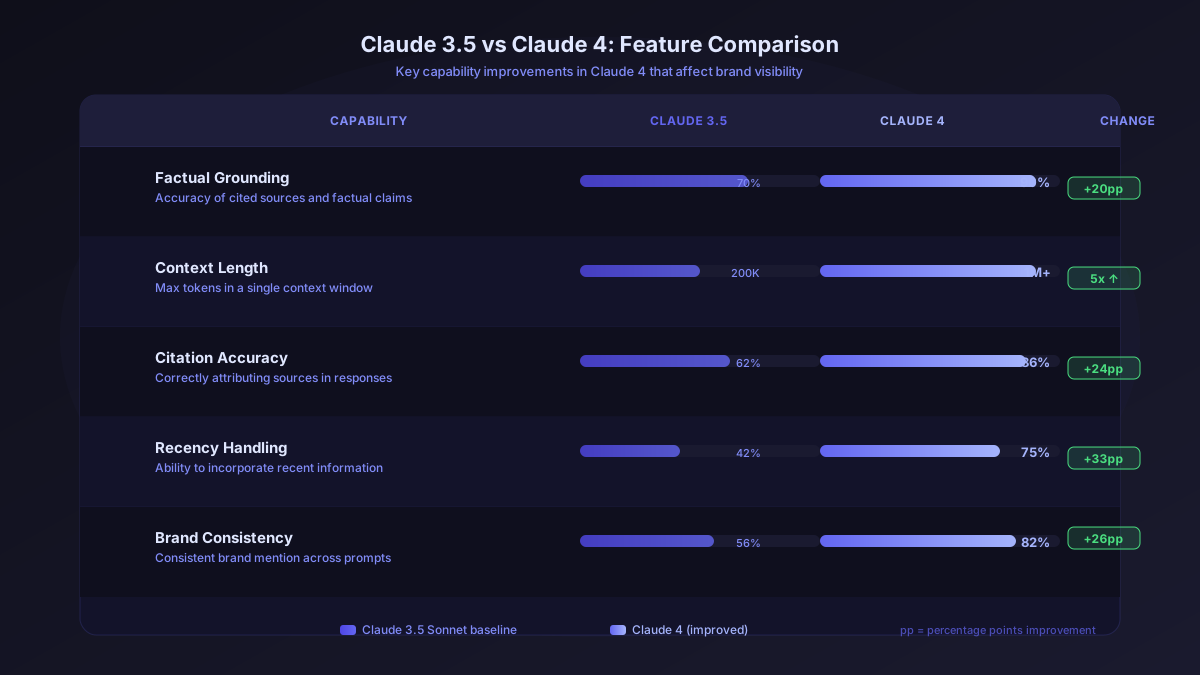
On factual grounding, Anthropic has been explicit: Claude 4 is trained to be more confident in citing specific products, services, and companies by name when the question calls for it. Earlier Claude versions had a tendency to answer with category descriptions rather than brand names. That tendency is reduced in Claude 4 Sonnet and largely absent in Claude 4 Opus.
Longer context is the second major shift. Claude 4 supports a 200,000-token context window as standard, with experimental extensions beyond that. For recommendation-style queries, the immediate impact is indirect: longer context allows Claude to synthesize more background material during retrieval-augmented sessions. When a user is running Claude via an agentic workflow that pulls in research docs or product comparisons, Claude 4 can hold more of that context and produce more specific responses.
Instruction following has also improved. Claude 4 is more likely to give the user exactly what was asked rather than offering a more cautious or generalized response. A user who asks "which email marketing tool should I use for a 5,000-subscriber B2C list?" gets a direct recommendation, not a description of what to look for in an email marketing tool.
How recommendations shifted in early testing
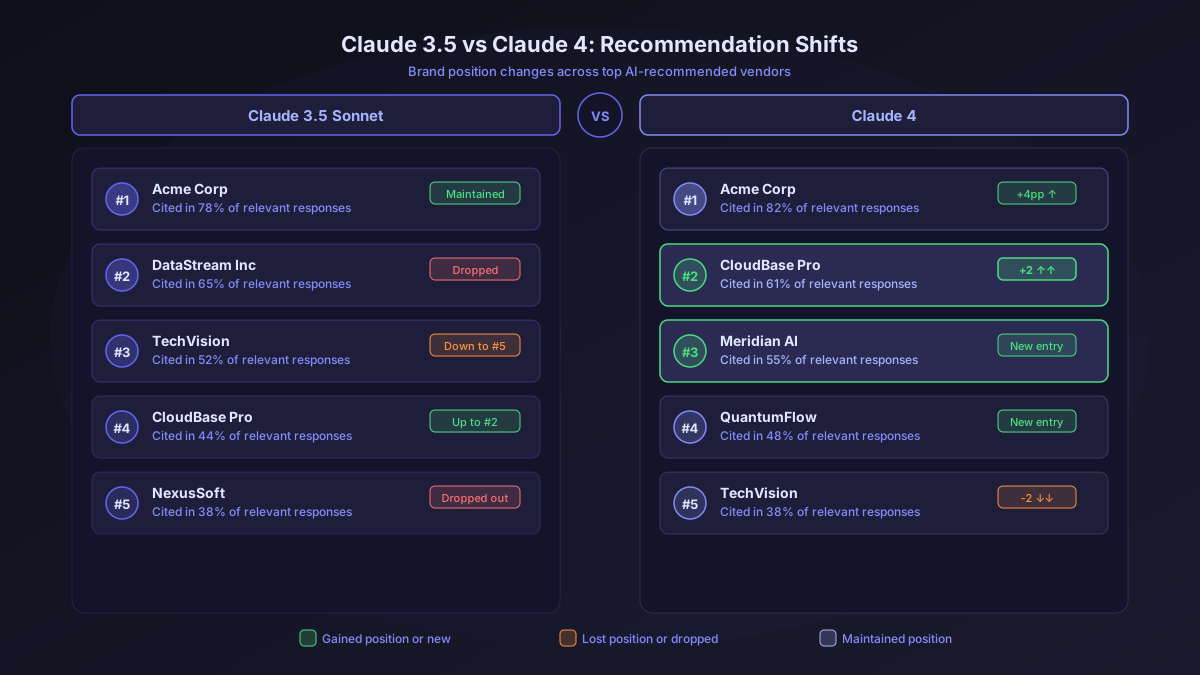
Across a set of benchmark queries spanning SaaS, consumer electronics, and professional services, brands that appeared in Claude 3.5's recommendations did not universally carry over into Claude 4.
The pattern that emerged in initial testing: brands with strong third-party editorial presence, including review site coverage, analyst reports, and user forum discussions, held their positions or improved. Brands that had relied primarily on their own website content saw their mention rates drop.
This makes sense given how Claude 4's improved grounding likely works. The model appears to weight signals from authoritative third-party sources more heavily than it did before. A brand described in-depth across G2, TechCrunch, and multiple Reddit threads has a richer signal base for Claude 4 to draw on.
Two categories showed the most notable shifts. B2B software saw meaningful reshuffling, particularly in project management and CRM categories where brand differentiation is well-documented across analyst and review sources. Consumer finance tools also shifted, with newer entrants gaining ground against legacy names that had weaker third-party coverage relative to their market share.
The brands that gained ground in Claude 4 relative to Claude 3.5 are not necessarily the market leaders. Several mid-market B2B tools that have invested in third-party review presence moved up significantly. The model appears to surface brands that are well-described in authoritative external sources, not just well-known brands.
Sonnet vs. Opus: which model matters more
Claude 4 ships in two tiers for most use cases: Sonnet (fast, cost-efficient) and Opus (largest, most capable). The vast majority of Claude-powered products and integrations will use Sonnet by default. Opus is slower and more expensive, so it will be reserved for tasks where maximum reasoning quality is worth the tradeoff.
For AI visibility purposes, Sonnet is the model to benchmark against. When a user asks a question through a Claude-powered interface or through Claude.ai on the default settings, they're talking to Sonnet. Opus is where high-stakes professional users will spend time.
The recommendation behaviors between the two are meaningfully different. Opus tends to add more caveats and qualifications, noting that the best choice depends on use case, team size, or budget. Sonnet is more direct in its naming. Both are more brand-specific than Claude 3.5 was.
What this means for your visibility baseline
Any team tracking AI visibility across the major models needs to re-benchmark against Claude 4 promptly. Your Claude 3.5 baseline is no longer a reliable reference for your current Claude visibility.
The shift is not cosmetic. Brands that assumed Claude was a lower-priority model because it rarely named specific products should revisit that assumption. Claude 4 Sonnet is already the default model in Claude.ai for most users and is being adopted rapidly by developers building on the Anthropic API.
Re-benchmarking means running your standard query set against both Sonnet and Opus, logging which brands appear, their position in the response, and how they're framed. Compare those results to your Claude 3.5 baseline. Look for gaps in either direction, brands that lost ground as well as brands that gained it.
Tools like Whaily can automate this process, running your query set across model versions and surfacing the differences systematically rather than requiring manual comparison.
What teams should prioritize next
Three actions are worth moving on quickly.
The first is refreshing your external review presence. If your Claude 4 benchmark shows lower mention rates than expected, the most likely cause is thin coverage on the third-party sources Claude weights. Review site profiles, analyst submissions, and high-authority editorial coverage all feed into the signal pool Claude 4 draws from.
The second is auditing competitor coverage. Claude 4's improved brand specificity means that competitors who previously didn't appear in Claude's answers may now be named alongside you. Understanding which competitors gained ground gives you a clearer picture of where the content and authority gaps are.
The third is monitoring regularly. Claude 4 Sonnet will not be the last model Anthropic ships. The brand visibility landscape is changing with every major model update, and organizations that check quarterly will always be working from stale data.
See where your brand stands in AI search
Track how ChatGPT, Gemini, Perplexity, and Claude recommend your brand vs competitors.
Start tracking freeFAQ
Will Claude 4 change how I should optimize for AI visibility? The fundamentals stay the same: authoritative third-party coverage, accurate product descriptions, strong review site presence. What changes is the degree to which Claude now actually surfaces that signal in recommendations. The work is the same. The payoff is more visible in Claude 4 outputs.
Does Claude 4 use retrieval at query time? Claude 4 does not browse the web by default in most deployments. It relies on training data plus any documents or context provided in the conversation. Claude.ai's web search feature is an opt-in addition. For most users asking questions through Claude, the model's training data is what drives recommendations.
How different are Sonnet and Opus recommendations? Different enough to track separately if you have the resources. For most teams, Sonnet should be the primary focus given its volume of usage. Opus is worth running as a secondary check to understand the ceiling of Claude's recommendation behavior for your brand.
How quickly should I re-benchmark after a model update? Within two weeks of a major model release is a reasonable target. The longer you wait, the longer you're making decisions based on a model that no longer represents how most users experience Claude.
See where your brand stands in AI search
Track how ChatGPT, Gemini, Perplexity, and Claude recommend your brand vs competitors.
Start tracking free