
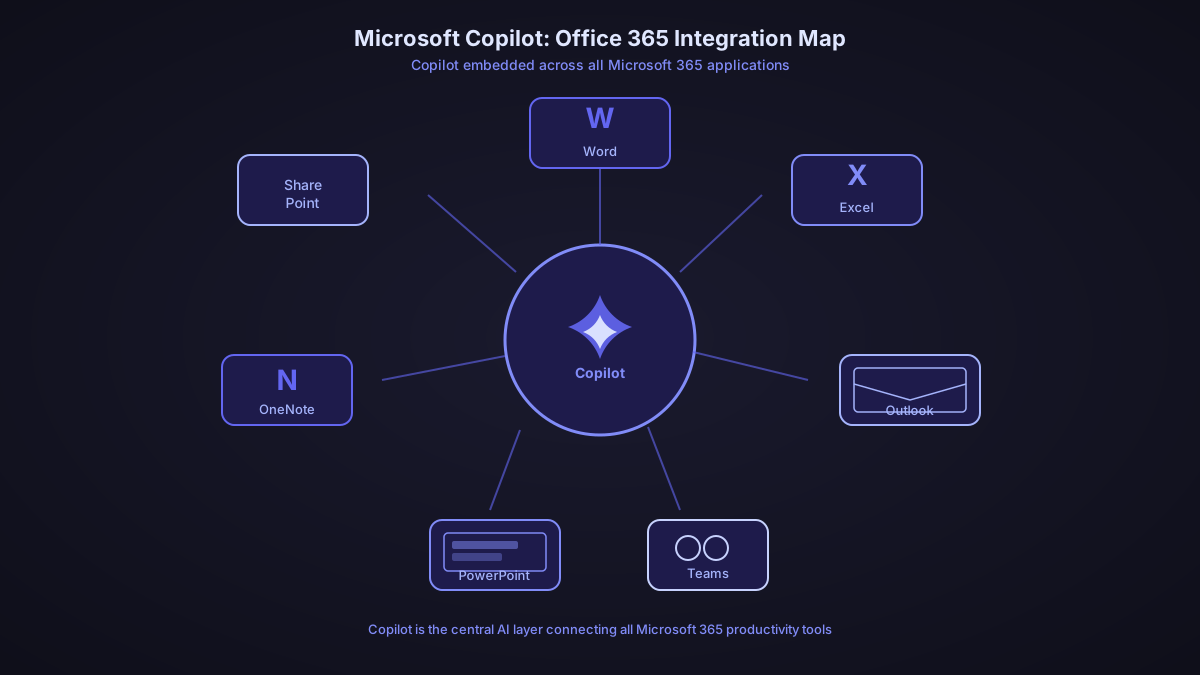
Microsoft quietly changed the economics of Copilot this week. The AI assistant, previously a paid add-on reserved for enterprise customers willing to pay $30 per user per month, is now available across every Office 365 subscription tier. That includes the plans used by small businesses, non-profits, schools, and the enormous mid-market segment that Microsoft has served for decades. The installed base for Office 365 sits above 400 million commercial seats. Copilot just became their default AI assistant.
For most product categories, this is not a trivial distribution event.
What Copilot actually does in a business context
Copilot lives inside Word, Excel, PowerPoint, Outlook, and Teams. Its core use cases are document drafting, summarization, meeting transcription, and data analysis. These are genuinely useful features. But there's a subtler behavior that matters to brand marketers: Copilot answers questions.
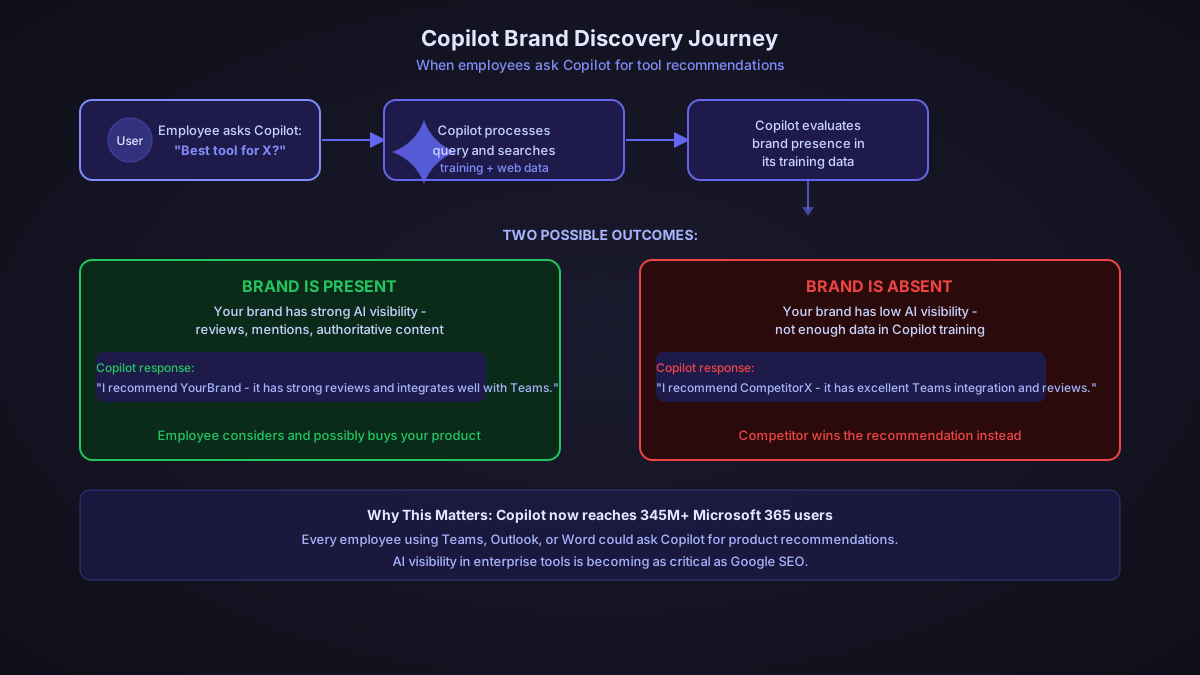
A procurement manager writing a vendor comparison document can ask Copilot, right inside Word, "what are the leading enterprise contract management platforms?" They get a confident answer naming specific vendors. A finance director building a slide deck on fintech integrations can ask about payment providers in the same flow. An HR business partner drafting a job description can ask which ATS platforms work best with Microsoft 365.
In each case, the question is asked inside a productivity tool the person already has open. There's no browser tab opened, no Google search conducted. Copilot answers using the Bing search index and its underlying model, and the user accepts the answer or refines it without leaving their document.
This is what makes Copilot's expansion significant. It doesn't require a user to consciously switch to an AI search tool. The AI assistant is already there, inside the workflow.
The Bing connection
Copilot draws on Microsoft's Bing search index for real-time information retrieval. This means your brand's current web presence, recent press coverage, and content indexed by Bing all influence what Copilot says about you.
Unlike closed-model AI systems that rely entirely on training data cut off at a fixed date, Copilot has access to live information. A vendor that received positive coverage in a trade publication last month may benefit from that signal today. A brand that has neglected its web content over the past year may find its Copilot presence deteriorating in real time.
The Bing dependency also means that signals Bing treats as authoritative, structured data, backlinks from credible domains, and recent coverage, carry into Copilot responses. Brands with strong traditional SEO foundations aren't starting from scratch here. But the query intent matters. Copilot users aren't just searching for your company name. They're asking category and comparison questions that your SEO strategy may never have optimized for.
Why this matters for B2B brands specifically
Consumer AI visibility is important. B2B AI visibility is arguably more concentrated and therefore more consequential.
Business software purchasing cycles involve multiple people consulting multiple sources across weeks or months. When a procurement team is evaluating project management software, they might ask Copilot five or six questions across different stages of the process. Each answer shapes the shortlist. A brand that appears consistently in those answers builds familiarity and credibility across the buying committee without any direct marketing touch.
The inverse is equally true. A brand that's absent from Copilot answers during a buying cycle may never make it to a formal evaluation, even if its product is a strong fit.
Copilot's expansion to all Office 365 tiers means this isn't a dynamic limited to enterprise procurement teams with premium subscriptions. Small business owners, agency founders, and mid-market operations managers all have the same AI assistant in their workflow now. For B2B brands that sell across company sizes, this is a broad new discovery surface.
What existing vendor relationships don't protect you from
Some B2B marketing teams operate under the assumption that established vendor relationships insulate them from AI-driven discovery. Their existing customer base knows them, contracts renew, and relationships maintain themselves. This assumption deserves scrutiny.
Renewal isn't guaranteed when a customer's procurement team is building a new comparison doc and asks Copilot for alternatives. Expansion into new departments within an existing customer often starts with someone who doesn't know the incumbent vendor. New buying committee members who joined the company after the original purchase have no pre-existing relationship with your brand.
In each of these scenarios, Copilot answers shape what alternatives get considered. Incumbent status doesn't mean AI visibility comes automatically.
Practical steps for brands
The first thing to establish is a baseline. Identify the buying-intent questions your customers actually ask when evaluating tools in your category. Run those queries through Copilot, ChatGPT, Gemini, and Perplexity. Map where your brand appears and where it doesn't. This is your starting point.
From there, the optimization levers are the same ones that inform AI visibility more broadly. Content that directly answers comparison and category questions. Presence on the third-party sources that AI models treat as authoritative, analyst reports, review platforms, trade publication coverage, community forums. Structured data that helps Bing understand your product's positioning accurately.
The Bing dependency does offer one concrete tactical angle. Brands that have underinvested in Bing-indexed content may find relatively quick gains by ensuring their core product pages are properly indexed, their schema markup is complete, and their press coverage is surfaced on domains that Bing crawls frequently.
Whaily tracks Copilot alongside ChatGPT, Gemini, Perplexity, and Claude, which makes it possible to see how your brand's presence compares across the surfaces your buyers actually use.
FAQ
Does this affect Copilot for Microsoft 365 and Copilot for the web the same way? Both surfaces draw on Bing's index and Microsoft's underlying models, so the brand visibility dynamics are similar. The context differs. Copilot inside Office applications is embedded in active work tasks. Copilot on the web is more similar to a standalone AI search tool.
Should B2B brands prioritize Bing SEO now that Copilot is widely distributed? Bing SEO has always shared most of its signals with Google SEO, and brands with strong Google presence typically index well on Bing. The more important shift is optimizing for buying-intent queries rather than purely branded or informational queries.
How quickly can a brand improve its Copilot visibility? Because Copilot uses live retrieval from Bing, new content and coverage can influence results faster than models relying solely on training data. Meaningful improvement typically takes weeks to a few months depending on how much content work is involved and how quickly Bing re-indexes it.
Is there a way to tell if a buyer found you through Copilot? Not directly. Copilot doesn't pass referral data the way a web browser does. Attribution for AI-driven discovery remains a gap across all AI surfaces, not just Copilot. The practical workaround is to track AI visibility as a leading indicator and correlate changes with downstream demand metrics.
See where your brand stands in AI search
Track how ChatGPT, Gemini, Perplexity, and Claude recommend your brand vs competitors.
Start tracking free