Most brand teams thinking about AI visibility assume the path is long. Get content into training data, wait for the next model version, hope the retraining captured the right signals. For models that rely purely on their training corpus, that assumption is correct. The feedback loop is measured in months or years, and the process is largely opaque.
Retrieval-augmented generation changes this entirely. For RAG-powered models, a piece of content published today can influence AI responses within days. Understanding how RAG works, and which models use it, is now foundational to any serious AI content strategy.
What retrieval-augmented generation actually is
A standard large language model generates responses from knowledge it absorbed during training. The model was trained on a massive corpus of text, the training ended at a cutoff date, and everything the model "knows" reflects that snapshot of the web. If something changed after the training cutoff, the model may not know about it.
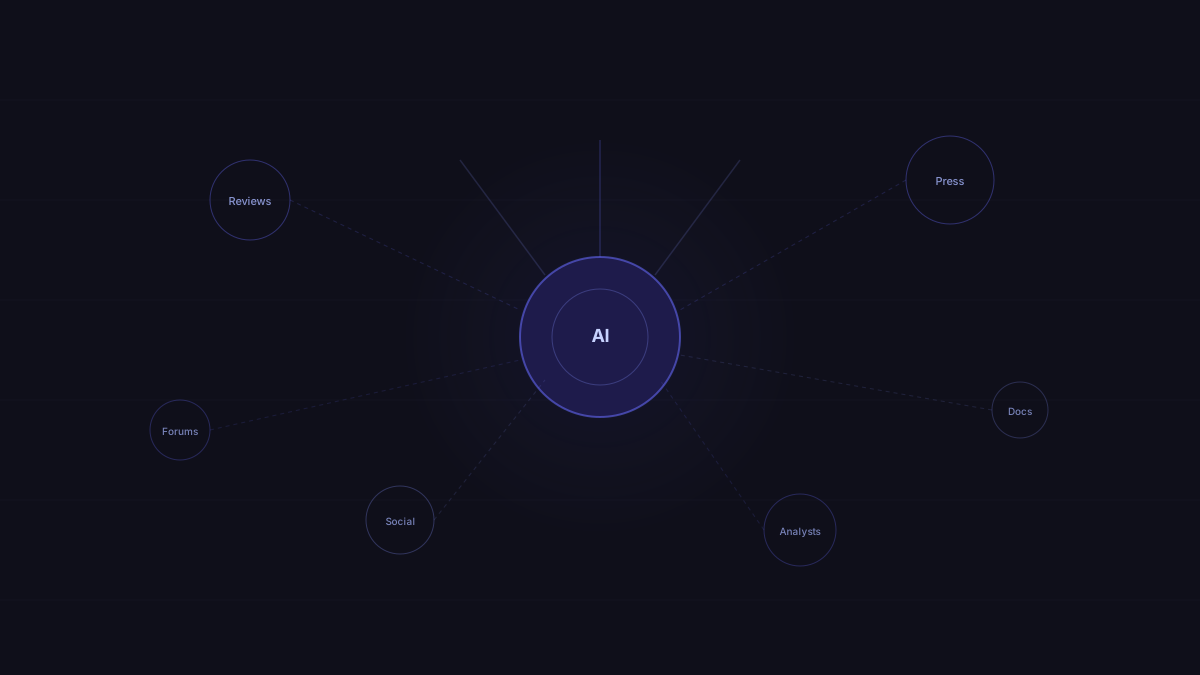
RAG adds a retrieval step before generation. When a user submits a query, the system first searches for relevant documents from a live source, typically a web index. It retrieves a set of candidate documents, passes them to the language model as context, and the model generates an answer informed by both its trained knowledge and the freshly retrieved content. The retrieved documents often appear as citations in the response.
This is a meaningfully different architecture. The model is not drawing solely on what it learned months ago. It is reading documents right now and incorporating them into its answer.
Which models use RAG and how
The RAG landscape across major AI systems is not uniform. Each model implements retrieval differently, and those differences affect how brand content can influence responses.
Perplexity is the clearest RAG-first system. Every query triggers a web search, and the response is built directly from retrieved documents. There is no reliance on stale training knowledge for factual claims. If your content is indexed and matches the query well, it can appear in a Perplexity citation within days of publication. Perplexity's retrieval is also relatively transparent: cited sources appear prominently, making it possible to verify whether your content is being used.
ChatGPT with browsing enabled (the default in ChatGPT Plus) uses RAG selectively. When the model determines a query benefits from fresh information, it retrieves web content before responding. Users can see when this happens because browsing activity is shown in the interface. For evergreen queries where the model's training data is sufficient, browsing may not trigger. This creates a mixed system where some responses draw from live content and others do not.
Gemini uses Google Search as its retrieval layer, giving it access to the same index that powers traditional Google results. This is a structural advantage in terms of breadth and freshness. Content that ranks well in Google search, or that appears in sources Google considers authoritative, has a reasonable path into Gemini responses via retrieval.
Claude, in its standard form, does not use live web retrieval. It operates from training data with a fixed knowledge cutoff. This means traditional training-data strategies apply: the path to influence is longer, and results depend on the model's next training refresh.
Why this matters for brand content strategy
The traditional mental model for AI influence was passive. Publish good content, earn authoritative mentions, build domain authority, and eventually find your way into training data. The process was real but slow, and you had no direct signal on whether it was working.
RAG changes the feedback loop. For retrieval-based models, particularly Perplexity, the path from "we published this page" to "AI responses cite this page" can be measured in days rather than months. This creates a more active relationship between content investment and AI visibility outcomes.
Teams tracking Perplexity citation rates have observed that a well-structured page targeting a specific query can enter Perplexity responses within three to five days of publication, provided it is indexed and matches the query with strong topical relevance. The same dynamic applies to Google AI Overviews via Gemini's integration with the Google index.
For content strategy, this means the prioritization logic changes. Content that targets the specific questions buyers ask AI systems, written in a form that retrieval systems can match and models can excerpt, should rank higher than long-form content optimized for traditional SEO signals. The content attributes that matter for retrieval are: topical focus, structural clarity, and freshness.
Content attributes that perform in retrieval
Not all content retrieves equally. Understanding what retrieval systems favor helps teams invest in the right content types.
Recency matters more than it once did. Retrieval systems often weight recently published or updated content higher for queries where freshness is relevant. A market overview published last week may outperform one published last year, even if the older piece has more inbound links. For fast-moving topics like AI tool comparisons or software pricing, content that ages without updates becomes a liability.
Structural clarity helps retrieval systems identify relevance. Pages with clear H2 sections, each addressing a discrete topic, are easier for retrieval systems to match to specific query fragments. A well-structured 1,200-word page targeting a specific question often outperforms a sprawling 4,000-word guide that covers many topics loosely.
Specificity outperforms generality. Retrieval systems are matching query language to document language. A page specifically about "evaluating analytics tools for product teams without data engineering resources" will retrieve against that exact query formulation better than a generic "analytics tools comparison" page. Niche, specific pages are not a weakness in RAG environments. They are an asset.
Authority signals still matter, but differently. Domain authority, earned links, and third-party citations help retrieval systems trust that a document is worth including. High-authority pages retrieve more consistently than low-authority ones, all else equal. But a high-authority page with poor structural relevance will often lose to a moderate-authority page that directly addresses the query.
Training data vs. retrieval: the practical difference
For brands choosing where to invest, the distinction between training-data optimization and retrieval optimization is concrete.
Training-data optimization focuses on getting your brand into the web content that future models train on. This means authoritative mentions in publications that major training corpora draw from, Wikipedia presence, analyst report citations, and coverage in sources like academic papers and respected industry media. The work is real and important, but the signal is delayed. You are planting seeds for the next model version, often a year or more away.
Retrieval optimization focuses on content that can be found and used by models right now. This means pages indexed by major search engines, structured for topical relevance, updated regularly, and earning citations from sources that retrieval systems treat as authoritative. The feedback loop is short. The work compounds with each new piece of relevant content.
The right answer is not to choose one over the other. Training-data influence builds long-term brand authority in AI systems. Retrieval optimization delivers faster results and is more directly measurable. Whaily can help you see which queries your brand is being cited for across both retrieval-based and training-data-based AI systems, so you can understand where your investment is landing.
Building a RAG-aware content calendar
Translating this into a content calendar requires a shift in how you choose topics and format pages.
Start with the queries your buyers are submitting to AI systems. These are not always the same as your top organic search terms. Interview customers about how they research purchases. Look at the suggested questions in Perplexity results in your category. Build your topic list from those inputs rather than from keyword volume data alone.
For each topic, write a page that answers the question directly and completely. Do not bury the answer. State it in the first paragraph, then support it with structured evidence in the sections below. This format retrieves well and gives AI models a clean excerpt to cite.
Update pages regularly. A page about "best analytics tools for product teams" that was last updated in 2024 will compete less well in Perplexity results than one updated in January 2026. Even minor updates, adding a new data point, refreshing a comparison table, noting a recent product change, signal freshness to crawlers.
See where your brand stands in AI search
Track how ChatGPT, Gemini, Perplexity, and Claude recommend your brand vs competitors.
Start tracking freeRAG has made the path to AI visibility faster and more actionable for brands willing to invest in it. The fundamentals of good content still apply, but the content attributes that matter, specificity, recency, structure, and direct answers, are different enough from traditional SEO that teams need to consciously reorient toward them.
FAQ
Do all AI systems treat retrieved content the same way?
No. Perplexity is fully retrieval-driven. ChatGPT uses retrieval selectively. Gemini retrieves via Google Search. Claude does not retrieve at all in its standard form. Each system has a different relationship between retrieved content and generated response, which affects how often and how prominently retrieved content appears in the final answer.
Can we tell if Perplexity is using our content in its responses?
Yes, with reasonable confidence. Perplexity shows its sources explicitly. You can run target queries on Perplexity and check whether your domain appears in the citations. Doing this systematically across a set of representative queries gives you a usable signal. Automating this check at scale requires tooling built for AI visibility tracking.
Does RAG affect how we should think about link building?
Indirectly. Links remain an authority signal that retrieval systems use to rank sources. High-authority pages retrieve more consistently. But the nature of the links matters less than in traditional SEO. A cited source in a recent industry report may provide a stronger retrieval authority signal than a large volume of low-quality inbound links.
How do we prioritize between training-data work and retrieval optimization?
If you need results within the next three to six months, retrieval optimization delivers faster measurable impact. If you are building for the long term, particularly for models like Claude that rely entirely on training data, the slower work of authoritative publication and third-party citation building cannot be skipped. Most brands should run both tracks in parallel, allocating more resources to whichever AI systems their buyers currently use most.
See where your brand stands in AI search
Track how ChatGPT, Gemini, Perplexity, and Claude recommend your brand vs competitors.
Start tracking free