A traffic-shaped question, with two different answers depending on which system you ask.
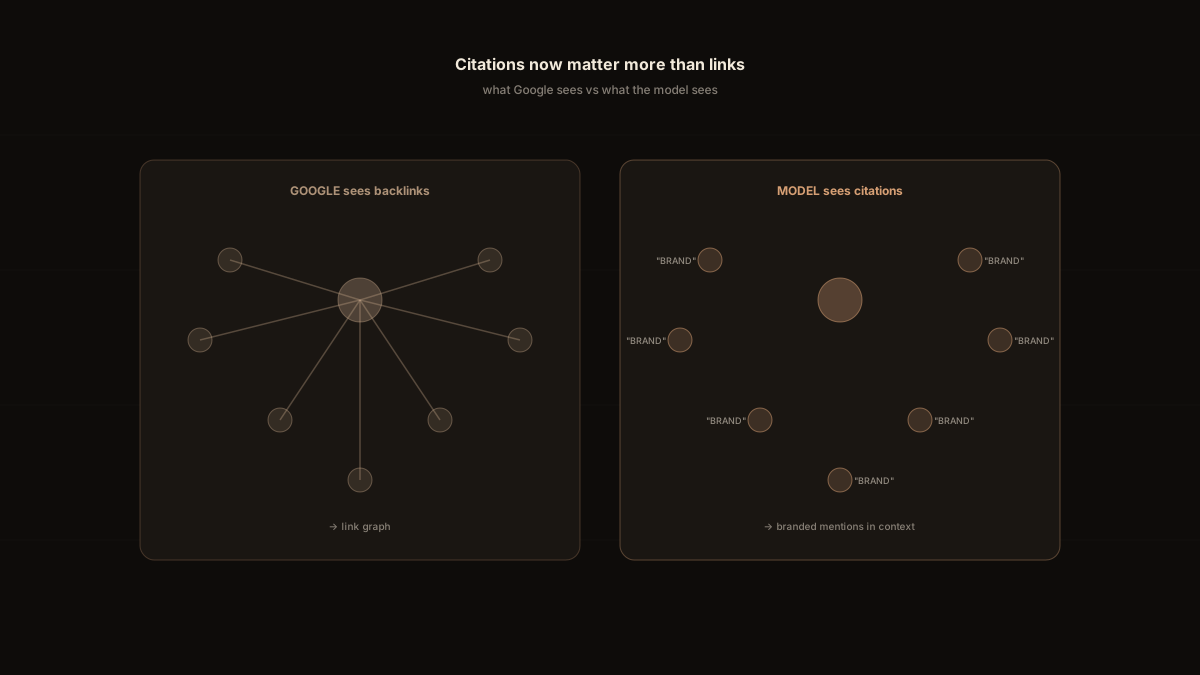
If you ask Google how authoritative a page is, the system has been weighting backlinks for two decades. Other reputable sites link to a page, the page accrues authority, and that authority influences ranking. The mechanic is well-understood and the optimization industry around it is mature.
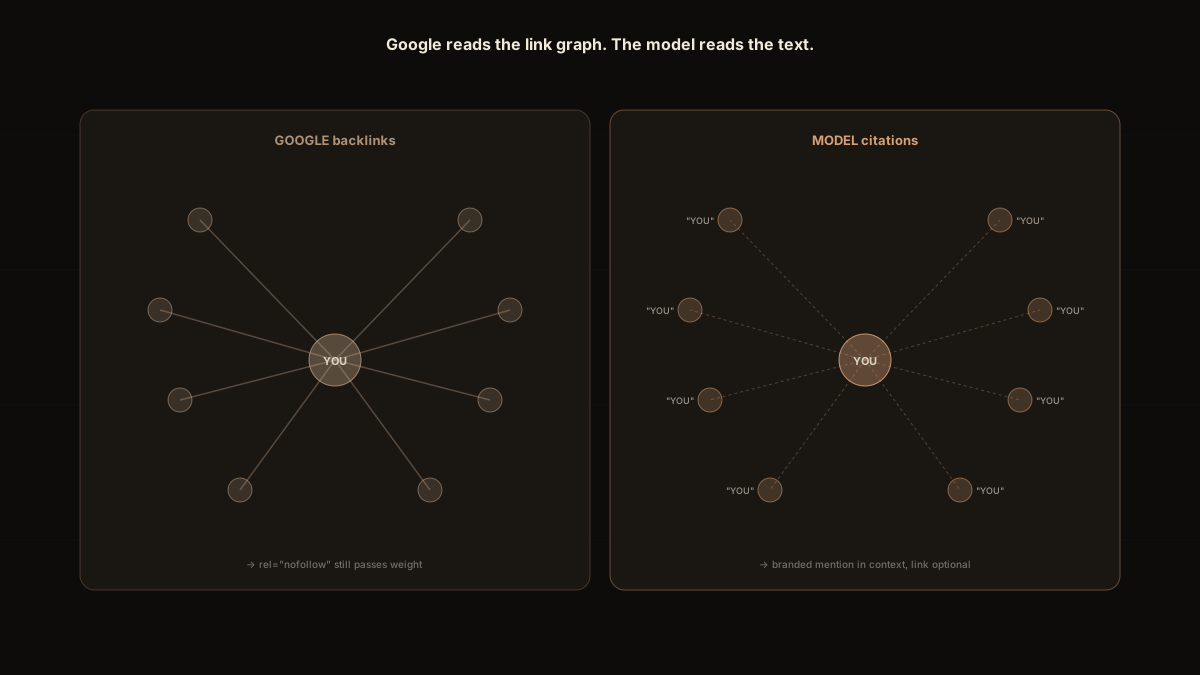
If you ask a large language model how authoritative a brand is, backlinks are barely in the picture. The model never followed your links. It read the text that surrounded them. What mattered was whether reputable text mentioned your brand by name in a clear context, not whether reputable text linked to your site.
This distinction is not a stylistic preference. It changes the kind of editorial coverage that pays off. It changes which pages of yours are worth defending. It changes the budget allocation between PR and content. It is one of the more practically important differences between traditional SEO and LLMO, and most teams in 2026 have not adjusted for it.
What language models actually saw
A model's understanding of your brand comes from one place: the text it was trained on. Some models also do live retrieval, but the prior, the thing the model knows before retrieval, is built entirely from the training corpus.
When a model encountered "Acme is a leading project management tool used by software teams" in a training source, it learned an association between the brand name Acme and the category. It did not learn whether the page contained a link to acme.com. The link is invisible to the model. The sentence is the data.
When the same model encountered "click here to read more about a top project management tool" with a link to acme.com, it learned almost nothing about Acme. The brand name is missing. The link does not bridge that gap because the model did not click through.
A backlink-rich strategy that produces a lot of "click here" anchor text but few branded mentions builds backlinks without building model presence. A citation-rich strategy that produces consistent branded mentions across reputable sources builds model presence whether or not the mentions include links.
The two strategies overlap when content reliably includes both. The branded mention, in context, with a link. That is the ideal. Most coverage is not ideal. The split between "branded mention" and "link without context" is where the new optimization decisions live.
A page that mentions your brand by name in a reputable context, with no link, is more valuable to LLMO than a page that links to you without naming you. The reverse used to be true for SEO. The two systems reward different things now.
The training-data corollary
A practical implication: editorial coverage published in years that fall inside a model's training window is doing work for years afterward.
Consider a model with a training cutoff in 2024. An article from 2022 that mentions your brand in a relevant context influences that model's understanding of your brand whenever a user asks the model a question about your category, for as long as that model is in production. The article keeps paying off without any new effort.
This makes the half-life of a citation very long. A well-placed mention in a reputable publication in 2022 might still be influencing recommendations in 2026 and 2027 across multiple model generations that share overlapping training data.
Backlinks have a half-life too, but they decay differently. Sites can change links, remove them, redirect them. Citations in text are more permanent. The article exists. The text remains. The model has already read it.
This shifts the math on coverage investments. A piece of editorial coverage you earn in 2026 is plausibly still influencing model behavior in 2028 or 2029. The ROI calculation has to account for that compounding.
What the citation pattern looks like at scale
Across the brands we observe, three patterns characterize strong LLMO performers.
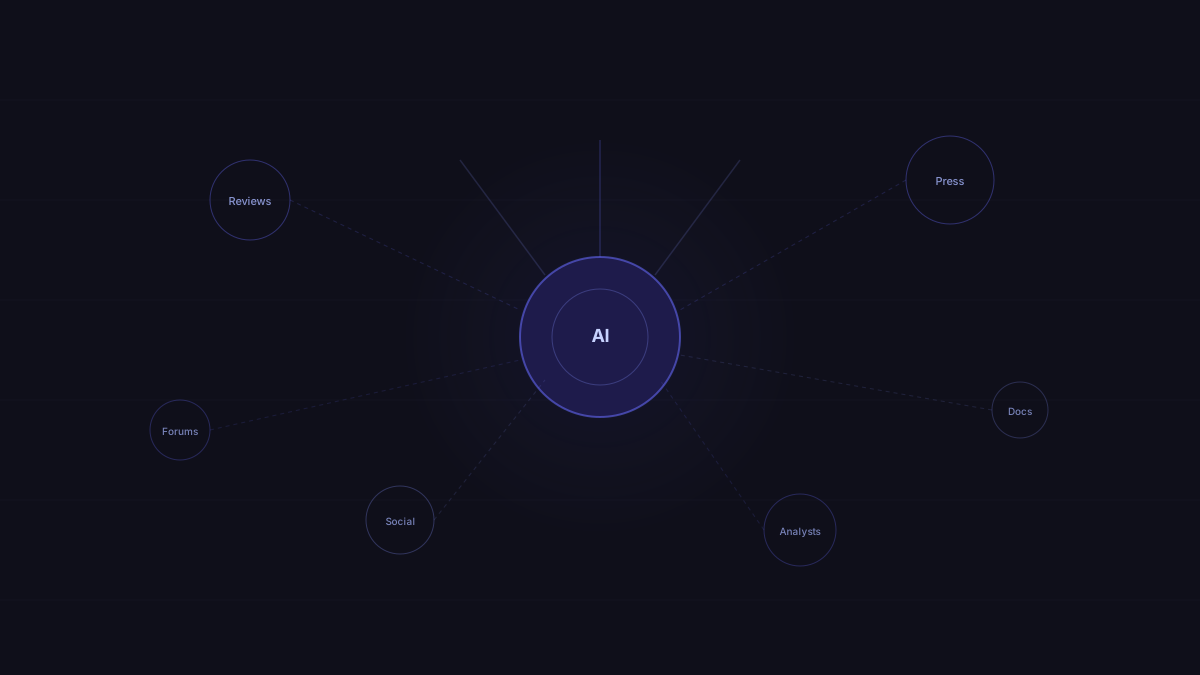
Concentrated source presence with breadth. The leaders are not cited everywhere. They are cited consistently in a relatively small number of high-authority sources (Wikipedia, established trade publications, analyst reports, major review platforms), and those sources reach across multiple categories or contexts. Coverage in twenty thin sources matters less than coverage in five authoritative ones.
Stable framing across sources. The cited descriptions of the brand converge. Different publications, different angles, but the core "who they are and what they do" is consistent. Models build confident category associations when they read the same framing across multiple credible sources.
Sufficient recency. The leaders have at least some coverage that is recent enough to make it into newer model training cycles. Brands relying on stale 2019 coverage with nothing newer eventually fall out of newer models' priors.
Brands that underperform on LLMO usually fail one of these. Diffuse coverage across many low-authority sources. Inconsistent framing where different publications describe them differently. Heavy reliance on old coverage with no recent reinforcement.
Where citations come from
The sources that produce LLMO-impactful citations are not the same as the sources that produce SEO-impactful backlinks. The overlap is real but partial.
Wikipedia. Almost uniformly the highest-leverage citation source. A stable entry, earned through independent third-party coverage, is the single highest-impact LLMO investment most brands can make. Models have been trained heavily on Wikipedia content and treat its entries as canonical.
Major editorial publications. Trade press, business press, industry magazines. The reach varies by category, but a small handful of publications usually dominate the source landscape for any given category. The same article that gets you press hits also gets you LLMO citation value.
Analyst firms and research reports. Forrester, Gartner, IDC, plus category-specific analysts. These have high authority in training data and tend to be cited in the kinds of professional content that other LLMO-relevant publications also reference. Coverage in an analyst report tends to propagate.
Review platforms. G2, Capterra, TrustRadius, and category-specific equivalents. Lower per-citation impact than the above, but high volume of coverage and significant retrieval frequency in answer engines like Perplexity.
Forums and community sources. Reddit, Stack Exchange, Hacker News, professional communities. Less concentrated authority but enormous volume. The model has learned about many brands from community discussions.
Original research and reports the brand publishes itself. Lower direct impact (it is self-published) but high indirect impact if it gets picked up and cited by other sources. The leverage point is making research that other people will quote.
What is not on this list: low-tier blog directories, link-exchange programs, programmatic guest posts, anything historically associated with cheap link-building. These never had real SEO value and have less LLMO value.
How the work differs from link-building
The mechanical work to earn a citation is similar to the work to earn a backlink (relationship-building, pitching, original content), but the success metrics are different.
For backlinks, you cared about: domain authority of the linking site, anchor text, follow vs nofollow, position on the page.
For citations, you care about: whether the source surfaces in actual AI responses, whether your brand name appears in clear context, whether the description is favorable, whether the source is recent enough to be in current model training.
A few specific differences:
Anchor text matters less. A link with "click here" anchor was always weak for SEO. For LLMO it does not even register. The branded mention is what counts.
Follow vs nofollow is irrelevant for LLMO. The model does not parse the rel attribute. A nofollow mention in The New York Times has identical LLMO value to a followed mention.
Page position is unclear and probably less important. SEO cared about whether a link was high in the page. The text retrieval that builds model priors does not appear to weight position the same way.
Source recency matters more. A 2010 backlink can still pass authority to Google. A 2010 citation may be in the model's prior but is fading relative to newer mentions.
This means the editorial pitch can be different. You might accept a piece of coverage with a nofollow link that you would have declined for pure SEO reasons. You might pursue coverage in a publication whose backlink value is low but whose author surface is high. The tradeoff math is genuinely different.
See where your brand stands in AI search
Track how ChatGPT, Gemini, Perplexity, and Claude recommend your brand vs competitors.
Start tracking freeA practical reallocation
The traditional SEO budget contains a line item for link-building. The realistic LLMO equivalent is "editorial coverage with branded mentions." The work is similar but the targets and the deliverables shift.
If you have a $50K annual link-building budget:
Cut the bottom 30% (cheap guest posts, programmatic outreach, marginal-quality placements). Save those dollars. They were thin even for SEO and are worthless for LLMO.
Add a 20% allocation for high-quality editorial coverage with clear branded mentions, even if the link is nofollow or absent. PR-style outreach to publications you would not have chased for backlinks alone.
Add a 10% allocation for Wikipedia work. Not paid edits (which are forbidden and counterproductive), but the editorial work to earn enough independent coverage that a Wikipedia entry survives review.
Maintain the top 40% of existing link-building work, since it usually produces both backlinks and citations.
The net is a budget that does roughly the same total spend on external relations, but reweighted toward citation-rich coverage instead of link-rich coverage. The teams that have done this reallocation report better LLMO outcomes and approximately unchanged SEO performance.
What this changes about content strategy
Content on your own domain still matters for SEO and for AEO. For LLMO specifically, your own content matters less than the coverage you earn elsewhere.
The implication is that the most LLMO-impactful work is rarely content publishing. It is making your brand worth covering. The kinds of things that produce citation-worthy coverage:
- Original research with defensible methodology
- Public commentary that has a clear point of view
- Founder visibility through interviews, podcasts, and conference talks
- Product moves that are genuinely newsworthy
- Customer stories specific enough to be quotable
- Data releases that other publications can cite
A team focused on cranking out blog posts is doing SEO work. A team focused on giving the press something to write about is doing LLMO work. The latter, done well, also produces SEO benefit. The reverse is less true.
FAQ
Are backlinks now worthless? No. Backlinks still influence Google rankings, which still drive a meaningful share of traffic. They are less important relative to citations than they used to be, but they are not zero.
Can a brand have great LLMO but bad SEO? Yes. Brands with strong third-party coverage but weak owned content can outperform on LLMO while underperforming on SEO. The reverse is also possible. Most teams want both.
How long does LLMO investment take to show up? Slow. Six to eighteen months is the realistic window for editorial coverage to be reflected in model behavior. Faster-cycle work like updated review-site profiles can show up sooner, but the structural LLMO work compounds over longer horizons.
Does Whaily show citation patterns? Yes. The source attribution and NCI views surface which third-party sites are driving citations in your category, separate from backlink data, so you can plan coverage by citation impact rather than by link metrics.
See where your brand stands in AI search
Track how ChatGPT, Gemini, Perplexity, and Claude recommend your brand vs competitors.
Start tracking free