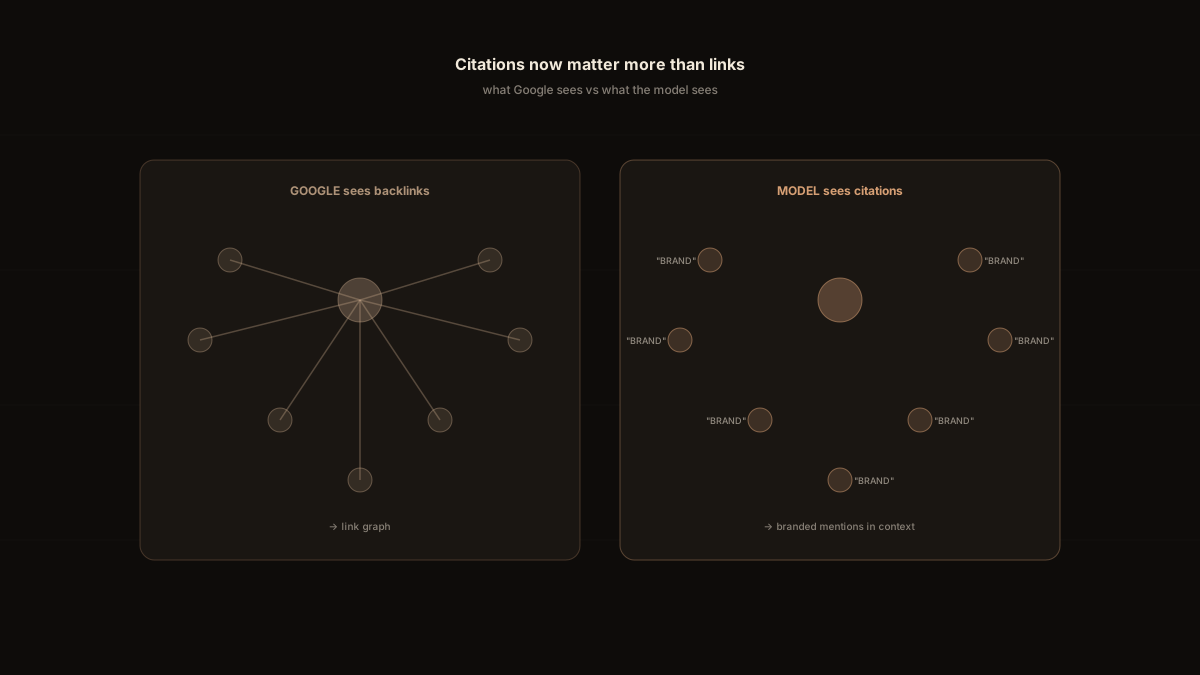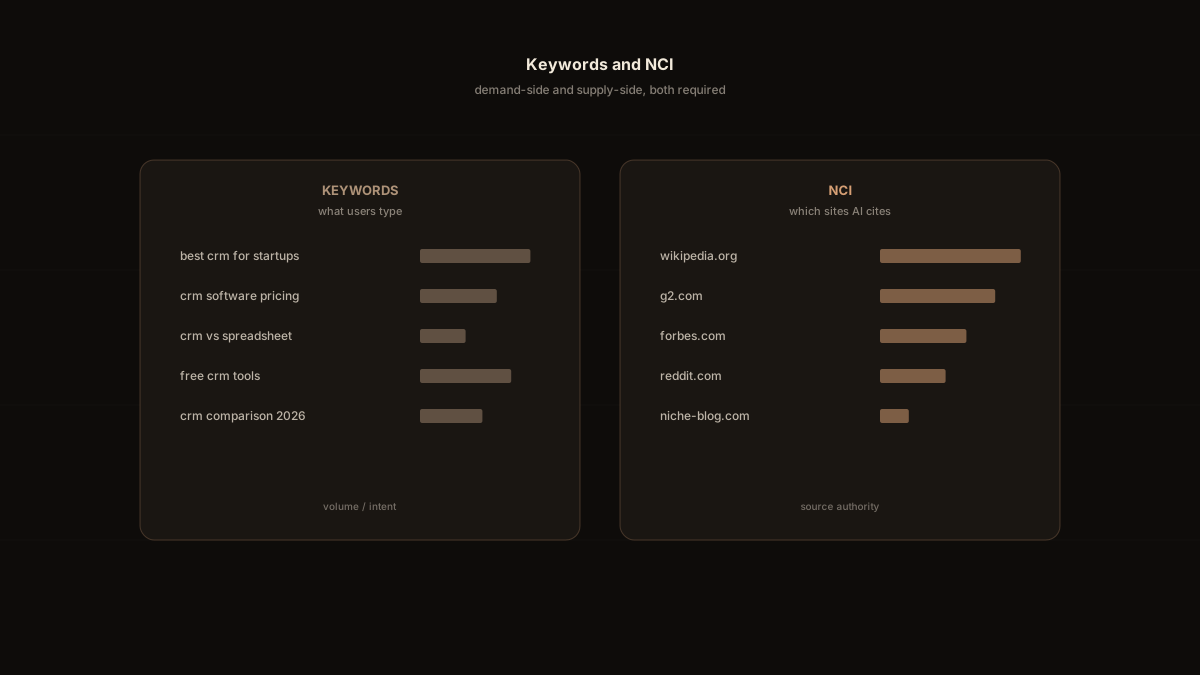
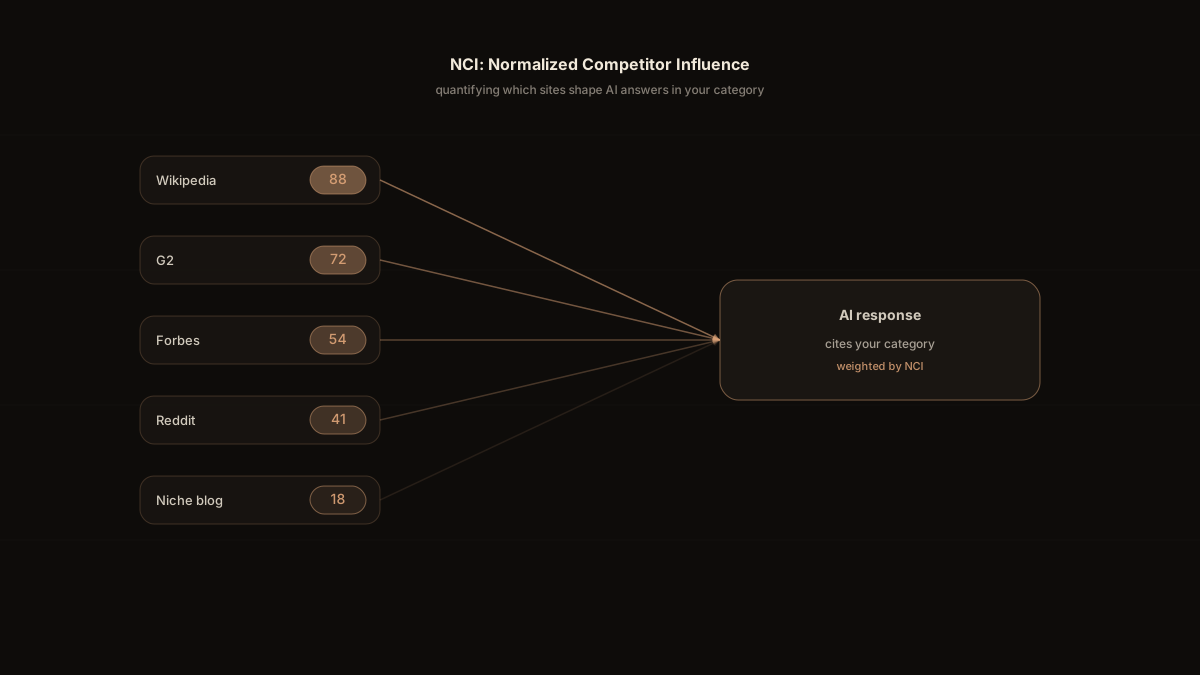
A reasonable question after looking at any AI visibility report: which of the sources cited in these responses actually matter for our category, and which are just noise?
The Normalized Competitor Influence Score, NCI, is Whaily's answer to that question. It is not a measure of content quality, and it is not a measure of AI's opinion of a piece. It is a measure of how much a given third-party site shapes AI responses about your specific category, normalized so the number is comparable across categories of different sizes.
This post explains what NCI measures, what it does not measure, and how the score behaves in practice.
What the score actually represents
NCI is calculated per site, per category. For any given third-party domain that surfaces in AI responses related to your category, NCI quantifies the share of relevant AI responses where that domain influenced the answer, weighted by where and how it appeared.
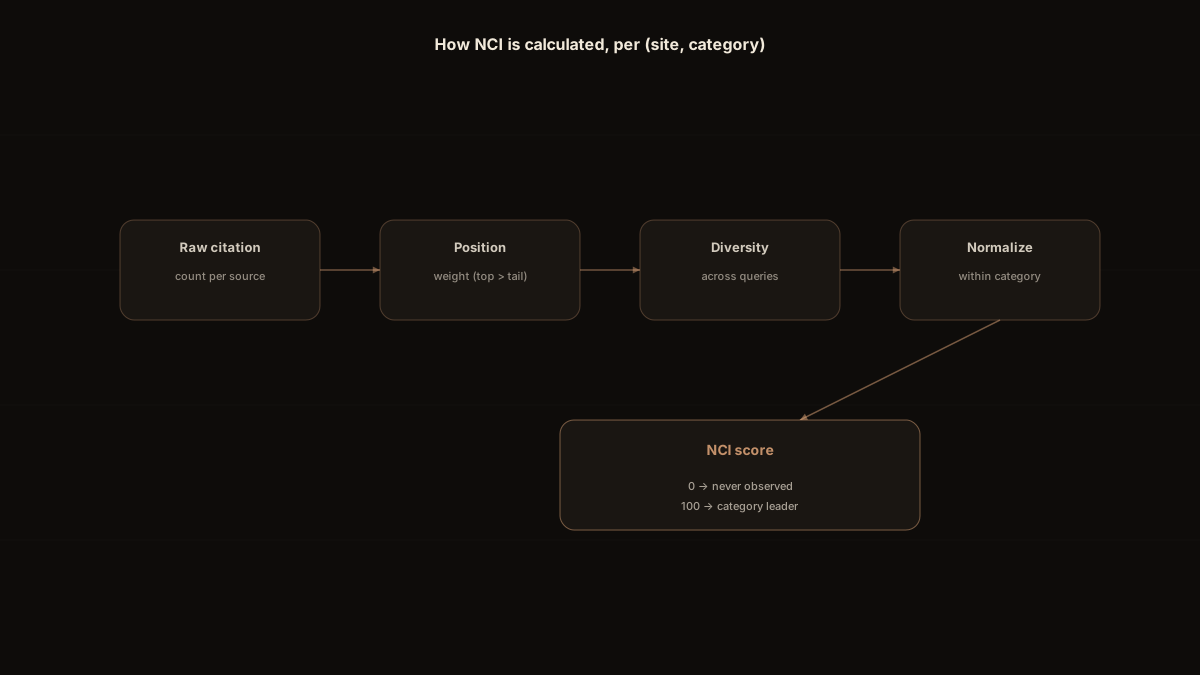
The inputs are:
- The frequency a site appears as a citation across the sampled AI responses for your category
- The position the site occupies in citation lists (top citations weigh more than tail citations)
- The diversity of prompts the site appears across (a site cited in many distinct queries is more influential than one cited in many paraphrasings of the same query)
- The recency and stability of the appearances (a site that consistently appears across runs is more influential than one with a single lucky citation)
The output is normalized between 0 and 100 so a domain's NCI in the CRM category is directly comparable to a domain's NCI in the project management category. Without normalization, large categories with many citations would dwarf small categories with few.
NCI is a score on the site, not on a piece of content. A domain with high NCI in your category is influential in that category as a whole. A specific URL on that domain may or may not be the citation source for any given response.
What NCI is not
Three things NCI is deliberately not:
It is not a measure of AI's preference. NCI does not say "AI thinks this content is high quality." It says "this domain has been retrieved or referenced enough times in this category that ignoring it would understate the source landscape."
It is not a search engine rank. A site can rank #1 on Google for your category's queries and have a low NCI because AI engines do not retrieve it. The reverse is also true.
It is not a single number per category. NCI is calculated per (site, category) pair. The same domain can have a high NCI in one category and a low NCI in another. G2 is influential in software comparison categories and irrelevant in legal-services categories.
How NCI is computed
The formal definition matters because it determines how the score moves.
For each (site, category) pair, NCI starts with a raw influence count: the number of relevant AI responses in the sampling window where the site was cited, with each citation weighted by position. A first-position citation contributes more than a fifth-position citation. The exact weights are calibrated so the position curve matches observed click-through and reference behavior across the major AI engines.
The raw count is then normalized in two ways. First, within the category: a site's count is divided by the total influence count for all sites in the category, giving a share. Second, across categories: the share is rescaled so the top influencer in any category lands at 100, and the rest are scaled proportionally.
The result is a score where 100 means "the most influential source in the category" and 0 means "never observed." A site with NCI 40 is roughly 40% as influential as the category leader, normalized for category size.
Why normalization is the key design choice
The decision to normalize per category is what makes NCI useful across an entire brand portfolio.
Without it, a CRM vendor with five competitive sites in their category would see different absolute numbers from a niche legal tech vendor with twenty competitive sites in theirs. The CRM vendor's "20% share" might be twice as valuable as the legal tech vendor's "20% share" in raw terms but the same in strategic terms. Normalizing lets you compare across categories: a 40 in your category and a 40 in another category mean the same proportional thing.
This matters for editorial investment decisions. If you operate in three categories, you want to know which category leader is closest to you on the score. A non-normalized number would hide that comparison.
It also matters for trend tracking. As AI engines change retrieval behavior, absolute citation counts swing. Normalized scores are more stable because the swings tend to affect all sites in a category similarly.
How sites move in the score
NCI is calibrated to be slow on the high end and faster on the low end. This is deliberate.
A site with NCI 80 in your category is influential because it has appeared consistently across many prompts over time. A single week of fewer citations does not collapse the score. A site at NCI 10 can move into the 20s with a few well-placed citations because the floor is more sensitive to recent activity.
The slowness at the top reflects what is actually happening in AI retrieval: established authority sites are sticky. The model has learned to rely on them. New sites can earn citation share, but displacing the leaders takes sustained editorial work, not single posts.
This calibration means NCI is most useful for two questions: who are the durable influencers in my category right now, and who is rising. The leaders rarely change month over month. The risers do.
The most actionable view of NCI is not the leaderboard. It is the change over time. Sites whose NCI rose 5+ points in a quarter tell you where the editorial energy in your category is going.
How to use the score
Three operational uses, ordered by how often teams actually act on them.
The first is third-party investment planning. If a site has high NCI in your category and you have no relationship with it, that is a target. Either editorial outreach to be covered, sponsored content if appropriate, or product placement if it is a review site. The score tells you which targets are worth the time.
The second is citation gap analysis. Take the top ten sites by NCI in your category. Compare to the sites that have actually cited your brand. The gap is your editorial backlog.
The third is competitive monitoring. If a competitor is consistently cited in responses where you are not, look at the source set. The competitor is usually being lifted by a small number of high-NCI sites that gave them coverage you have not earned. Knowing which sites those are tells you where the leverage is.
See where your brand stands in AI search
Track how ChatGPT, Gemini, Perplexity, and Claude recommend your brand vs competitors.
Start tracking freeWhat the score does not tell you
A few honest limitations.
NCI does not tell you whether a specific AI response was good or bad for your brand. It only tells you about the source landscape. A response can pull from low-NCI sources and still surface your brand favorably, and vice versa.
NCI does not predict ranking on Google. The correlation is real because high-authority sites tend to do well in both ecosystems, but they are not the same measure. Do not use NCI as a substitute for traditional SEO authority.
NCI does not assign causation to specific content pieces. A site has high NCI because of its cumulative content, not because of any particular post. Influencing it usually means investing in the editorial relationship over time, not optimizing one URL.
How NCI fits with other Whaily metrics
NCI is one of three layers Whaily tracks per category.
Brand visibility measures whether your brand is appearing in AI responses, by engine, by query, over time. NCI explains the source side of why.
Competitor visibility measures the same for competitors in your defined set, with the same source attribution. NCI lets you see whether a competitor's visibility is being driven by sites you have access to or sites you do not.
Purchase criteria mapping measures how AI engines describe the attributes of brands in your category. NCI tells you which sources are most likely to be shaping those descriptions.
Used together, the three layers give you a working answer to: am I visible, am I winning, and where is the influence actually coming from.
FAQ
Is NCI a single industry-standard term? No. NCI is Whaily's specific implementation of source-influence scoring. Other vendors may use similar terms with different methodology. The name matters less than understanding what is being measured.
How often does NCI update? Whaily recalculates NCI scores on a rolling window. The defaults are calibrated so a meaningful shift in citation behavior shows up within a week. Larger sampling windows produce more stable scores; shorter windows are more reactive.
Can I influence my own NCI? Your own domain's NCI in your category is a function of how often AI engines cite you. The way to move it is to publish content that AI engines retrieve and rely on for your category's queries. The work overlaps heavily with AEO.
What if a high-NCI site stops being cited? The score declines, but slowly. Established sources are sticky in AI retrieval, and the calibration reflects that. A site has to consistently lose citation share for several weeks before its NCI moves significantly.
See where your brand stands in AI search
Track how ChatGPT, Gemini, Perplexity, and Claude recommend your brand vs competitors.
Start tracking free