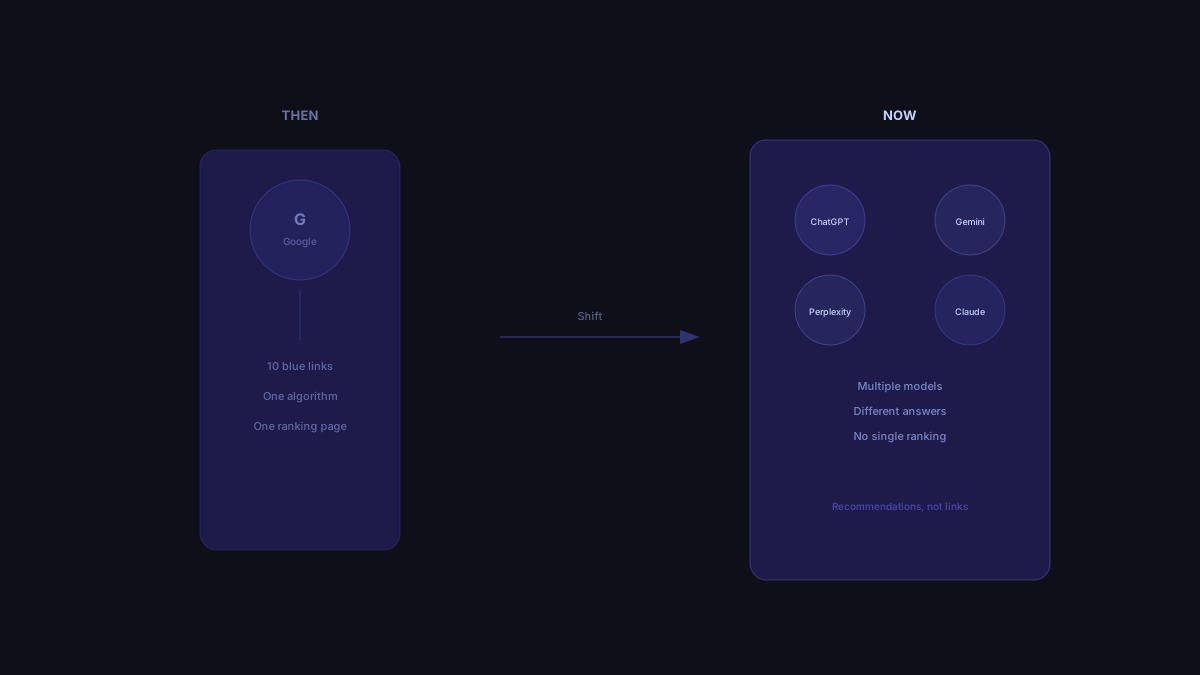

Marketing teams are adding a new acronym to their vocabulary. AEO, short for AI Engine Optimization, describes the practice of shaping how AI-powered search and recommendation systems understand and present your brand. It sits alongside SEO in the modern marketing toolkit, but it operates on different signals, different timescales, and different mechanics.
This article explains what AEO is, how it relates to existing search optimization work, and what the practical levers are for marketing teams getting started.
What AEO actually is
AEO is the discipline of optimizing a brand's presence in the outputs of AI models. Specifically, it focuses on the moments when someone asks an AI system a question and the system responds with a recommendation, comparison, or summary that either includes or excludes your brand.
The target isn't a ranking position. It's inclusion and framing. When a potential buyer asks ChatGPT "what's the best accounting software for a growing startup," you want your brand to appear in the answer. You want it framed accurately, for the right use cases, and ideally positioned ahead of direct competitors.
AI models don't operate a public ranking system. There's no bid mechanism, no keyword density formula, no list of 200 signals to check off. Influencing AI outputs requires a different approach: building the kind of presence across authoritative sources that shapes what models understand about your brand when they form a response.
How AEO differs from SEO
SEO and AEO share a foundation. Both care about content quality, authority signals, and a coherent brand narrative online. A brand that has invested seriously in SEO for years is better positioned for AEO than one starting from scratch. But the similarities end at that foundation.
SEO optimizes for a ranking algorithm. Its inputs are relatively well-documented: backlink quality, page speed, structured data, keyword targeting, and so on. Performance is measurable through Search Console data, rank tracking tools, and click-through rates. The feedback loop, while not instant, is traceable.
AEO optimizes for model comprehension. AI models aren't ranking pages in a list. They're forming a synthesized opinion about your brand based on everything they've seen during training (and, for retrieval-augmented models, what they can find right now). Measuring performance requires systematically querying models with the kinds of questions buyers ask, then tracking how your brand appears in the responses.

Another key difference is the nature of the output. SEO success means your link appears on a results page. The user sees multiple results and makes a choice. AEO success means your brand is named in a confident AI response. Many users accept that recommendation without further comparison. The bar for appearing is higher, but the conversion dynamics when you do appear are different.
The three primary levers
Three areas of work drive AEO outcomes. They're not entirely new concepts, but the way they apply to AI search differs from how most marketing teams currently think about them.
Content authority
AI models learn from the content that exists on the internet. If your brand is discussed extensively in high-quality editorial sources, trade publications, independent reviews, and authoritative comparison articles, that signal accumulates in the model's understanding of your category. This is why brands with a 10-year editorial track record often appear more reliably in AI responses than newer competitors with stronger recent SEO performance.
The practical implication: invest in content that earns placement in sources the model considers authoritative. Being covered in an industry publication that's indexed by the model's training data is more valuable than producing more first-party blog content. Analyst reports, trade press, and editorial roundups matter.
Third-party signals
Review platforms are a particularly strong signal. G2, Capterra, Trustpilot, and Trustradius are sources AI models treat as authoritative aggregations of real user opinion. A brand with hundreds of detailed, recent reviews on G2 is better understood by AI models than a brand with a strong website and no third-party review presence.
The same logic applies to forums. Reddit, industry-specific Slack communities, Hacker News, and product-focused subreddits are data sources that AI models draw on heavily. Authentic positive discussions in those communities about your product contribute to the model's understanding of where your brand fits.
Third-party signals don't just influence retrieval-augmented models that search the web at query time. Review platforms and forum content are prominent in training data for closed models too. The work of building third-party presence compounds over time, and it's harder to fake than first-party content.
Structured data and technical signals
Structured data doesn't directly teach AI models anything new. But it makes content more parseable, both for web crawlers and for retrieval systems that pull context at query time. Schema markup for products, organizations, and reviews helps AI systems correctly attribute information about your brand.
Technical SEO hygiene also contributes: canonical URLs, clean crawl paths, fast page loads, and accurate metadata all ensure that when an AI system retrieves content about your brand, it retrieves the right content. Broken crawl paths and duplicate content create noise that degrades how AI systems interpret your brand's signals.

What AEO work looks like in practice
For a marketing team starting with AEO, the first priority is measurement. You need a baseline. Which AI models mention your brand when asked category-level questions? How often? What do they say? Without that baseline, any optimization work is flying blind.
The second priority is an audit of third-party presence. Check your G2 and Capterra profiles. Are they up to date? Do they reflect your current positioning? Is the review volume high enough and recent enough to signal active use? If not, a review generation campaign is one of the highest-leverage AEO activities available.
The third priority is earned media and editorial presence. Identify the publications and analyst firms that are most likely to appear in AI training data for your category. A placement in one of those publications, or a mention in an analyst shortlist, can shift how models frame your brand more effectively than a hundred internal blog posts.
Whaily can help establish the measurement baseline: running structured queries across ChatGPT, Gemini, Perplexity, and Claude, then tracking brand mention frequency and framing over time.
How to think about the timeline
AEO outcomes operate on a longer timeline than paid search. You can spin up a Google Ads campaign and see results in a week. Building the kind of editorial and third-party presence that shifts AI model outputs takes months, sometimes longer.
That timeline has an important implication. Brands that start AEO work in 2026 are building a compounding asset. The editorial coverage and third-party reviews you accumulate this year will influence AI training data and retrieval results for years. Starting early is a genuine structural advantage.
The flip side: brands that delay are accumulating a gap that gets harder to close. AI model training data skews toward content that's been authoritative for some time, not just content that's good today. The window to establish AI search authority before the market matures is open right now, but it won't stay open indefinitely.
See where your brand stands in AI search
Track how ChatGPT, Gemini, Perplexity, and Claude recommend your brand vs competitors.
Start tracking freeFAQ
Do I need to completely change my SEO strategy to do AEO? No. Strong SEO work, particularly around content quality, backlink authority, and structured data, provides a useful foundation for AEO. The additions are primarily around third-party signal building (reviews, forums, earned media) and systematic AI visibility measurement.
How do I know if my AEO efforts are working? The only reliable way to measure AEO outcomes is to query AI models directly and track how your brand appears. Tracking tools that run structured queries across multiple models on a regular schedule give you the data you need. Rank tracking and Search Console data won't capture AI search presence.
Is AEO relevant for brands outside of software and tech? Yes. AI-assisted search queries span every consumer and B2B category. Retail, financial services, healthcare, professional services, and consumer goods all see AI-assisted discovery. The specific platforms and query patterns vary by category, but the core discipline of optimizing for AI model comprehension applies broadly.
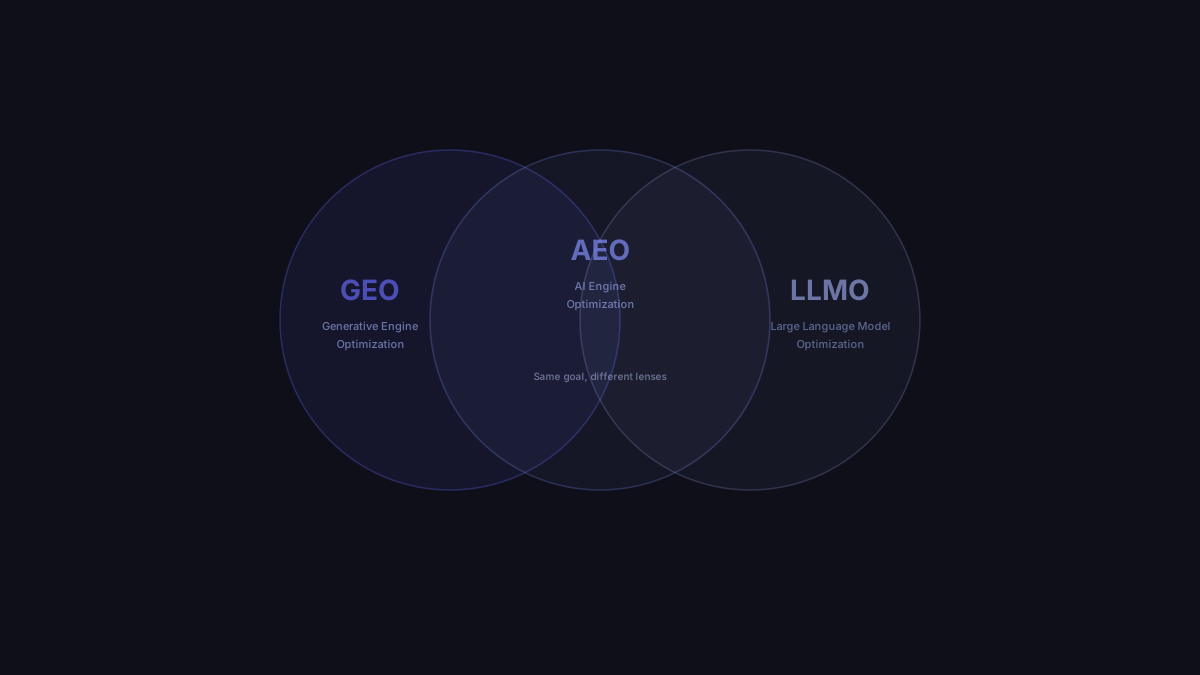
What's the difference between AEO, GEO, and LLMO? These terms are often used interchangeably. GEO (Generative Engine Optimization) and LLMO (Large Language Model Optimization) describe essentially the same practice as AEO. The terminology hasn't fully standardized. AEO is the most commonly used term in marketing contexts, while GEO and LLMO appear more often in technical discussions.
See where your brand stands in AI search
Track how ChatGPT, Gemini, Perplexity, and Claude recommend your brand vs competitors.
Start tracking free