A potential customer types "what's the best project management tool for remote teams?" into ChatGPT. They get a confident, well-structured answer recommending three or four tools by name. Your brand isn't one of them. That buyer never considered you. They didn't get a list of links to browse. They got a recommendation, and they moved on.
This is the problem that AI visibility was coined to describe. If you're running a marketing or growth function in 2026, it's the gap in your measurement stack most likely to cost you pipeline.
What AI visibility actually means
AI visibility measures how consistently and prominently an AI model recommends your brand when users ask questions in your product category.
The distinction matters. This isn't about whether AI models can find your website. It's about whether they surface your brand when someone asks a buying-intent question. "What CRM should I use for a B2B sales team?" "Which email marketing tools are best for e-commerce?" "Is [your brand] a good choice for enterprise data management?" These are the moments AI visibility tracks.
Traditional web analytics don't capture any of this. Google Search Console shows you impressions and clicks on blue links. It tells you nothing about what ChatGPT said to 50,000 people yesterday.
Why this matters right now
The numbers on AI-assisted search are difficult to ignore. ChatGPT crossed 400 million weekly active users in early 2025. Perplexity processes hundreds of millions of queries per month. Gemini is embedded in Google's own search results. Microsoft's Copilot ships inside every Office 365 subscription.
The queries flowing through these tools differ from traditional search in important ways. They're longer, more conversational, and more often explicitly purchase-oriented. Users aren't typing keywords. They're asking for recommendations.
This creates a new category of zero-click discovery. The AI model gives a confident, opinionated answer. Many users act on it without visiting any website. There's no blue link to rank for. There's no featured snippet to optimize. Either the AI decided to include your brand or it didn't.
How AI models decide which brands to mention
AI models don't have a ranking algorithm in the way Google does. There's no public list of signals to optimize against. But the factors that influence AI recommendations are not a complete mystery.
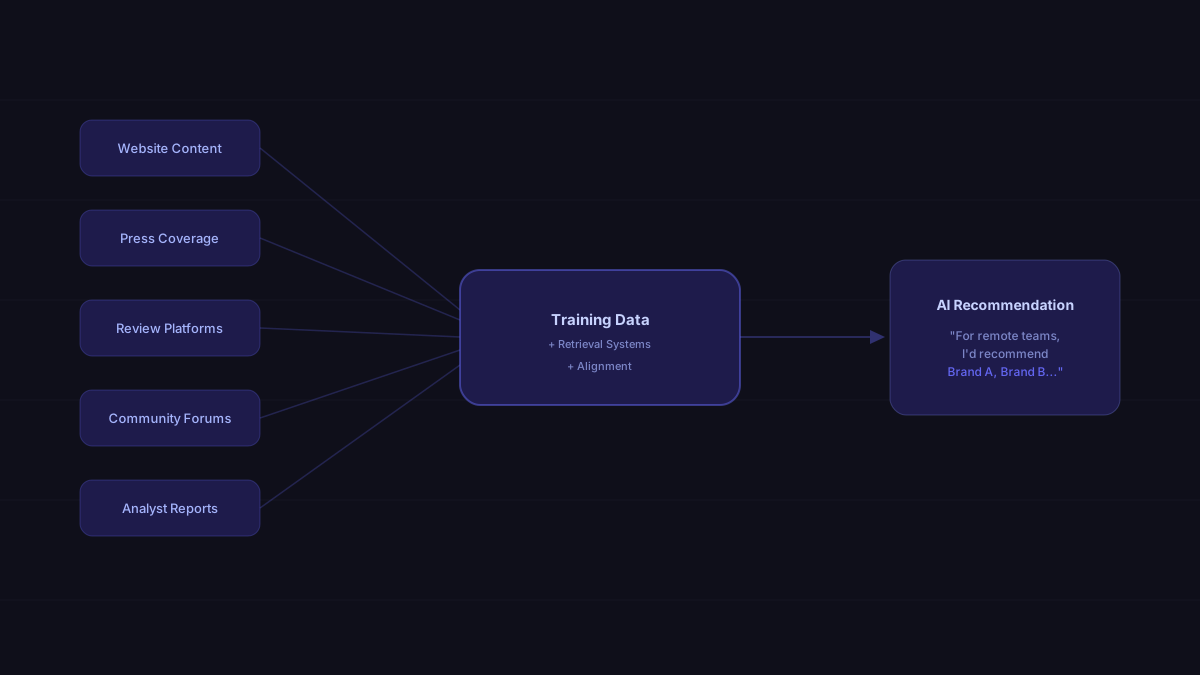
Three primary forces shape what an AI model says when asked about your product category.
Training data
Large language models learn from text that existed on the internet during their training window. If your brand is frequently mentioned in authoritative content, trade publications, user forums, and review sites, that signal gets baked into the model's weights. A brand with strong organic editorial presence has a head start here. The content that mattered three years ago still shapes what models say today.
Retrieval-augmented generation (RAG)
Models that use live web search, like Perplexity, pull fresh content at query time before generating a response. Your current web presence, recent press coverage, and freshly-indexed content all influence these results. This is a different game from closed models that rely on static training data alone.
Third-party authority signals
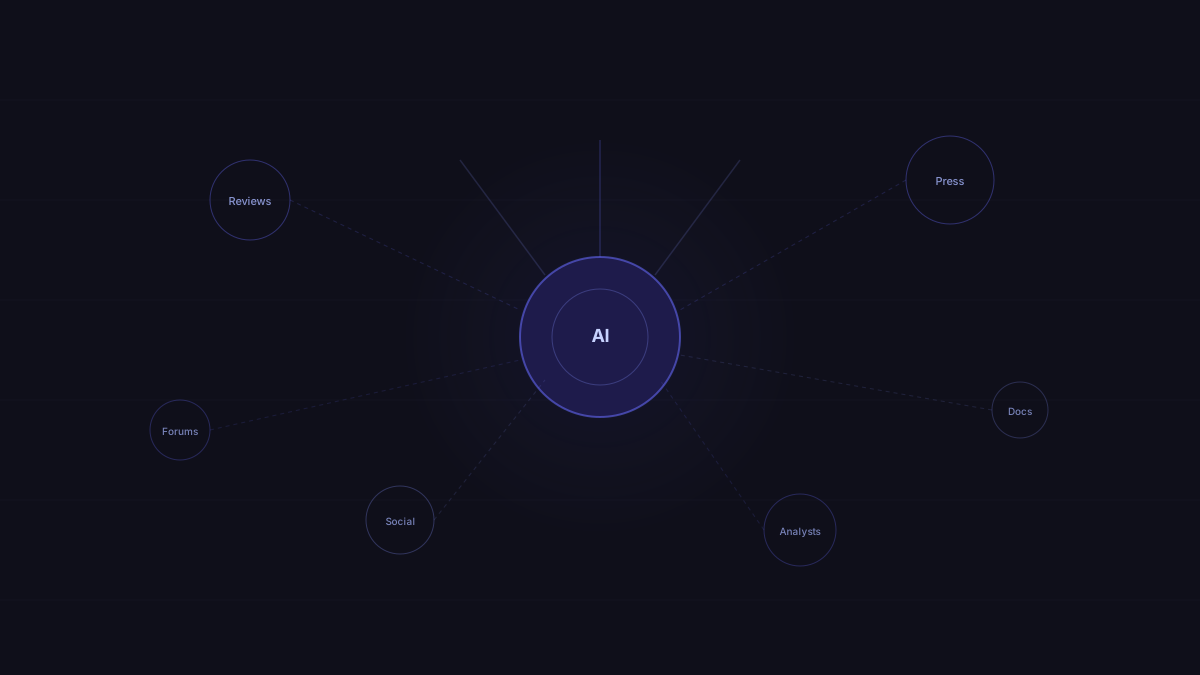
Review platforms like G2, Capterra, and Trustpilot. Industry analyst reports from Gartner or Forrester. Comparison articles on high-authority publications. Reddit threads where real users discuss tools. These sources shape how AI models understand and position your brand, even when they're not directly cited in the output.
The difference between ranking and being recommended
SEO optimizes for ranking. AEO (AI Engine Optimization) optimizes for recommendation. Conflating the two leads to bad strategy.
When you rank in Google, users see your link in a list alongside competitors. They choose whether to click. The comparison happens in the user's head. Rank 1 gets more clicks than rank 3, but every result on the page is at least visible.
When an AI model recommends a brand, it names 2 to 4 options and explains why each fits. The comparison happens inside the model, before the user sees anything. If your brand isn't in those 2 to 4, the user never knew you existed.
Traditional SEO gave you a chance to compete on the results page. AI search happens upstream. You're in the answer, or you're invisible.
There's a trust dynamic worth understanding here too. When a friend recommends a restaurant, you believe them more readily than you trust a banner ad. AI models occupy a strange middle ground. They feel authoritative and personal, more like a consultant's recommendation than a search engine's index. Research consistently shows that users trust AI-generated recommendations at high rates, particularly for product and software decisions.
The multi-model problem
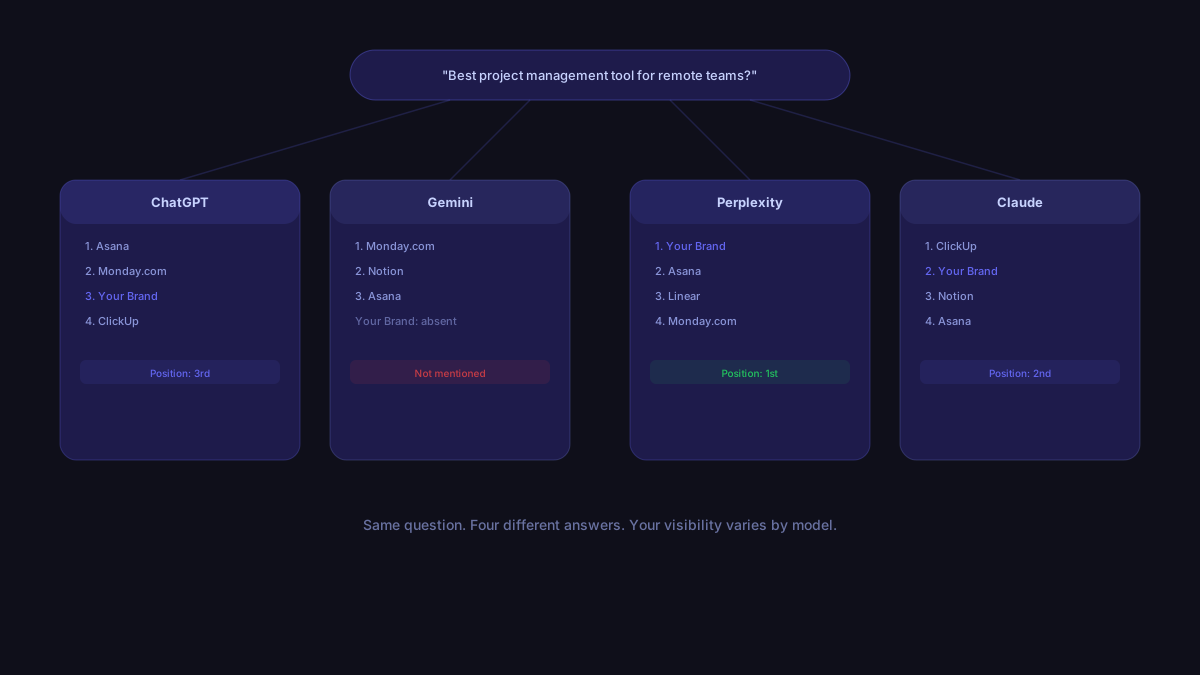
Most brands haven't reckoned with a basic complication: different AI models produce different answers to the same question.
Ask ChatGPT "what's the best HR software for a 200-person company?" and you'll get one list. Ask Gemini the same question and the answer shifts. Perplexity cites recent sources and produces yet another result. Claude may emphasize different criteria entirely.
This isn't a bug. Each model was trained on different data, at different times, with different retrieval systems (or none at all). Your brand might be consistently recommended by one model and absent from another. You might perform well on queries in your home market and poorly in queries from other regions.
Measuring AI visibility requires sampling across multiple models, multiple phrasings of the same question, and multiple locales, then tracking how those results change over time. A single screenshot of one ChatGPT answer tells you almost nothing useful.
Brands that appear in AI search results for their category are often the same brands that dominated Google's "best of" listicle rankings 3 to 5 years ago. AI training data skews toward content that was authoritative when it was written, not content that's authoritative today. This creates a lag effect that newer entrants need to plan around.
How to think about measuring AI visibility
Measuring AI visibility means building a structured picture of how your brand appears across AI systems over time. Five core metrics form the foundation.
Mention rate
This is the most fundamental number. Out of 100 queries about your product category, how many include your brand? This is your baseline visibility score.
Position and framing
Presence alone isn't enough. Is your brand mentioned first, as a primary recommendation? Or fourth, as an afterthought? Is it described accurately? Is it recommended for the right use cases? A brand mentioned in the wrong context can be worse than a brand not mentioned at all.
Model coverage
Are you visible across the AI ecosystem, or dependent on a single engine? Strong presence on Perplexity but absence from ChatGPT is a concentrated risk.
Prompt coverage
Users ask about your category in many different ways. "Best CRM for startups" and "enterprise sales CRM" may produce different results for the same brand. Prompt coverage measures how many of those variations you're capturing.
Trend over time
A single measurement is a snapshot. Tracking month over month is what turns data into actionable intelligence. A brand's AI visibility can shift after a model update, a spike in press coverage, a viral Reddit thread, or a new analyst report.

See where your brand stands in AI search
Track how ChatGPT, Gemini, Perplexity, and Claude recommend your brand vs competitors.
Start tracking freeYour brand is being talked about. The question is what's being said.
AI visibility isn't a trend on the horizon. It's a measurement gap that already exists in your business. Buyers in your market are asking AI models about your category right now. Those models are forming opinions, drawing on sources you may never have considered, and recommending brands to users who trust the answer they get.
The brands that take AI visibility seriously in 2026 will understand where they stand, why they're positioned the way they are, and what levers they can pull to change it. The brands that ignore it will keep making decisions based on Google Search Console data while their competitors get recommended by ChatGPT.
The first step is knowing where you stand.
FAQ
Is AI visibility the same as SEO? No. SEO focuses on ranking in traditional search engines. AI visibility measures whether AI models recommend your brand in response to category questions. Strong editorial content helps both, but the mechanics and optimization strategies are different.
Which AI models should I track? At minimum: ChatGPT (GPT-4o), Google Gemini, Perplexity, and Claude. These represent the majority of AI-assisted search queries. Depending on your industry, you may also want to track Microsoft Copilot.
How often does AI visibility change? It can shift gradually as models retrain, or suddenly after major coverage or a model update. Monthly tracking is a sensible baseline. Weekly tracking makes sense if you're running active campaigns.
How is AI visibility different from brand share of voice? Share of voice measures how much of the conversation in your category your brand owns across media and social channels. AI visibility specifically measures presence in AI-generated responses. You can have high share of voice and low AI visibility if the sources AI models rely on don't reflect your brand well.
See where your brand stands in AI search
Track how ChatGPT, Gemini, Perplexity, and Claude recommend your brand vs competitors.
Start tracking free