When a marketing team asks how well their brand performs in search, they usually point at a rank-tracking dashboard. The dashboard is honest. It is also incomplete. It tracks position 1 through 100 on Google for a defined set of keywords, and very little else.
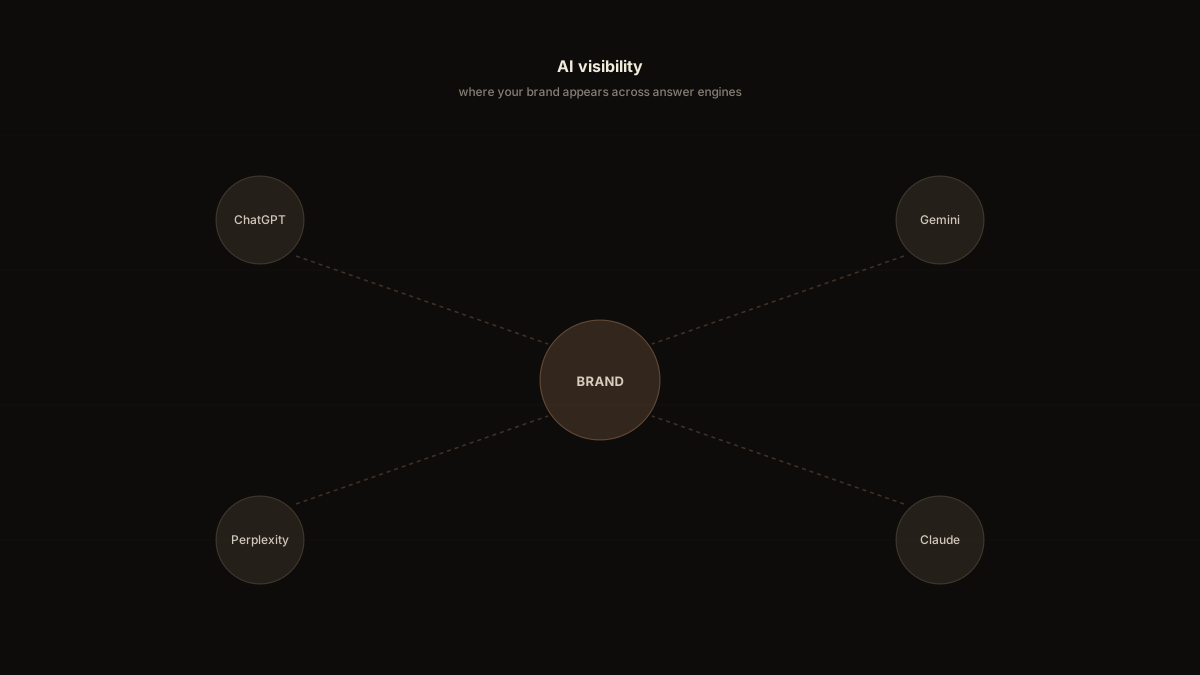
That picture covered most of the buyer journey for two decades. In 2026 it covers maybe half. The other half lives inside ChatGPT, Gemini, Perplexity, Claude, and a growing list of vertical answer engines. Buyers send those engines purchase-intent questions and receive a single, opinionated answer. Whether your brand appears in that answer is not visible in any rank tracker.
AI visibility is the working name for the question rank tracking cannot answer: when an AI system is asked the kind of question your buyer would ask, does your brand surface, and how is it described?
What AI visibility measures
Rank tracking measures position on a results page. AI visibility measures three things at once: presence, framing, and source attribution.
Presence is the binary question. For a given prompt, in a given model, on a given date, did the brand name appear? A single yes/no is noisy. A distribution across hundreds of prompts and several models is informative.
Framing is the qualitative layer. When the model named your brand, what was it said to be good at? Which competitors did it sit alongside? Was the description accurate? A B2B vendor consistently surfaced as "an enterprise option" performs very differently in the market than the same vendor surfaced as "the affordable choice for early-stage teams."
Source attribution is the audit trail. Some models cite sources. Others embed them in retrieval but never surface them. When a brand appears in a response, the citations that drove that response tell you where the model learned to recommend it. That set of sources is what you can actually influence.
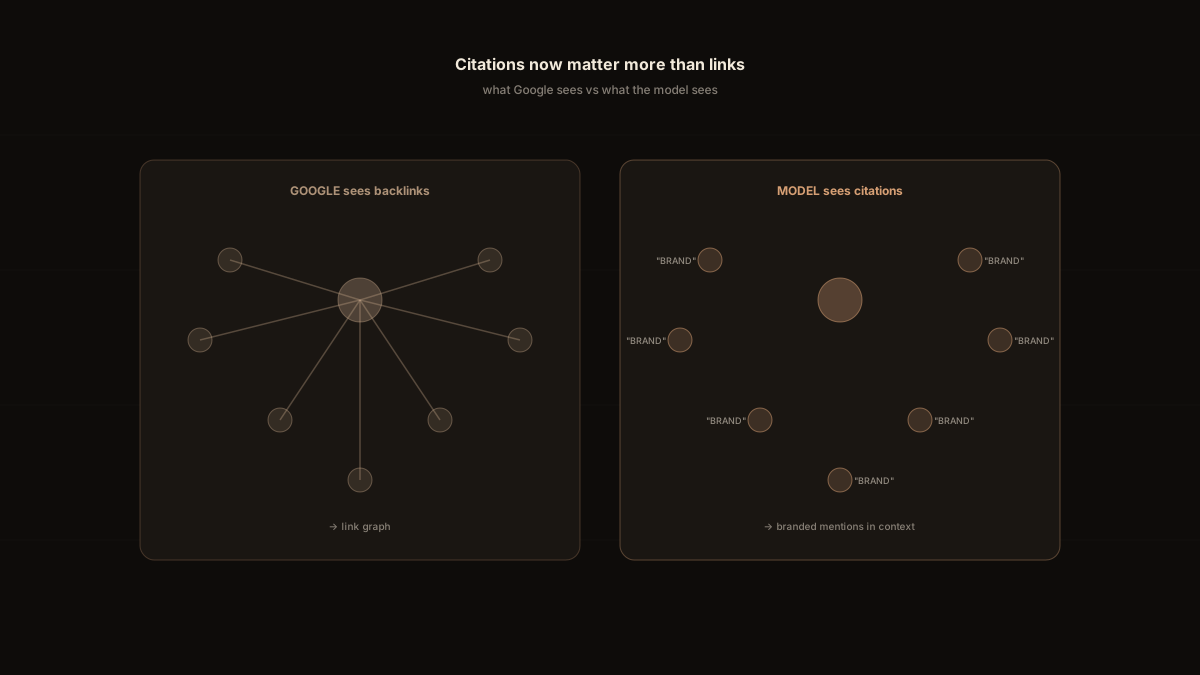
A brand can rank #1 on Google for "best CRM for startups" and not appear at all when ChatGPT is asked the same question. The two systems learned about your category from overlapping but distinct sources, and they weight authority differently.
Why "rank" doesn't transfer
Two structural differences make rank a poor proxy for AI search performance.
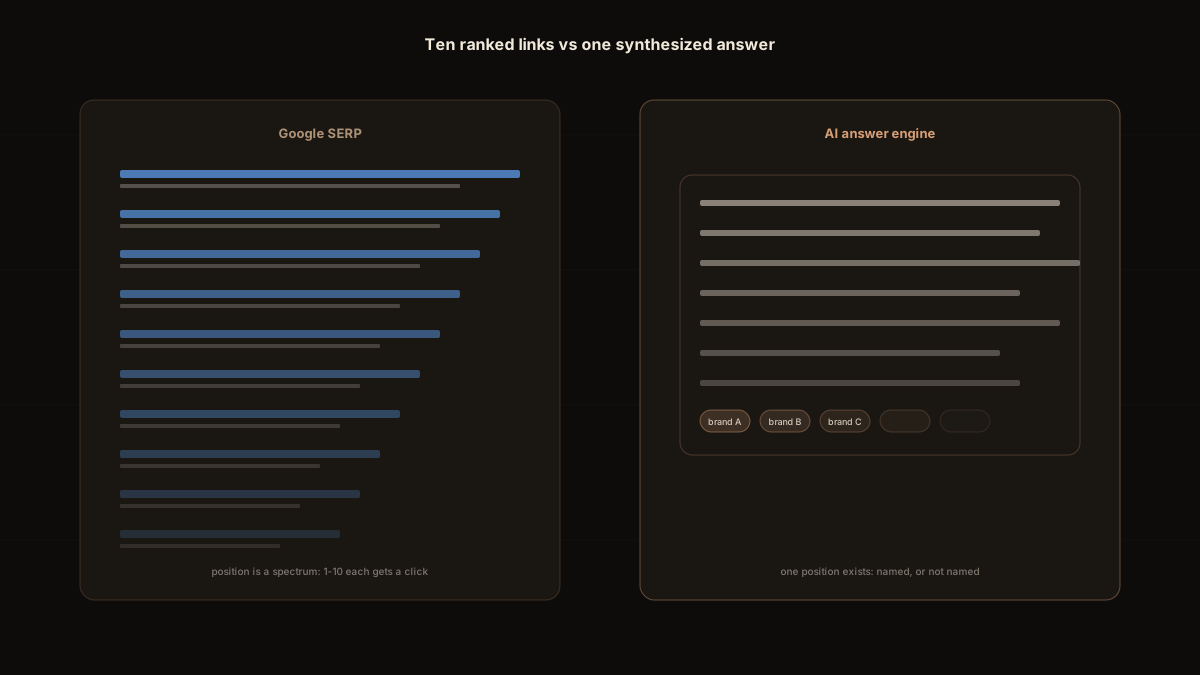
The first is the single-response problem. Google returns ten links and lets the user choose. An AI answer engine returns one synthesized response. Position 1 versus position 8 used to mean a different click-through rate. In an AI answer, position 1 versus position 8 means "named" versus "not named." There is no second-prize visibility.
The second is the fragmented index problem. Google had one index. AI answer engines have several, each trained at different times on different corpora. ChatGPT's recommendation about your category may be anchored to content published in 2023. Perplexity's may be anchored to whatever it retrieves in real time. Gemini may sit in between. Your brand can be visible in one and invisible in another, and the cause is rarely something you control on your own site.
These two differences mean that even a perfect Google rank report tells you about a fraction of the discovery surface. The rest is dark to anyone who only measures one engine.
The three working metrics: GEO, AEO, LLMO
A lot of acronyms have appeared to label this work. Three are worth keeping.
GEO (generative engine optimization) is the strategic frame. It covers anything you do to influence how generative systems describe your brand and category. GEO is a verb, not a metric, in the same way SEO was a verb before "rankings" became a metric.
AEO (answer engine optimization) is the tactical layer focused on platforms that return a single answer. ChatGPT, Perplexity, and Gemini's AI Overviews are all answer engines. AEO work asks: how do we get cited or referenced in the single answer the engine returns?
LLMO (large language model optimization) is the layer focused on how the model itself thinks about your brand and category, independent of any retrieval step. If a model has no internet access and is asked to recommend a tool, what does it say? That output depends on what was in training data, which depends on what was written about your brand on the public internet for years before the model was built.
Most brands need to track all three. They overlap but answer different questions:
A team that only measures AEO will miss the slow erosion of brand recall inside the model itself. A team that only measures LLMO will miss the live retrieval changes happening week to week. The three are complementary, not competing.
What good AI visibility measurement looks like
The shift from rank tracking to AI visibility has three operational consequences worth being explicit about.
You sample, you do not poll. Rank tracking pulls a definitive number from a single SERP per keyword. AI visibility samples responses across many prompts, often with deliberate paraphrasing, to estimate how reliably a brand appears. One ChatGPT response is anecdote. A hundred responses across five phrasings is a measurement.
You measure across models, not within one. A single-model report is misleading. A brand that appears in 70% of relevant Perplexity responses but 10% of Gemini responses has a problem, and the average tells you nothing useful about either.
You track citation source, not just outcome. If your brand appears in an answer because Forbes wrote about you, the durable signal is the Forbes coverage, not the ChatGPT response. A useful AI visibility view shows which third-party sources are driving citations so you can invest in them deliberately.
See where your brand stands in AI search
Track how ChatGPT, Gemini, Perplexity, and Claude recommend your brand vs competitors.
Start tracking freeCommon measurement mistakes
Three patterns show up repeatedly in early AI visibility work, and they all distort the picture.
The first is treating a single screenshot as a measurement. A teammate runs one ChatGPT query, gets a good result, and concludes the brand is in good shape. The same query rephrased five minutes later might omit the brand entirely. Sample size matters more than for rank tracking, not less.
The second is conflating presence with framing. A brand can appear in a response and be described in ways that undercut its market position. "An expensive option for large enterprises" is a presence. It may not be the presence you want.
The third is ignoring competitor framing. Your visibility is always relative. If a competitor surfaces alongside you and is described as "easier to deploy," that is data about how AI systems summarize your category, and it should change your editorial priorities.
Where to start if you're new to this
You do not need to instrument everything before you learn anything useful.
Start with the top ten purchase-intent queries your buyers actually send. Run each across the three or four AI engines that matter for your market. Record whether your brand appears, how it is framed, and which competitors share the response. Do this manually if it helps. The discipline of looking at the actual outputs builds the intuition you will need for the more systematic work later.
Once the manual baseline is in place, automate the sampling so you can track changes month over month. Movement is what you care about. A single point measurement tells you where you are; a trend tells you whether your investments are working.
The fastest way to get useful signal is to track ten queries across four models for one month. That is forty data series per query, enough to see whether you are present, whether the framing is stable, and whether competitors are gaining or losing ground.
How Whaily fits in
This is the work Whaily does for you. The platform samples your most important queries across ChatGPT, Gemini, Perplexity, and other engines on a schedule, records brand presence and framing, and surfaces which third-party sources drive citations.
The point is not the dashboard. The point is having a defensible measurement of where your brand stands in AI search, so you can invest in the work that actually moves the number.
What to track next
Rank tracking did not become useless overnight. It still measures a real thing, and Google still routes a meaningful share of buyer traffic. The change is that rank tracking is now one input in a broader visibility view, not the whole view.
If your team is still reporting AI visibility through rank-tracker dashboards, the next step is small: add a parallel view that captures presence, framing, and citation source across the AI engines your buyers use. Run it for a quarter. Compare what each view tells you. You will see, fast, how much of the picture rank tracking quietly stopped covering.
FAQ
Is AI visibility the same as GEO? No. GEO is the strategic frame for optimizing your presence in generative engines. AI visibility is the measurement of where you currently stand. You can do GEO work without measuring AI visibility, but you cannot tell if the work is moving anything.
How is AI visibility different from share of voice? Share of voice traditionally measures mentions across press, social, and search. AI visibility narrows the question to AI answer engines specifically and adds the framing and citation dimensions that share of voice usually ignores.
Can I measure AI visibility without a platform? Yes, for a small set of queries. Manual sampling across four engines and ten queries is achievable and worth doing once. Beyond that, the volume of prompts and the consistency of sampling become the bottleneck.
Does AI visibility affect SEO? Indirectly. The third-party sources that influence AI citations are usually the same sources that influence Google E-E-A-T signals. Investing in authoritative external coverage tends to help both.
See where your brand stands in AI search
Track how ChatGPT, Gemini, Perplexity, and Claude recommend your brand vs competitors.
Start tracking free