The pattern is familiar enough to feel scripted.
OpenAI ships a new model. The release post is dense, the demos are choreographed, the speculation begins immediately. Marketing leaders ping their teams. "Does this change what we're doing?" Some people predict the end of search. Others predict the end of AI. Both are usually wrong.
Two days later, the responses on production queries look mostly like they did the week before.
This post is about the parts that actually change when a major model ships, the parts that do not, and what is worth doing in the meantime.
What model upgrades change
A few real shifts tend to follow major model launches. They are smaller than the launch hype suggests but they are real.
Retrieval behavior shifts on the queries the new model handles differently. Newer models are usually better at routing queries to web search versus relying on internal knowledge. A query that the old model answered from training data may, in the new model, trigger a live search. This can change which sources get cited and in what order, even if the underlying content is identical.
Reasoning depth changes how the answer is structured. A new model often gives more detailed, more nuanced answers on complex queries. The list that used to be three names is now seven names with comparisons. The brand that was in the top three might still be there but is now sharing space with four others.
Defaults around citation and source presentation can change. OpenAI has been adjusting how prominently it surfaces sources in answers, how clickable they are, and how many it lists. Each adjustment changes user behavior and click distribution downstream.
The interface metaphor sometimes shifts. A model launch is often accompanied by interface changes that affect how users interact. New search modes, new conversation styles, new ways of grounding answers. These compound the model behavior changes with user behavior changes.
What does not change between model releases:
- The training data corpus is mostly stable across closely-related model versions. The model knows roughly the same set of brands it knew before, just with different reasoning over them.
- The third-party sources that drive citations are largely unchanged. Wikipedia is still Wikipedia. G2 is still G2.
- Your domain's authority signals (schema, structure, content quality) are the same to the new model as the old one.
- The fundamental shape of the visibility problem (presence, framing, source mix) is unchanged.
In other words, the substrate stays roughly fixed across model versions. What changes is how the model reads and presents the substrate.
A model launch can move your visibility score by ten or fifteen points in either direction without anything about your brand or your content changing. The cause is the model, not you. Track the delta against your baseline before reacting.
The two-week noise window
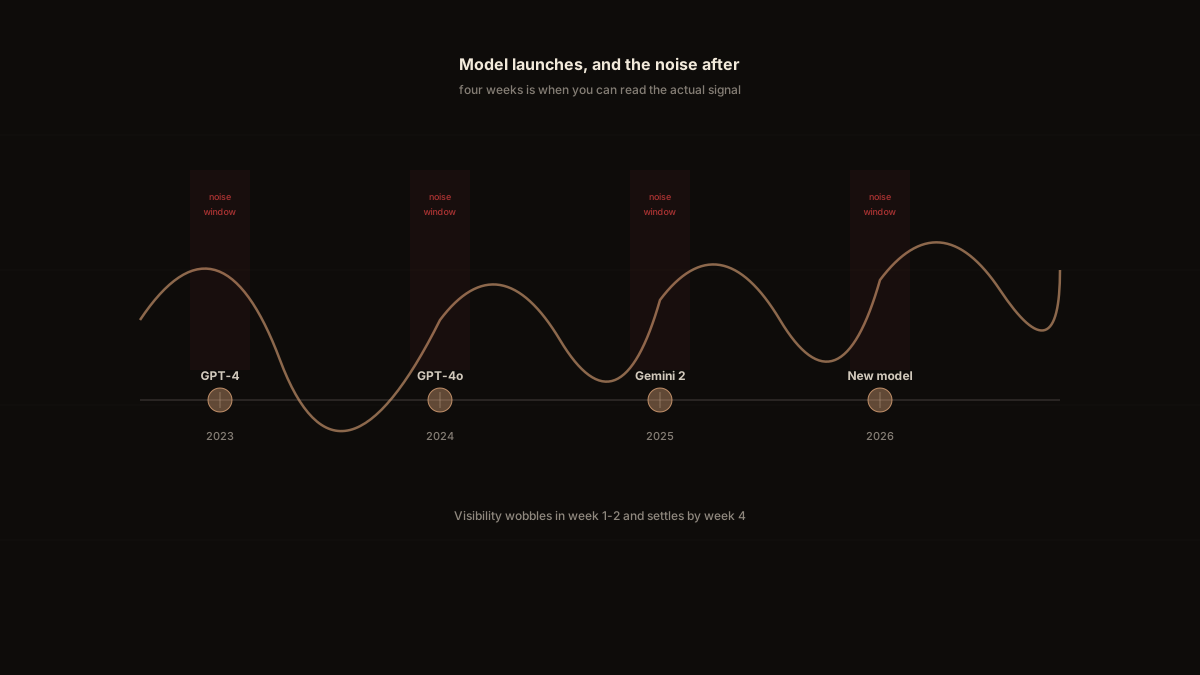
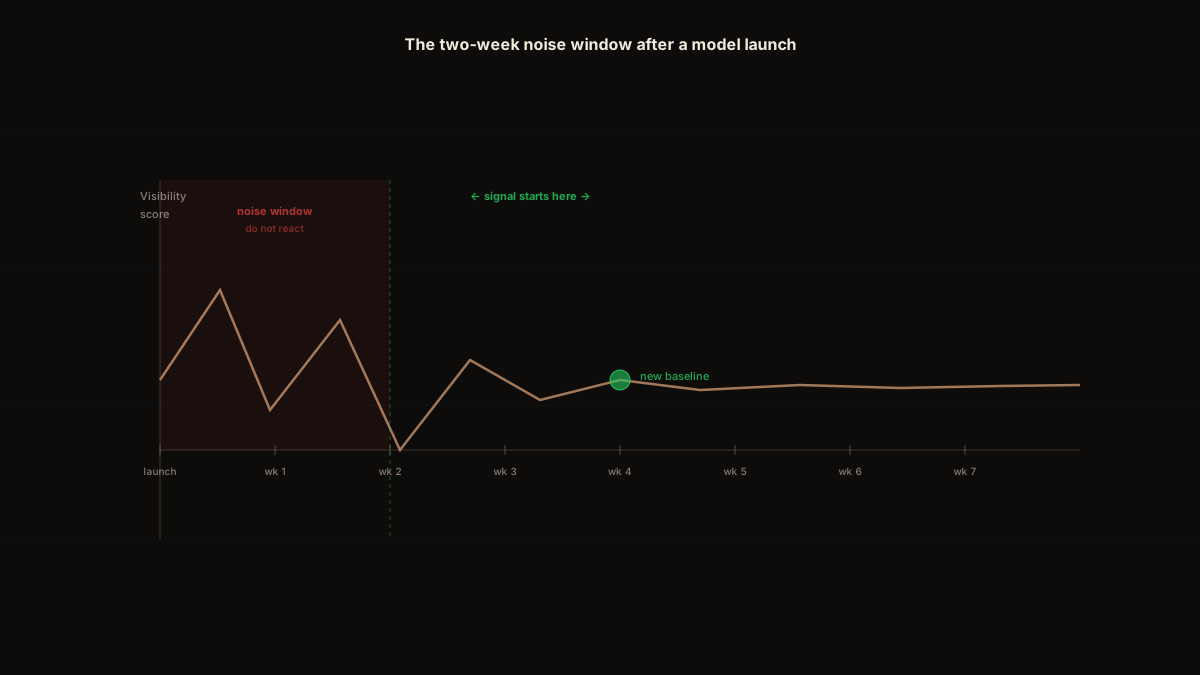
There is a useful pattern to know about. The first two weeks after a major model launch are noisy.
Users are exploring the new model. Query patterns are weird. Responses are unstable as the platform tunes the deployment. Retrieval behavior is being adjusted. The data your AI visibility tools collect in this window often does not match what the system settles into.
Most teams who panic in week one of a launch are panicking about a measurement that will not look the same in week four. The teams who calmly check their dashboards every other day for the first month tend to be closer to the truth than the teams who hold all-hands meetings about the dip on day three.
A good operating habit: when a major model ships, mark the date on your dashboard. Look at the data weekly for the first month. Compare week four to your pre-launch baseline. That comparison is the real signal. Days one through fourteen are mostly noise.
What the actual changes have looked like historically
A few patterns from past major model releases.
GPT-4 to GPT-4o (2024). Most brands saw modest shifts in citation order and a slight increase in source diversity. The top brands stayed at the top. Some mid-tier brands gained ground because the new model was more likely to surface comparable alternatives. Overall stability after the first month.
Claude 3 to Claude 3.5 (2024). The reasoning improvements changed how Claude described categories. Better at distinguishing competing products. Brands with clearer differentiation gained citation share. Brands with weak differentiation lost ground because the model was now better at noticing the weakness.
Gemini 1.5 to Gemini 2.0 (2025). The big shift was retrieval behavior. Gemini 2 was much more aggressive about live web search. Brands relying on training-data presence saw their scores drop because the model was now reaching for current sources, where their presence was thinner.
The lesson: each upgrade has a flavor. The flavor matters more than the version number. Watch for which kind of brand the new model rewards.
What to actually do in the first month
A practical checklist.
Maintain your baseline. Before reacting to anything, confirm your pre-launch measurement is solid. If you do not have a clean four-week pre-launch baseline, your "the new model is destroying our visibility" claim is unfounded.
Sample more often, not less. Reduce your usual cadence and double the frequency for the first month. Daily or twice-weekly sampling on key queries. The noise window benefits from more data points, not fewer.
Watch the source mix, not just presence. Often the visible change after a model launch is a different source mix in the citations. Your presence rate might be the same but the model is now citing different third-party sites for the same answer. The source mix shift tells you what kind of content the new model now prefers.
Hold investment decisions steady. Resist the temptation to overhaul your strategy in response to two weeks of new-model data. The marginal cost of waiting another four weeks is small. The cost of pivoting on noise is large.
Watch competitors too. If your visibility dropped uniformly with competitors, it is a model effect. If your visibility dropped while a competitor's rose, something specific is happening and is worth diagnosing.
When the change is real
Sometimes a model release does drive a structural change in your visibility. A few signs that what you are seeing is signal, not noise.
The change persists past week four. Day-three changes are noise. Week-four changes that match the launch hypothesis are signal.
The change matches a known feature of the new model. If the new model is "much better at handling long-tail queries" and your visibility on long-tail queries shifted while head-term visibility held, that is consistent with the launch story.
The change affects competitors differently. If you and a competitor moved in opposite directions on the same queries, the underlying difference between you (content, sources, framing) is being weighted differently by the new model. That is worth investigating.
The source mix shifted in a recognizable direction. If the new model is favoring forum content over editorial content, you can verify by looking at which specific sources are now cited more frequently.
When the change is real, the response is the same as any other significant visibility shift: diagnose the failure mode, pick one lever, run it for a quarter.
The longer arc
Step back from any individual launch and the pattern is steadier than the news cycle suggests.
AI visibility leaders in 2023 are mostly still AI visibility leaders in 2026. The underlying signals (Wikipedia presence, editorial coverage, structural authority, review volume) compound. Brands that have been investing for years are durable across model launches because their substrate is strong.
Brands that won fleeting visibility through retrieval quirks have been less stable. Each model release shuffles the lower deciles. The top of the distribution moves slowly.
This is the honest answer to the question your CEO asks after every launch: "do we need to redo our AI strategy?" Almost always no. The work that wins consistently is the work that wins across model releases.
See where your brand stands in AI search
Track how ChatGPT, Gemini, Perplexity, and Claude recommend your brand vs competitors.
Start tracking freeWhat is worth doing this week
Three small things.
Set up an alert or note for major AI launches you care about (OpenAI, Anthropic, Google, Perplexity). Mark the dates on your visibility dashboard so the noise window is identifiable later.
Pull your last three months of visibility data and look at it through the lens of: did anything that happened in this window get attributed to a model launch that, in retrospect, was really just noise? If the team chased a launch that turned out to be a non-event, log the lesson.
Reaffirm your investment plan. Whatever your AI visibility strategy was a month ago, the new model release is probably not a reason to change it. If your team is asking whether to change course, the default answer is "let's get four weeks of data first."
FAQ
Will the new OpenAI model change my AI visibility score? Probably, by some amount. The size and direction depend on which queries you care about and how the model differs from its predecessor. Wait four weeks before drawing conclusions.
Should I rewrite content for the new model? Almost never. The content that worked for the previous model usually works for the new one. Rewriting in response to a single launch is high-effort and rarely changes the outcome.
Is the model launch good or bad for my brand? Without your specific data it is impossible to say. It depends on your source mix, your query coverage, and which axis the model improved on. Measure first.
Does Whaily handle the noise window automatically? The platform's trend views are designed to smooth short-term volatility around known events. You can also mark launch dates explicitly to interpret the data around them.
See where your brand stands in AI search
Track how ChatGPT, Gemini, Perplexity, and Claude recommend your brand vs competitors.
Start tracking free