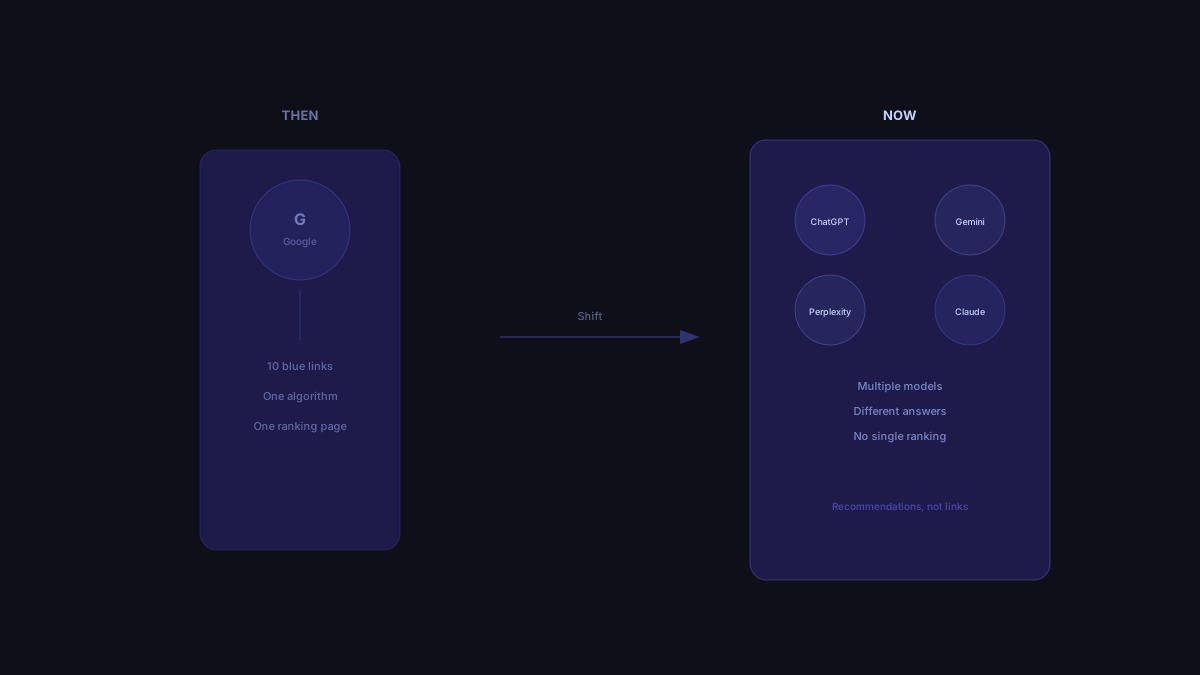
In traditional search, a user types a query and gets a page of ten results. They scan the titles. They click two or three. One of those clicks becomes a session on your site. The whole system depends on that click.
AI search breaks this chain at the second step. The user types a query. The AI generates an answer. The answer contains brand recommendations, product comparisons, and sourced conclusions. The user reads the answer, forms a view, and moves on. No results page. No browsing. Often, no clicks.
This is zero-click discovery. It is not a temporary edge case or a feature affecting only casual consumer searches. It is a structural shift in how buyers encounter and evaluate brands, and it is accelerating.
What zero-click discovery actually looks like
A buyer at a 200-person SaaS company is evaluating analytics tools. She opens Perplexity and types: "What's the best analytics platform for a product team without a data engineer?" The response is a 300-word answer naming three tools, explaining the use-case fit for each, and linking to sources. The buyer reads the answer. One of the named tools stands out. She goes directly to that company's website, skipping every other result that would have appeared in a traditional search.
The brands that were not named in that answer received zero consideration. Not a low click-through rate. Zero. They were not ranked below the fold, they were absent from the decision.
This is the zero-click discovery dynamic in practice. The "results page" that once gave every ranking site a fighting chance does not exist. The AI generates a single synthesized answer, and brands either appear in it or they do not.
There is no page two
Traditional search had a hierarchy: position one was best, position ten was worse, page two was nearly invisible. Marketers spent years fighting over ranking positions because even position eight got some clicks.
AI search flattens this. There is no equivalent of position eight. The model generates a response that mentions two or three sources, sometimes four. Outside of those named entities, the consideration set does not exist. A brand could have published the best content in its category and still not appear in a single AI response if the model's training data or retrieval system did not pick it up.
The implication for brand strategy is stark. In a traditional search world, being on page two meant you needed to improve. In an AI search world, being absent from citations means you have no presence in that buying channel at all.
The zero-click pattern is most pronounced for informational and comparison queries, which cover a large share of the B2B buying journey. Transactional queries ("buy X now," "pricing for Y") still frequently result in clicks because the user needs to complete an action on a site. But discovery, evaluation, and comparison are increasingly zero-click interactions.
Where users go after a zero-click AI response
Zero-click does not mean buyers stop acting. It means the click that drives action happens differently.
In traditional search, the click goes to the result. The brand gets a session, can track the source, and can measure the journey from landing page to conversion. In AI search, the buyer may go directly to a brand's homepage after seeing the name in a response, or they may type the brand name into a new search, or they may send the tool name to a colleague via Slack. None of these actions appear as organic search referrals in a traditional analytics stack.
This creates a measurement gap. AI-influenced discovery shows up in direct traffic, branded search volume, and word-of-mouth metrics rather than in organic channel attribution. Brands that are seeing unexplained growth in branded search or direct navigation may already be benefiting from AI recommendation without knowing it. Brands that are not may already be losing buyers in a channel that doesn't appear in their attribution reports.
What being "in the answer" requires
The operational consequence of zero-click discovery is that optimizing for ranking position is not enough. The goal is to be in the synthesized answer, and that requires different inputs than traditional SEO.
AI models select sources for their answers based on a combination of factors: the authority of the source, how well the content matches the query framing, the recency of the content where retrieval is involved, and the structural quality of the page. Sources that define their domain clearly, use recognizable terminology, provide evidence for their claims, and are mentioned across multiple trusted third-party sites are more likely to be surfaced.
This shifts content strategy toward a different type of output. Instead of writing for keyword density and click-through rate optimization, teams need to write for citeability. A page that can be summarized by a model, that contains quotable definitions and attributed statistics, and that is backed by third-party mentions is a page that can enter AI responses.
Measuring visibility in a zero-click world
Traditional web analytics cannot measure zero-click discovery. Google Analytics does not record sessions that never happen. Search Console shows impressions and clicks for organic results, but AI Overviews have their own reporting, and standalone AI systems like Perplexity and ChatGPT send no data to your analytics stack at all.
Measuring AI visibility requires a sampling approach. You construct a set of queries that represent how buyers in your market search for solutions like yours. You submit those queries to the AI systems your buyers use. You record whether your brand appears, where it appears, and what the model says about it. You repeat this over time to track whether your citation rate is improving or declining.
This is a fundamentally different measurement discipline than rank tracking. Rank tracking tells you your position on a stable results page. AI visibility measurement tells you how often your brand appears in a probabilistic output that may vary across query runs. Sampling frequency and query breadth both matter for getting a reliable signal.
Whaily is designed for this kind of tracking: systematic sampling across AI systems, consistent query coverage, and trend data that shows whether your visibility is moving in the right direction.
The practical response for brand teams
Accepting that zero-click discovery is real, the practical response involves two changes.
The first is content investment. Pages that are likely to be cited need the attributes that make them citable: clear structure, direct answers, sourced claims, and coverage of comparison and use-case questions. This is the supply side of AI citation.
The second is measurement. Building the capability to monitor AI citation rates is no longer optional for brands that care about where buyers encounter them in the research phase. Without measurement, you cannot tell whether your content investments are landing or whether a competitor is eating your position in AI-generated answers.
See where your brand stands in AI search
Track how ChatGPT, Gemini, Perplexity, and Claude recommend your brand vs competitors.
Start tracking freeZero-click discovery will not reverse. The convenience of getting a synthesized answer is too strong a pull for users to abandon. The question is whether your brand is in those answers or whether it is waiting for a results page click that is happening less and less often.
FAQ
How do I know if zero-click discovery is already affecting my traffic?
Look for divergence between branded search volume (growing) and organic landing page sessions (flat or declining). Also check if your "direct" traffic has been growing unexplained. AI-influenced discovery tends to manifest as increased brand awareness metrics and direct navigation rather than referral traffic.
Does zero-click affect B2B and B2C differently?
The effect is present in both, but the buying journey dynamics differ. B2B buyers are more likely to use AI for category evaluation and vendor comparison, which are exactly the zero-click query types. B2C buyers use AI more for recommendations and reviews. Both are affected; the query types and decision stages differ.
Can we track which AI queries our brand appears in without building custom tooling?
Manual sampling is possible: choose 20 to 30 representative queries, run them monthly on the AI systems your buyers use, and log the results. This is slow and doesn't scale, but it gives directional data. Purpose-built tools automate this at the frequency needed to catch meaningful changes.
Is this the same as the zero-click problem SEOs have discussed for years?
Related but different. The original zero-click concern was about Google featured snippets and knowledge panels reducing clicks. AI search extends the same dynamic but makes it structural rather than incidental. An AI response synthesizes an answer from scratch. There is no equivalent of clicking "more results" to see what's beneath it.
See where your brand stands in AI search
Track how ChatGPT, Gemini, Perplexity, and Claude recommend your brand vs competitors.
Start tracking free