
Brand snapshot
What several AI models say about your brand, on one page.
A brand snapshot asks a fixed set of buyer questions about your brand on the models you choose, five times each, and writes down what every model agreed on. It is a point in time, not a trend, and it is priced before it runs.
 ChatGPT
 Claude
 Gemini
 Perplexity
 DeepSeek
 Grok
GrokThe problem
You have never read what the models actually think you are.
Tracking tells you how often you are named. It does not tell you what category a model puts you in, who it thinks you are for, which brands it puts beside you, or when it would steer a buyer away. Those answers shape every recommendation the model makes, and most brands have never asked for them in one place.
How it works
From sign-up to signal in minutes.
Pick the models
Choose which models to ask from the ones your plan reaches. The questions are fixed and versioned, so two snapshots a month apart compare like with like.
See the price and confirm
The price is shown before anything runs: per answer by model class, with a 4.90 dollar minimum per report. A small selection costs the minimum, and adding a model or two does not move the price.
Read the report
One page in five sections, with how often each model gave that answer across its own runs, the method it was produced by, and every stored answer as evidence. Flag anything inaccurate, or share the page as a frozen link.
What you get
Everything you need, in one place.
Seven questions, five sections
Identity, audience, neighbours, objections and facts: what kind of product you are, who you are for, the shortlist you appear on, what a model recommends instead, and when it would not recommend you.
Asked five times, not once
Every question runs five times per model, so each claim on the page carries the share of runs that agreed with it. A one-off answer never becomes a finding.
A control brand on every question
Each question is also asked about a company that does not exist, in your category. If a model answers just as confidently about that one, the report says so instead of dressing a template up as an opinion.
Evidence and method attached
The stored answers behind every claim, the exact question wording and version, the models, the temperature and the run count all sit on the same page.
Share a frozen copy
Create a share link and the report goes out exactly as it read at that moment, addressed to a reader who is not you, with the parts that are yours alone kept back.
Every plan, including Free
A snapshot is a purchase, not a plan feature, so any brand can run one. The models on offer are the ones your plan reaches.
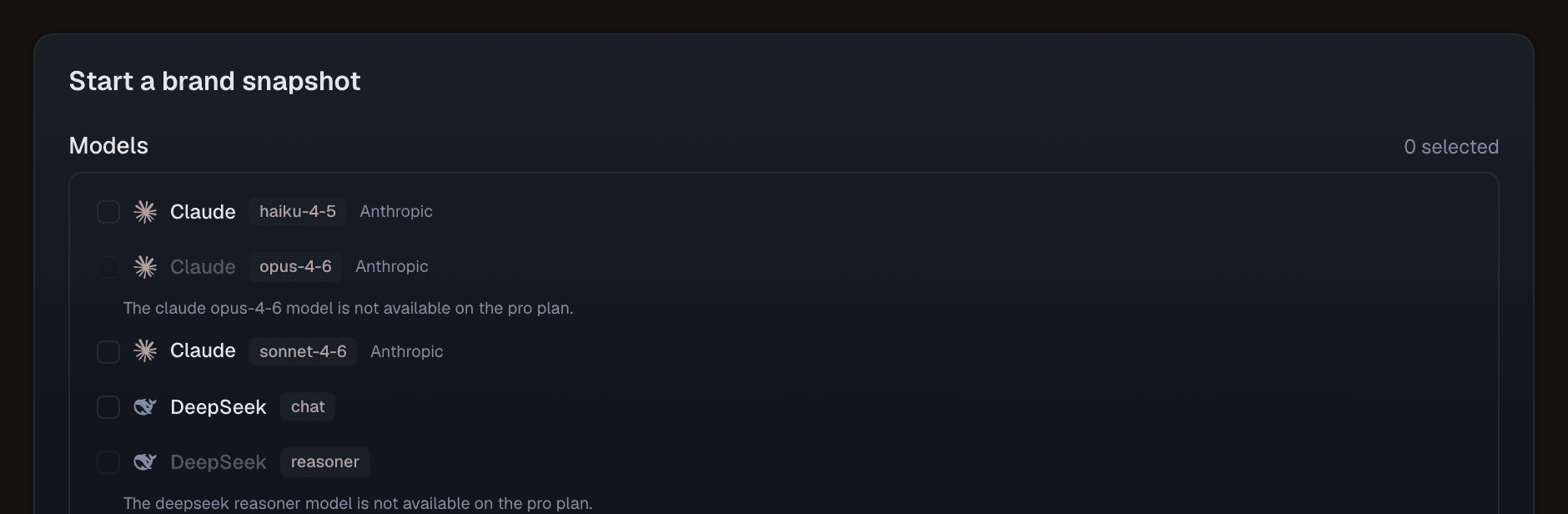
Choose the models and see the price before you confirm.
The start form lists every model your plan reaches, says that each question runs five times, and shows the price you will pay before the button does anything.
Why it matters
A recommendation starts with a description.
Before a model names a brand in an answer, it has already decided what that brand is: which category it belongs to, who buys it, what it is good at and where it falls short. Those beliefs are stable enough to shape every answer the model gives about your market, and they are invisible in a mention rate. A brand snapshot reads them out directly, in the words the model uses when asked plainly.
The report is built to be trusted rather than impressive. Every question is asked five times per model, so a claim comes with the share of runs that produced it, and a model that changes its mind is shown changing it. Every question is also asked about a control brand, a company that does not exist in your category, because a model that describes a fictional competitor with the same confidence is reciting a genre rather than an opinion about you. The questions are versioned, so a snapshot taken next quarter answers the same wording as this one.
It is priced as a purchase rather than bundled into a plan, and the price is on screen before you confirm: per answer by model class, with a 4.90 dollar minimum per report. Most selections pay the minimum. The report, the evidence behind it and the method it was produced by are one page, and a share link freezes that page for a reader who is not you.
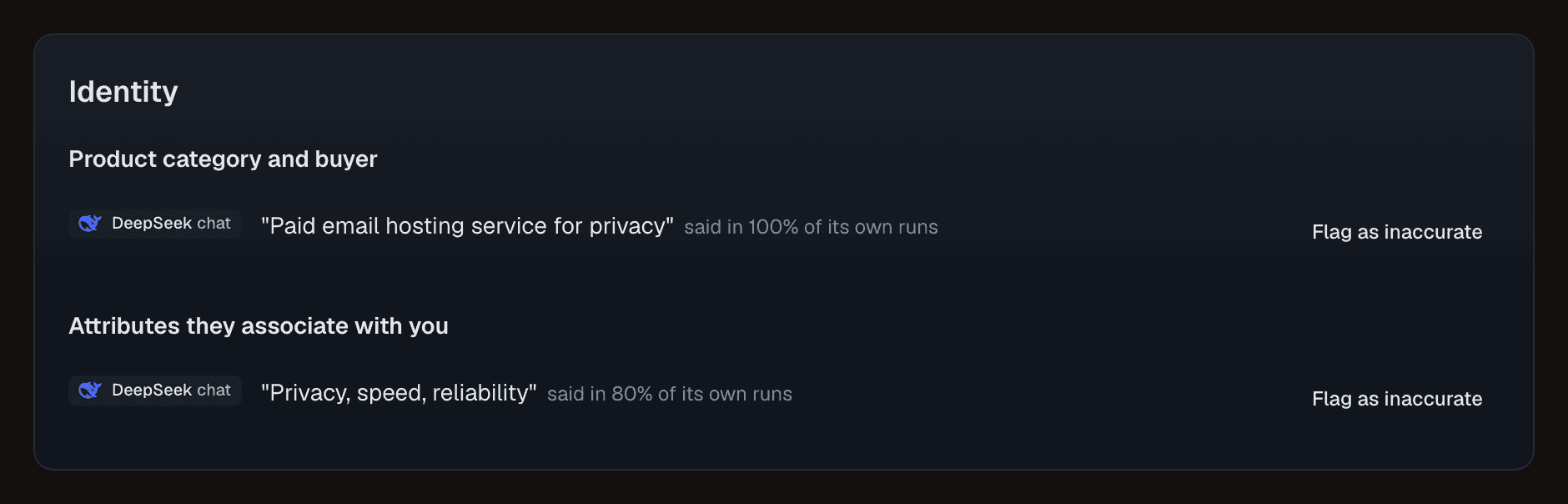
The report: five sections, each claim with its share of runs.
Identity, audience, neighbours, objections and facts, model by model, with "said in 80% of its own runs" beside each claim and a flag for anything the model got wrong.
Questions
The short answers.
What questions does a snapshot ask?+
How much does it cost?+
Which plans can run one?+
Is this the same as tracking?+
Can I share the report?+
Ready to be recommended by AI?
Start free. See your first insights in minutes.