
Bursts
Run a prompt hundreds of times before you trust the mention rate.
A single AI answer is one sample from a system that can give a different answer next time. A burst runs one prompt across the models you pick, tens to hundreds of times or more per model, so a mention rate comes back with a range attached instead of a single number.
 ChatGPT
 Claude
 Gemini
 Perplexity
 DeepSeek
 Grok
GrokThe problem
One answer is not a measurement.
Ask a model the same question twice and the brands it names can change between the two runs. A dashboard built from single answers can tell you a brand was mentioned once, on one day, by one model. It cannot tell you whether that would happen again if you asked ten more times. Treating a single run as a stable percentage is where a lot of AI visibility reporting goes wrong.
How it works
From sign-up to signal in minutes.
Pick a prompt and the models to test
Choose an existing tracked prompt and the models you want to stress-test. You are not limited to whichever model happened to answer last.
See the cost and the confidence before you confirm
Before a burst runs, you see what it will cost and roughly how tight a range that many runs will buy you. Pricing is per run by model class, with a small minimum per burst, and lower if you run it on your own provider key.
Read the result as a range, not a point
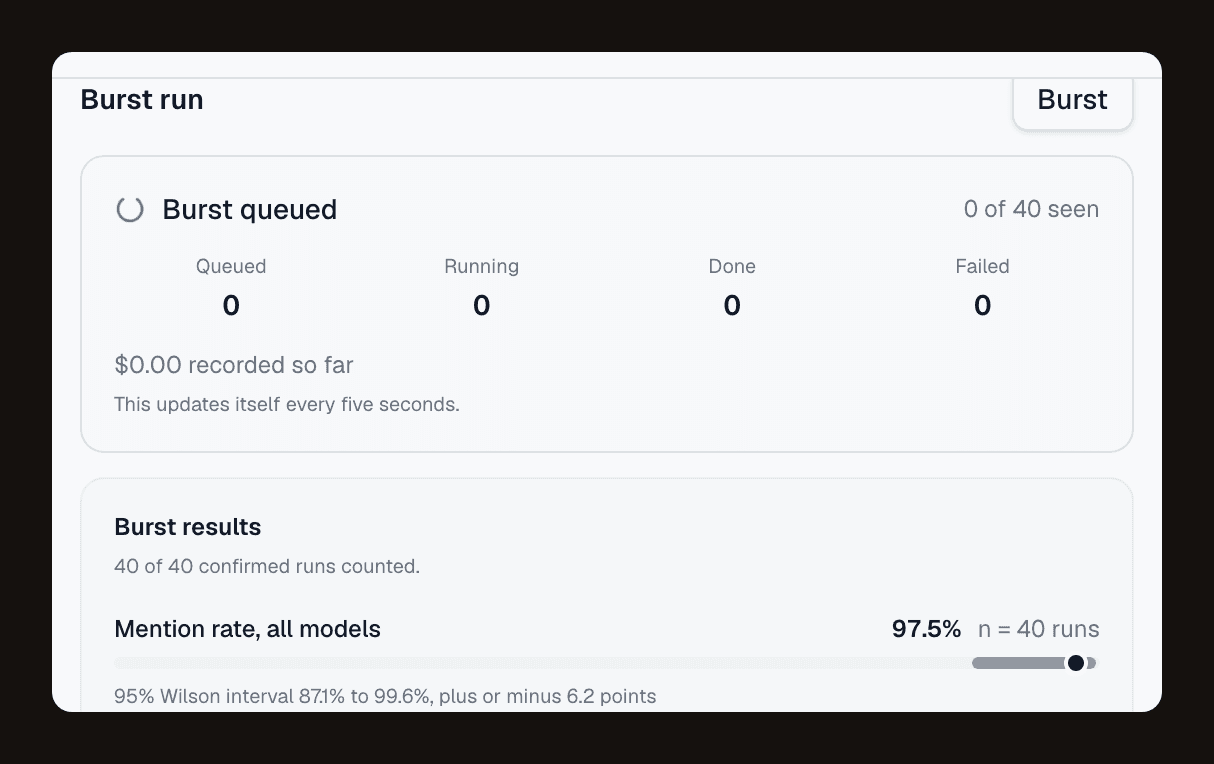
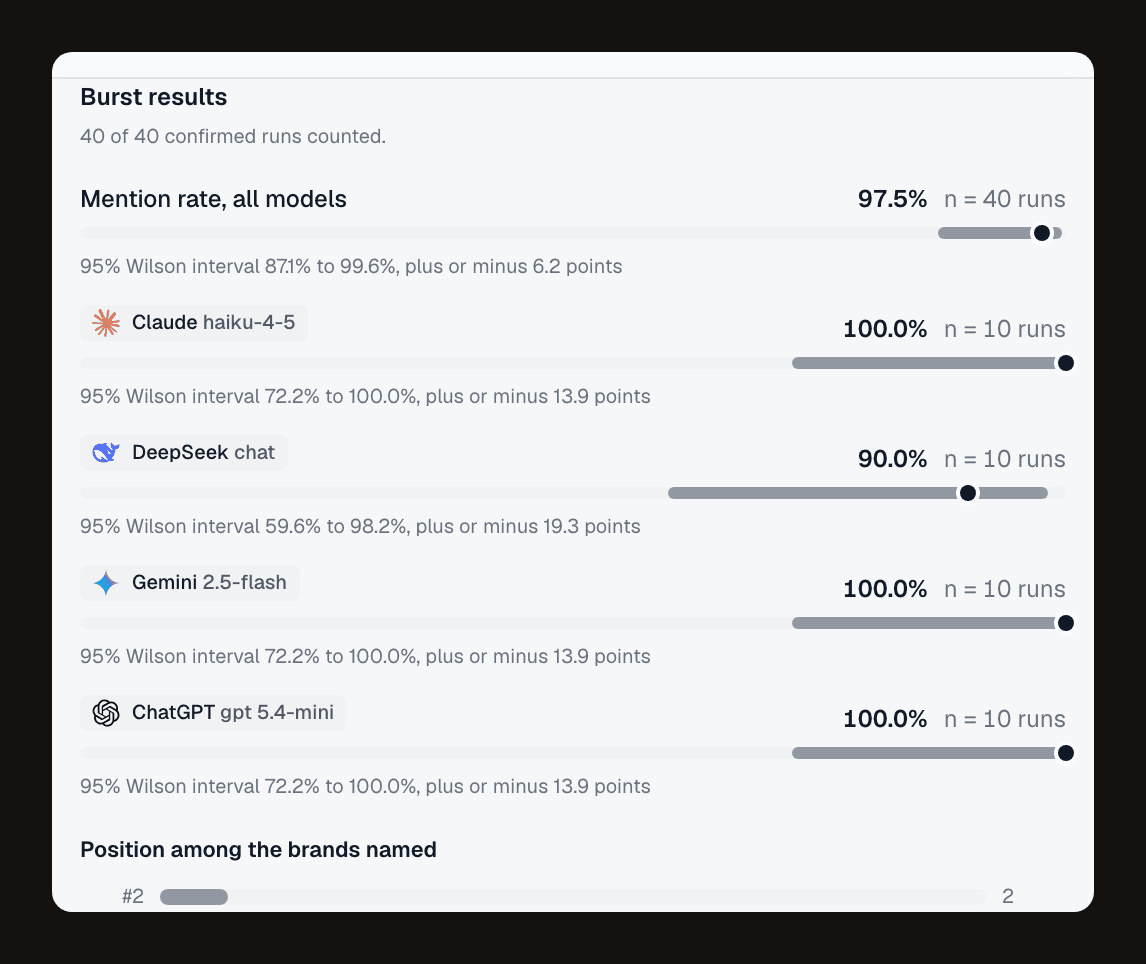
Results come back as mention rates with a 95 percent Wilson confidence interval per model. Burst answers are kept separate from your regular tracking data, so a stress test never skews your daily trend line.
What you get
Everything you need, in one place.
Run one prompt many times per model
Tens to hundreds of runs per model or more, capped at 5,000 runs per model and 20,000 per burst so a single test cannot run away with cost.
95 percent Wilson confidence intervals
Every mention rate comes with an interval, per model, so you can see how much the number could plausibly move on the next run.
Cost and confidence, before you commit
The app shows the projected cost and the confidence it buys before you confirm a burst, so there are no surprises after it runs.
Kept out of your tracking numbers
Burst answers never enter the daily or weekly tracking metrics. They exist to test a question on demand, not to replace the regular schedule.
Priced per run, lower on your own key
Bursts are priced per run by model class, with a small minimum per burst. Bring your own provider key and the per-run price drops, because the tokens are billed by your provider instead of ours.
Starter plan and up
Bursts are available from the Starter plan up. Check the pricing page for what your plan includes.
See the cost and the confidence before you run it.
Pick a prompt and the models to test, then see the projected cost and the interval width you will get before you confirm the burst.
Why it matters
A mention rate without a range is not a measurement.
AI models are not deterministic. Ask the same prompt twice and the model can name a different set of brands, in a different order, with different phrasing. That is not a bug in the model, it is how these systems work. It means a single tracked answer, the kind most AI visibility tools report on, is one sample, not a measurement.
A burst turns that sample into a real measurement by taking many of them. For example, 100 runs on one model that name the brand 31 times give a range of roughly 23 to 40 percent, not a flat 31 percent. Whaily computes the exact interval for every burst you run using the Wilson method, so the number above is an illustration, not a specific result. The interval narrows as the run count goes up, which is why the app shows you the tradeoff between runs, cost and confidence before you commit to a burst.
Because burst answers are kept separate from the daily and weekly tracking numbers, running a large burst to settle a question never distorts your regular trend line. Bursts are for the moment you need to know, with confidence, whether a mention rate is real: before a board meeting, before a claim goes in a slide, before you decide a competitor really did pull ahead.
A mention rate with a range, not a guess.
Mention rate and a 95 percent Wilson confidence interval per model, so a number like "recommended in a third of runs" comes with an honest range attached.
Questions
The short answers.
How many times does a burst run a prompt?+
What do the results look like?+
Does a burst affect my regular visibility tracking?+
How much does a burst cost?+
Which plans can run bursts?+
Why not just trust the answer I already got?+
Ready to be recommended by AI?
Start free. See your first insights in minutes.