
Model Coverage
Know which model version answered, every single time
"ChatGPT" is not one model, and a visibility number without a version cannot be compared next month. Whaily names the exact model behind every answer, and tells you before that model goes away.
 ChatGPT
 Claude
 Gemini
 Perplexity
 DeepSeek
 Grok
GrokThe problem
A visibility score is meaningless without a model version attached.
Providers ship new model versions on their own schedule, and the differences between two versions of the same family can be large. If a dashboard just says "GPT" or "Gemini", you cannot tell whether a drop in visibility is a real change in how your brand is discussed or just a quiet model swap behind the scenes. Whaily records the exact version on every answer, so a chart move has an explanation attached.
How it works
From sign-up to signal in minutes.
Every model lives in a registry with a channel
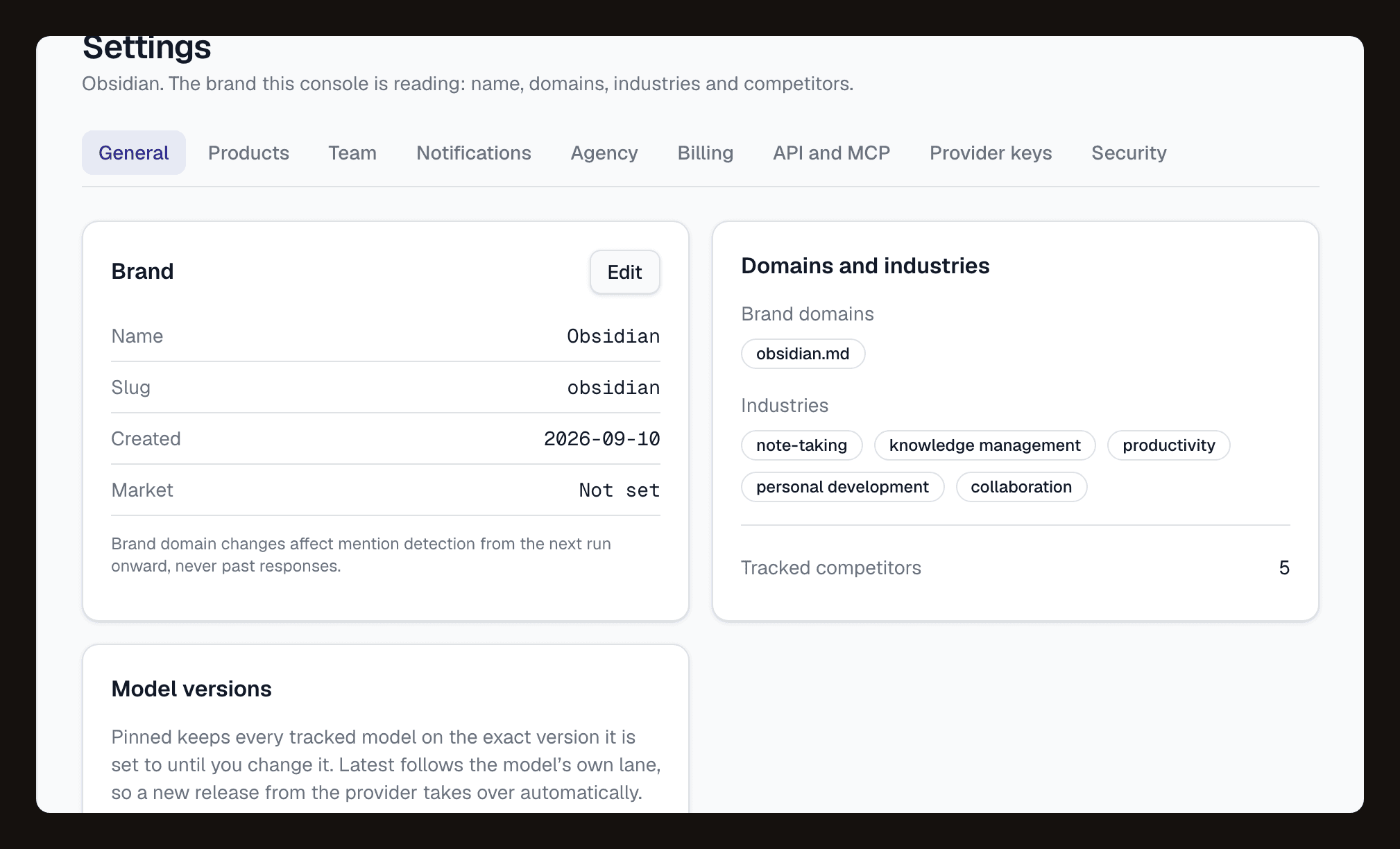
Each model belongs to a channel, such as claude-sonnet, gpt-mini or gemini-pro. The registry today includes Anthropic Claude Haiku 4.5, Sonnet 4.6 and Opus 4.6; OpenAI GPT-5.4, GPT-5.5, GPT-5.4 mini and GPT-4o mini; Google Gemini 2.5 Flash and Gemini 2.5 Pro; Perplexity Sonar and Sonar Pro; and DeepSeek chat. xAI Grok 4.6 is opt-in on Enterprise. Newer versions, such as Claude Sonnet 5, Opus 5, the GPT-5.6 family and Gemini 3.x, enter the registry admin-only until verified.
You choose pinned or latest for each channel
A pinned selection keeps running the exact version you chose until someone changes it, and Whaily emails your organisation as that provider's shutdown date approaches. A latest selection follows the channel automatically: when the provider ships a new release, tracking migrates to it on the next scheduled run. Every stored answer still records the exact version that actually replied, never just the channel name.
A retiring model gets a succession marker on your timeline
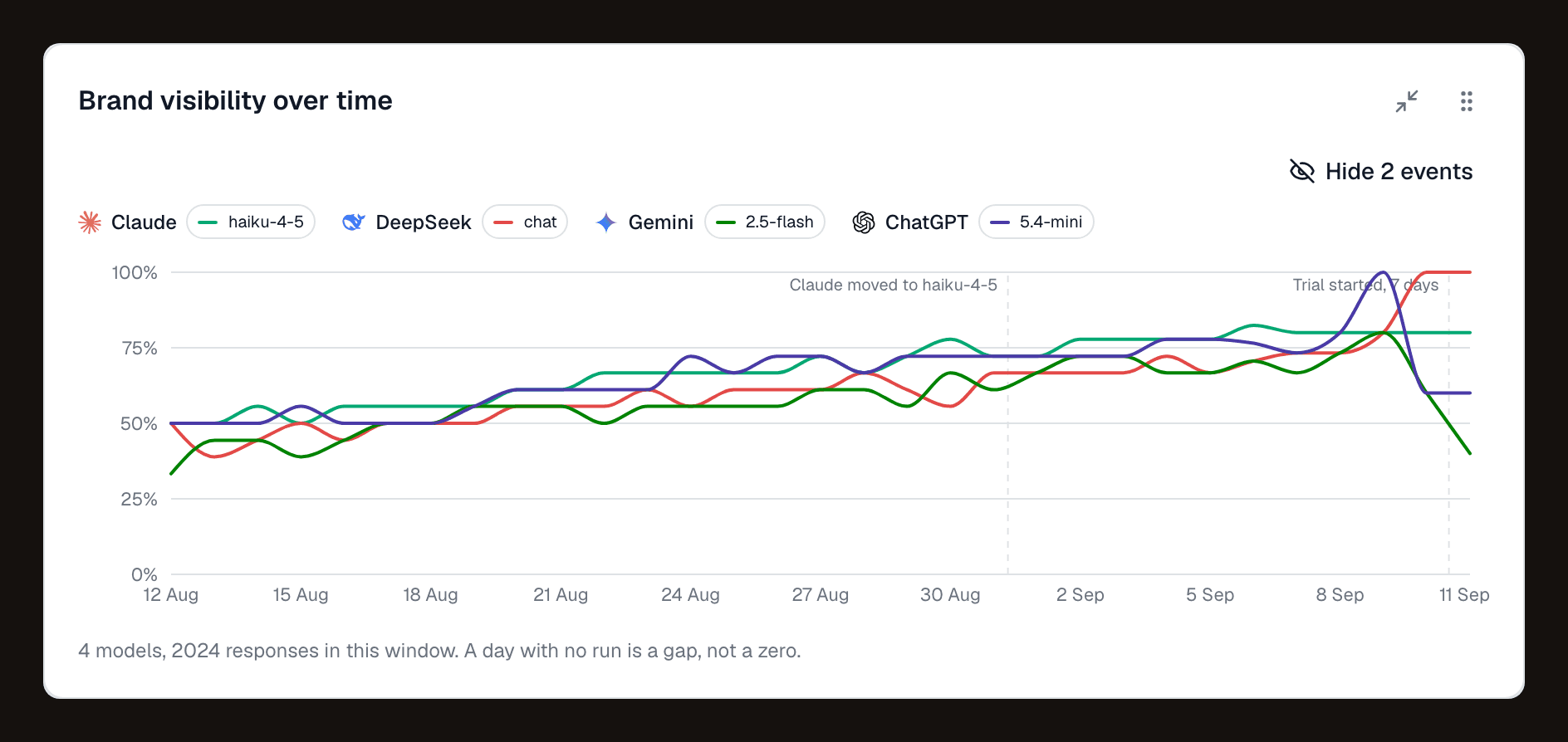
A weekly sweep checks every tracked model for a retirement date. If one is retiring within 30 days, or has already retired, Whaily emails owners and admins and writes a model succession marker on the visibility timeline. So if your score moves the week a model changed underneath you, the chart tells you why before you have to ask.
What you get
Everything you need, in one place.
Provider, family, version, always
Every number in the product carries the exact model as three parts, never a vague label like "ChatGPT" or "Gemini". You can compare this month to last month because you know exactly what answered both times.
Pinned or latest, your choice
Pin a version to hold it steady for a study, or follow latest to always track what your customers are actually reaching. Ledger rows record the exact version regardless of which mode you pick.
Succession emails before a shutdown
A weekly sweep finds models retiring within 30 days or already gone and emails owners and admins, so a version change is never a surprise.
A marker on the timeline, not a guess
When a version changes, Whaily writes a model succession marker on the chart alongside your other timeline annotations, so a score move after the change is explainable at a glance.
We call the APIs, not the chat apps
We measure the model through its provider API, the same version a developer would call. The consumer chat apps add a router, a system prompt, search tools and memory on top, so what a logged-in user sees in the app can differ from the API answer. We say this plainly rather than blur the two.
Google AI Overviews as an opt-in engine
AI Overviews is not called through a model API. It is available as an opt-in engine through a SERP data provider, kept separate from the API-called models in your reporting.
The models your plan reaches, in one place.
Claude, GPT, Gemini, Perplexity and DeepSeek run on every paid plan. Grok is opt-in. Standard models run daily; premium models run three days a week on Starter and Pro, and daily on Enterprise.
Why it matters
Precision on the model is what makes the rest of the data trustworthy.
AI providers move fast. A model family name like "GPT" or "Gemini" can point at several different versions within the same month, each with its own behaviour, and providers regularly retire older versions on their own timeline. If a visibility platform reports at the family level, a real shift in how your brand is discussed and a quiet model swap look identical on the chart. Whaily avoids that by storing the exact model, as provider, family and version, on every single stored answer.
That precision carries through the whole product. Pin a version when you want a stable baseline, for example to compare two campaigns fairly against the same model behaviour. Or follow latest when you want your numbers to reflect what your actual customers are reaching today, since most people talking to an AI assistant are on whatever version the provider currently serves. Either way, the ledger never loses the exact version, so historical answers stay attributable even after your channel setting has moved on.
We also draw an honest line around what we do and do not measure. Calling a model through its provider API gives a clean, comparable signal: the same prompt, the same model version, no router or memory layer changing the answer underneath you. What it is not is a view into the logged-in consumer app, where a system prompt, search tools, chat memory and a routing layer between multiple models can change what a real user sees. We do not measure the ChatGPT web interface, Google AI Mode, Microsoft Copilot or Meta AI. Google AI Overviews is the one exception, available separately as an opt-in engine through a SERP data provider rather than a model call.
A version change, marked where you can see it.
When a tracked model succeeds to a new version, or a provider retires one, the change shows up as an annotation directly on the visibility timeline next to your prompt and competitor changes.
Questions
The short answers.
Which models does Whaily track?+
What is the difference between pinned and latest?+
How do I know if a score change is because a model changed?+
Do you measure the ChatGPT app, Google AI Mode, Copilot or Meta AI?+
What about Google AI Overviews?+
Can I reach Opus on a lower plan?+
Ready to be recommended by AI?
Start free. See your first insights in minutes.